Showing posts with label plants in the dooryard. Show all posts

Friday, March 11, 2011

Goat Willow

[photo taken 3-22-10, the week after we moved in.]

This slender dooryard tree has intrigued us ever since our arrival.
J.M. was able to name the shrubs and plants unfamiliar to us, all but this one.
As it produced these silky grey "kittens" followed by yellow-furred catkins, we have referred to it as the pussy willow tree.
Today the grey pusskins were again in evidence against the blue sky.
On a whim, as I do like to know the proper names for plants, I typed "pussy willow tree" into the google search engine.
J. is quite pleased to learn that he has been calling it by its familiar name.
The proper name is salix caprea or goat willow.
In Europe the plant is known as "sallow."

This is not the common pussywillow which is naturalized at the edges of marsh land or low wet places in New England.  That familiar shrub is salix discolor.
My father knew where the pussywillows grew and brought home the first of them, still in their tight red-brown scaly buds.  Put in a vase without water they stood on the dining room buffet for weeks, until displaced by summer flowers.
Placed in water the grey pussies quickly became catlets shedding their yellow pollen.

[Tree swallow in residence in salix caprea, May 21, 2010.]

Here is our goat willow--probably planted by the late Mrs. Rogers as an ornamental.
I enjoyed the time spent in learning more about this tree and its relatives....more tidbits of information to tumble into the rag-bag mind.


Thursday, December 30, 2010

An Almost Balmy Day

When we woke this morning and opened the curtains we realized there had been rain in the night.
Lingering traces of roadside snow were washed away.
This was the temperature [F.] at about 11 a.m.
J. took the photo as the old thermometer is fastened high on the side wall in the carport.

There was a boisterously playful wind for much of the day.
The bird feeder bounced on its wire hanger.

Much of the remaining seed landed on the ground.
The juncos will enjoy picking it up.

Goldfinches found the mesh cylinder which holds niger seed.
They are beautiful birds, even in their winter olive-drab.

New growth of catnip flourishing at the edge of the wooden barrel planter.
The cats relished some, fresh-picked.

Is it our imagination, or has the lawn greened up from the snow and rain?
There is mildly squelchy mud in places and that earthy scent which I have before associated with early spring in New England.

I don't know the name of this wiry shrub which grows in the corner of the garden fence.
There are abundant crimson berries but the birds seem to take no notice.

It was so pleasant outside that I couldn't settle to inside chores [in spite of 'dust kitties' floating about]
so put on my wellies and tramped along the boundary fence and about the dooryard.
These twisted vines caught my eye. Not sure what they are as the honeysuckle is usually evergreen.  I'll have to remember to look when there are green leaves again.

This may be a dead cedar--there is white cedar scattered through the adjoining woodlot.
I was looking out today for interesting textures and shapes.

Goldenrod seed fluff.

This dooryard maple still has clinging leaves.
Their texture is not crisp, more like a stiffened fabric.

Sun slanting across the yard to the north.

Honeysuckle rampaging over a dormant shrub.

The ground under the magnolia tree is thick with fallen cones.

Pods on the redbud, black shapes against late afternoon sky.

Sunday, April 4, 2010

Photo tour

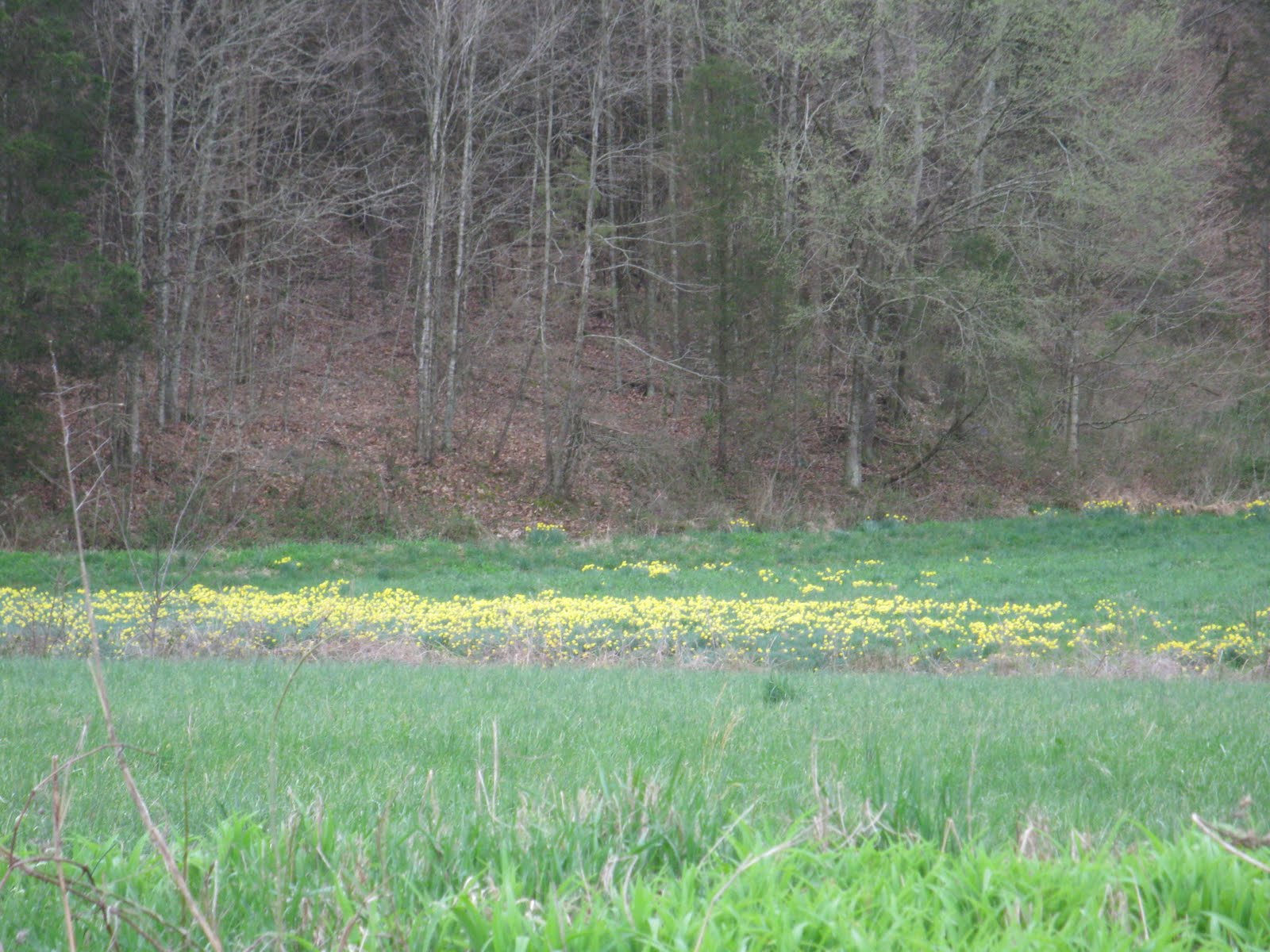
The property just along the road was inherited by a man who merely rents out the land and, according to neighbors, "hasn't been near the place in five years." Cattle are pastured there and often surround the abandoned house. Daffodils grow in the yard and haven't been stomped by the cattle.

This swath of daffodils in a nearby field is typical of their abundance, seemingly growing wild.

Our bedroom is still rather impersonal, the walls wearing the clean white paint applied before we purchased.
We wonder if our huge log-pole pine bedstead will look appropriate in the little cottage.
The cats are not concerned with the lack of embellishments in the room.
We are happy that they have settled in and emerged from under the bed.


J. found a plank in one of the old barns, cut pieces to size and then sliced them  lengthwise to make two bluebird houses.
This one he hung on the north-west side of the house, well away from the old one in the apple tree.


The second of his birdhouses has been placed in the "pussywillow tree" below the east-facing front porch.
We'll be watching to see if any of several hovering bluebird couples are impressed with the new accomodations.

Patches of violets have flowered under the clothesline and in the grass along the side of the house and garage.

The ancient pear tree burst into fragrant bloom today. I found remnants of last autumn's pears in the grass beneath the tree. They were shriveled and leathery, but smelled richly of dried fruit.
I also found a tiny-leaved straggly rosebush beneath the pear tree.
I'm wondering if it is the white flowered "Scotch briar rose" or perhaps a yellow flowered one I recall as "Father Hugo". I need to locate the boxes full of gardening books and refresh my mind.  Surely identification will be easier when the rose blossoms.

I  think that the pear tree may predate the cottage, which was built in 1980. There is a hollow in the trunk at the point where it begins to branch, which suggests that it is an elderly tree. A previous house stood for many years on the farm, which was known as Mosslands, named for the Moss family who have been in the neighborhood since pre Civil War times.


A clump of hollyhock, rather oddly placed at the edge of a small grassy bed which contains iris.

Too fine a day to stuff laundry in the dryer.
Pebbles the Horse is currently pastured just beyond the clothesline, in an electric-fenced area which extends past the back of the garage. She makes note of all our activity in the dooryard and frequently reminds us that she is a poor starving and neglected horse.
When an Amish buggy trundles by on the road, Pebbles flicks her tail, frisks about her pasture and whickers a greeting .


This vine is straggling up a makeshift trellis. In looking at the bits of gone-to-seed blooms from the past year, I'm guessing it could be a clemetis.
I've identified the two dogwoods we were told are planted north of the house.  Other shrubs which are showing new leaves are not familiar from my years of gardening in New England.
I may be consulting gardening books or posting photos with a plea for help in identifying.