Wild turkeys foraging near the boundary fence.

One of the feral cats has become much bolder recently. He had his face in the kibble dish along with our 'barn kittens' the other day when I stepped into the car port. I was able to pet him a bit before he realized he was being touched.
The kittens like to peer in the sliding door--I suspect they enjoy tormenting the pampered insiders.
I heard Mrs. Beasley intoning the feline war chant and discovered that ginger cat inches away outside the glass.
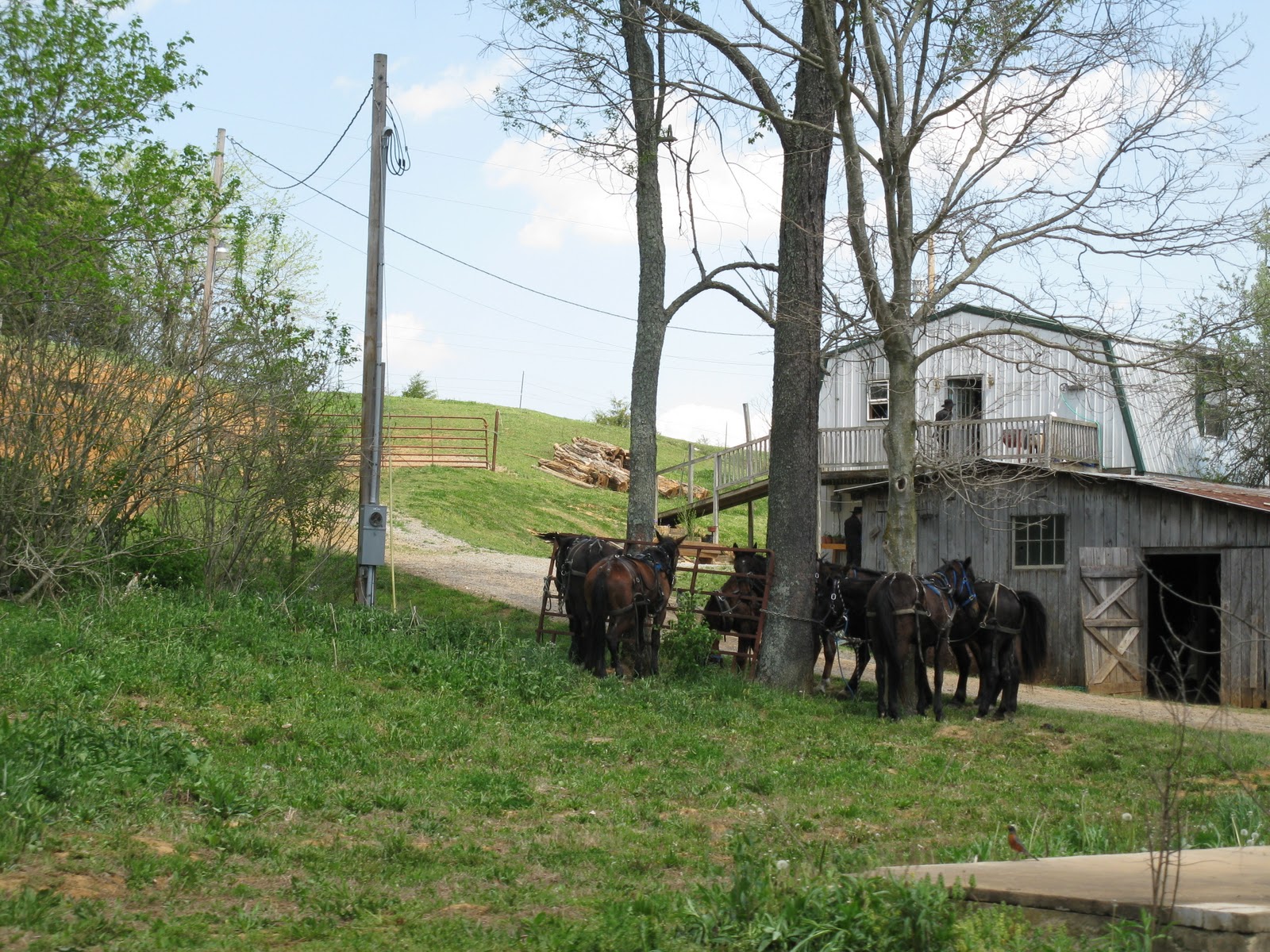
Being fresh out of inspiration for a real story and with the landscape remaining a soggy expanse of neutral shades, I'll try to present a sense of our small rural neighborhood.
I haven't mentioned our "Englisher" neighbors as often as I have written about the Amish of the area.
The contradictions of the Amish lifestyle are interesting, not least for the ways in which we find them inter-acting with other area families.
Kentucky has a number of Amish and Mennonite enclaves scattered around the state. Indiana and Ohio, nearby states, are also know for bustling Amish communities. Pennsylvania is still the place which first comes to mind when we think of settlements of the "Plain People."
A good friend from our church has interacted with the Amish and isn't afraid to ask questions or spark discussions. From listening to him and from reading I gather that the Amish way of life has much to do with honoring tradition. The traditions are supposedly grounded in an interpretation of scripture which suggests that simplicity is a safeguard against many evils. It would seem to be a case of 'salvation by lifestyle.'
The degree of strictness with which certain 'doctrines' are carried out can vary according to interpretation by the ruling 'bishop' of an area, thus when the bishop is replaced, certain practices can be modified.
J. has counted up about a dozen Amish households within less than 10 miles of us. We've been told that a decade ago there were at least twice that number.
These families are far more mobile than I would have guessed.
They move I suppose, for some of the same reasons that the rest of us do: better accomodations, to be near family, better opportunites to support their large families.
Observing them as neighbors, I can admire their commitment to hard work and their sense of tradition.
However, as their communities have become less agrarian, many of them are becoming more in need of 'outside' assistance, even if only transportation to do their shopping and banking at a distance too great to be easily done by horse and buggy. Many of the Amish men of the area pay someone to convey them to and from work at a local furniture factory. The families pay 'drivers' to shuttle the children to the small Amish school.
The Amish believe that an 8th grade education is sufficient for anything that life will demand of them.
Thus a girl of 16 or so, having completed 8 grades of schooling is considered well enough educated to teach younger children.
Most of the families are large. Sitting ahead of us at the Christmas program was a young man, perhaps not more than 30, who has 7 children--the oldest being 7 years of age [yes, there are twins in the family, but there it is!]
Because the Amish ask nothing of the "state" for the most part they have been left alone by state and federal government.
I find much of the Amish logic perplexing. They are not allowed to have telephones installed in their homes [a worldly instrument which would encourage idle gossiping? wasted time?] but they have phones in an outbuilding!
We've found that a number of our neighbors interact with the Amish in the same ways that we do, providing transportation, coming to know one or two families quite well. One lady has an freezer in one of her out-buildings which the Amish across the road use to make ice blocks to keep their own perishables cold.
We've found this area of Kentucky to be a welcoming one. Greetings and small kindnesses are exchanged. Folks are busy, but will stop to chat for a moment in decent weather when we are working outside. The lower reach of J.'s hayfield runs across the road from neighbor D. H.'s home. If D. was home when J. was loading hay, he loped across to swing bales onto the wagon, then with a wave of the hand, returned to his own yard.
Being church goers we've made friends there. We're invited to participate and told "We're glad you're here."
We chose for our retirement years a place where we have no kin, no background, other than the commonality of rural heritage. We feel nothing short of blessed by our reception here.
D.H. talking with us in the dooryard one evening in the summer, while fireflies sparked across the lawn and cicadas chirped overhead, took his leave with the remark, "We knowed from the first that you was going to fit in, be good neighbors."
Welcomes don't get much better than that!