Showing posts with label horses. Show all posts

Sunday, November 14, 2010

The Sound of Hoof-Beats


Each Sunday morning the sound of hoof beats and the creaking of carriage wheels announces the
assembling of our Amish neighbors for their weekly Meeting.
The Amish do not have church buildings, so their gatherings are held in members' homes, turn-about.
Our house sits atop a gentle knoll above the road which roughly follows the winding of a creek.  To the south is a rise, to the north the road weaves along the bottom land for half a mile before climbing again.
The clopping of horses hooves reaches us before we can see the approach of a buggy from either direction.

When we arrived here in late March and for several months after, Pebbles the Horse was highly intrigued with the doings of these Amish equines.  As the weeks have gone by she has become accustomed and mostly acknowledges their passing by with only a toss of the head.
This morning, about 8, I stood by the front window and watched a black buggy go along the road at a smart clip.  By the time I headed up to feed the barn kittens and serve Pebbles her grain, hoof beats were ringing a crisp tatoo in the chilly air. Four buggies broke over the rise and advanced into the hollow, almost "bumper to bumper."
Pebbles snorted and trumpeted.  She tore up and down her pasture, kicked up her heels in a rodeo buck, turned and charged back toward the barn, head tossing, tail raised.  She even flung out a foreleg in a spritely show of enthusiasm.  As the 4th buggy rounded the curve out of sight she slid to a halt and demanded her grain.  Two more buggies passed in quick succession, but with her mouth busily chomping, she gave them only the roll of an eye.
I was again outside when the first buggy passed on its homeward route late in the afternoon.
I fetched my camera and wondered if I could get close enough to the road for a decent photo--without violating the Amish taboo of "graven images."
I headed across the front lawn toward the lower pasture where J. was gathering roots and branches left from his recent land clearing.
To my delight I watched a black buggy pull off the road onto the verge.

It was Joseph and Delilah stopping for a neighborly word on their way home.
Joseph held the reins, Delilah had a firm grip on the youngest Yoder boy whom she was attempting to keep enfolded in a fleecey lap robe.
We exchanged pleasantries and I asked Joseph about the breed of the buggy horses.
He replied that most are Standard Breds or a S/B cross.
"This is our young horse," he explained, "and he is a Standard bred-Percheron cross."
I asked if I might take a photo if I waited until they pulled onto the road and took it in such a way that the occupants of the buggy wouldn't be seen.
{I often suspect that Joseph appears scandalized by me although he is perfectly at ease with J.}
Delilah was nodding in the affirmative and Joe said he thought that would be alright.
At that moment another buggy caught up and wheeled around the Yoder conveyance, much to the dislike of the young horse in the shafts--who made it clear that he wasn't going to be left behind!
I took the above two photos as Joseph pulled back onto the road.
You may recall my mention that the Yoders have five  small children.
All five were in the buggy, the four older children tucked somehow behind the narrow seat which held their parents and baby brother.
J. related that when he approached the buggy a small black shod foot was poking out and that he tweaked it, producing giggles.

Taken in March--a meeting-bound buggy headed north below our house.

On this summer Sunday a horse and buggy heads up the rise.

In April Joseph and Delilah's home was the gathering place for what is called the Easter Meeting--held on a Friday.

The buggy horses tethered behind the row of carriages.
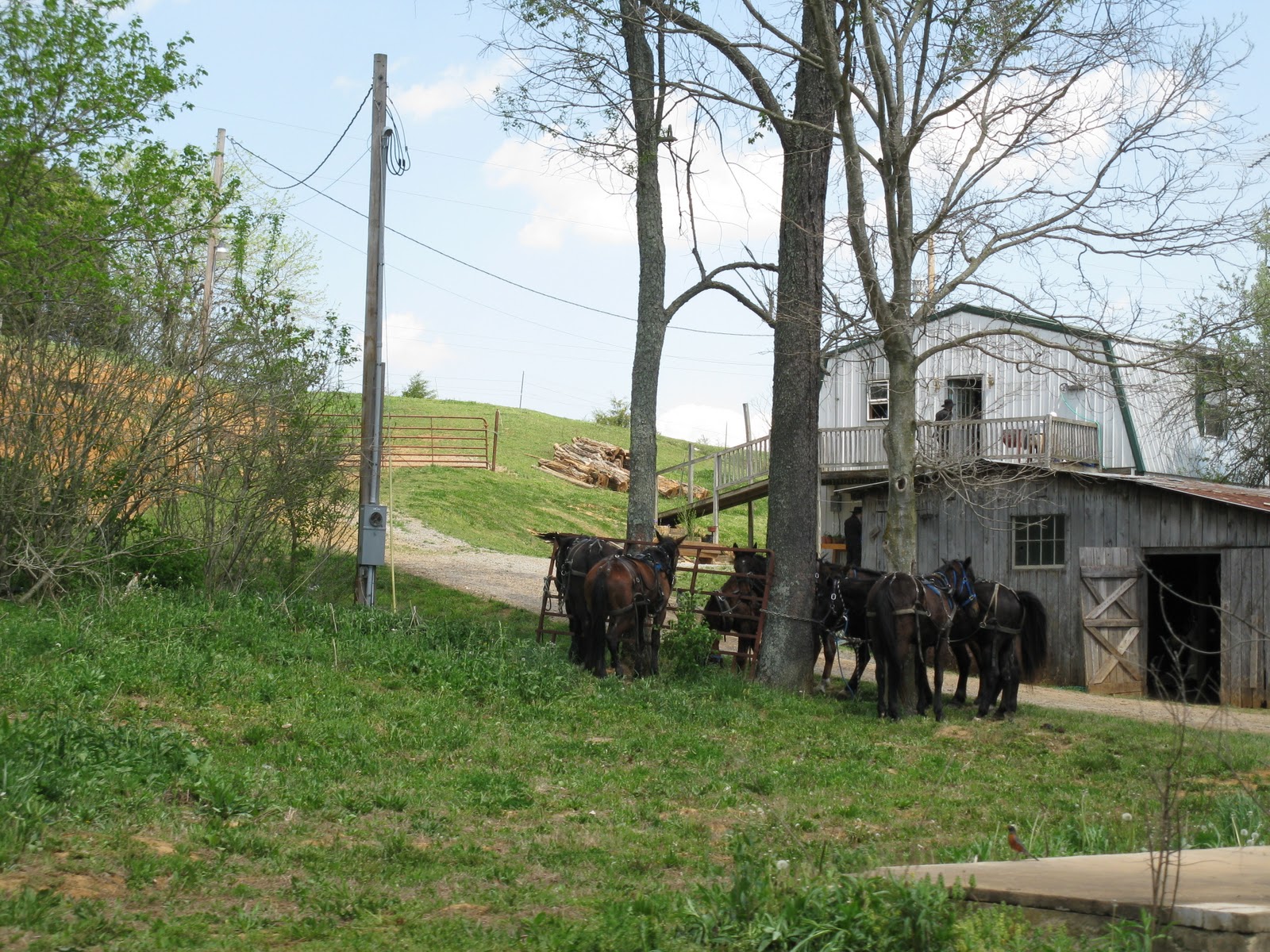
A closer view of the waiting horses.
I took these from the passenger seat of the car.
Much as I would like better photos, I don't want to give offense.
As I became better acquainted with Delilah she assured me that photos of the horses and buggies are fine.
Amish people don't pose for photos--which leaves me wondering about the many postcard images.

You'd think perhaps we would begin to recognize individual horses--if not different buggies.
J. pointed out a "double" buggy headed home this afternoon.
I felt quite superior as I announced, "That's Eli Herchberger's buggy and that's Barney the Horse!"

Like many children growing up in the 1950's I listened to the radio "cowboy" dramas: The Lone Ranger; Gene Autry.  The sound effects of those far-off days were memorable--if hardly authentic. Hoof-beats had a hollow, wooden sound, but somehow the rythem was about right.

Humans can hardly reproduce that sound of a horses' hooves clopping along the road.
Alfred Noyes in his famous poem, The Highwayman, did it well--I can hear the sound in my mind almost better than it can be articulated.

"Tlot tlot, tlot tlot! Had they heard it? The horse-hooves, ringing clear;


                              Tlot tlot, tlot tlot, in the distance! Were they deaf that they did not hear?


                              Down the ribbon of moonlight, over the brow of the hill,


                              The highwayman came riding--"

On Thursday, curled up enduring a head cold, I finished re-reading a favorite book, "O, The Brave Music"
by Dorothy Evelyn Smith.
In that book the narrator hears the sound of approaching horses as
"cupper-lup; cupper-lup; cupper-lup."

I can "hear" them both--perhaps the staccato "tlot-tlot" is the cadence of a trotting horse
and "cupper-lup, cupper-lup" the rocking of a canter---I welcome a definition
from those of you who are better authorities on horse-kind.

 
The former owners of our house placed this weathervane--it seems appropriate for our neighborhood.

Thursday, July 2, 2009

Cooling Shade


By cool Siloam's shady rill
How fair the lily grows!
How sweet the breath, beneath the hill,
Of Sharon's dewy rose!

Lo! such the child whose early feet
The paths of peace have trod,
Whose secret heart, with influence sweet,
Is upward drawn to God.

Reginald Heber, 1812
Our town in Wyoming has an elevation of 5,358 ft (1,633 m), more than a mile high, and as such is considered high desert. Trees do grow along the rivers and irrigation ditches: cottonwoods, Russian Olive, willow. There are no hardwoods. Within the limits of the very small city, trees set out decades ago along streets and in the parks are watered and provide green shade during the short, but usually fiercely hot summer. A few miles out of town, the landscape quickly reverts to the monotony of sagebrush and stubbly, coarse grass. Shade is scarce and the sun beats down on windblown dust.
We live less than two miles from the center of town and thanks to an irrigation ditch which loops and curves through the property we have trees--my husband is fond of stating that they are about the only trees between the city limits and the junction 8 miles away.
Driving into town on a summer's day I pass a horse pasture. For several years I noticed that on hot afternoons the horses would crowd into the lop-sided rectangle of shade thrown by a huge billboard. Early in January we endured a week of unusually high winds--and this is land where the wind blows famously. Limbs and branches crashed down and the tree service people were busy for days to come. We had our own clean up to do--part of a tree down just outside the dining room window, branches all over the driveway. At one point as I stood gazing up into the bare and creaking heights of a cottonwood, my husband suggested wryly, "Do you suppose maybe you should move out from under the trees while you stand and think?"
The metal billboard was also a casualty of the gales and no one has removed the twisted metal poles or the battered sign. Earlier this week I observed that the horses still gather close around the wreckage, still taking the available shelter from the sun in the heat of the day. They were most cordial and obliging when I stopped the truck and climbed out to take their pictures.
Mulling this, I recalled some of the old hymns of the church which mention shade, Bible verses which give thanks for a cooling stream or the blessing of relief from the beating and merciless sun. "Mighty rock in a weary land, cooling shade on the burning sand..."
These were the stories and songs of people whose heritage was desert heat at its worst; the rights to a well were defended in bloody combat; green grass, a clear running brook, a safe pasture with a grove of shade trees became the poetry of thanksgiving.
Eleven years ago I moved to the interior west leaving behind a lifetime of maple shaded dooryards, flowering hedgerows, acres of beech and oak, ash and hickory. I came to live in a place where dried tumbleweed mounded along the roadside fences, where the wind whipped coarse grit against my skin; where trash and dust rolled up the valley each afternoon driven by the relentless winds.
I cherish these willows around the pond, the cottonwoods and the Chinese elm, the Russian olives which straggle along the irrigation ditch. Our horse has shade where she can retreat to swish her tail during the heat of the day.
The Lord is your keeper;The Lord is your shade at your right hand.
Psalm 121:5

Wednesday, June 24, 2009

A Traveling Man


"It was a dark and stormy night...". That classic opening line suits this little tale.
At dusk on Saturday evening, with angry clouds boiling down from the mountains, the wind moaning, my son-in-law phoned from next door. "Look out your front door, there's a sheep wagon headed toward town."
I headed outside with my camera and tried to focus through the swirling grey-green dusk on a slowly moving conveyance which did, indeed, appear to be a horse-drawn sheep wagon. A yellow warning light blinked dully from atop the lurching wagon while a pickup truck with 4 way flashers on alert, crawled behind. We voiced the concern that surely this little entourage must stop soon for the night rather than risk travel in dark and storm.
On Monday when I mentioned this sighting to my friend at work, she told me that the fellow and his horses had set up camp in the parking lot of a discount store on the north edge of town. Curious, I drove there on Tuesday and a bit diffidently approached, camera in hand.
Two men sat on folding chairs in the shade provided by the wagon and an attached trailer. This close I could see that while the wagon had the classic shape of those still used here by sheepherders, it was one of a kind.
"May I take photos of your horses?" I asked. "We watched you passing on the highway below our house when you came into town." The younger man gave gracious permission while the older, a slender gentleman with white hair and beard, watched, eyes bright in his tanned and leathery face.
We had a few moments of pleasant conversation, about places we both have traveled. I inquired if the horses were Belgians and was told that they are Suffolks, "An English draft breed that dates back to the Magna Carta. The animal control people have been here to make sure my horses are not being abused. " A wry smile accompanied this statement, as though it was a situation encountered before. The big horses, hides clean and shining, were tethered to the back of the supply cart, munching their hay. Drums of water stood nearby. No sign of manure, no flies anywhere around them.
I wished the man a safe journey and as I turned to leave, he added, "I don't talk much about myself, but if you'd like to know more, be sure you have a photo of my sign. You can visit the website which a friend has made."
This afternoon as my daughter and I drove home from grocery shopping, we met the traveling man headed out on the next phase of his journey. Having read his story I had hoped he would still be here this evening. I missed the opportunity to offer anything to help him on his chosen way.
If you would like to read more about Lee the horse logger, here is the link to his website.