Showing posts with label family stories. Show all posts

Wednesday, August 3, 2011

Grampa Mac's Posies

I went out this evening into the steamy twilight, the heat of the day drawing round me like an unwelcome shawl. Most of the perennials I have already cut back in these past weeks of temperatures of 90 degrees F.
It has been too dry and even the nightly dew has been sparse.
I was surprised to see that the rose Hawkeye Belle had two partly open blooms--too precious to be left for the Japanese Bettles to destroy in the morning.
I fetched the kitchen scissors and snipped the rosebuds, then strolled along the edges of the recently cut front yard field, trailed by the barn cats.
I thought of the little bouquets which Grampa Mac
so often cut for me.
"Posies," he called them.
The farmhouse dooryard offered the usual flowers of an old New England home.  The never-used front door was faced with a grassy rectangle anchored on one end by a honeysuckle bush and on the other by an apricot tree.  Between these two sentinels lay a spread of lily of the valley which crept out from the honeysuckle to cluster at the base of a red peony. A second peony enjoyed the apricot's lacey shade. 
The center of the garden was defined by a clump of lemon daylilies.  Beyond the lilies a fan of pale iris staked a claim, nearly over taken by a rambling rose with small glossy leaves and clusters of flat pale pink blooms.  It was The Fairy, acquired by Great-Grandmother Eliza who had saved up cereal boxtops and sent them off with the requisite postage.
I can picture the unwrapping of the fragile, bare-root plant when it arrived after days of anticipation.
I doubt that Grandma Eliza set it out.  That task would likely have been done by her husband Eddie or by Grandpa Mac.

Fairy Rose
Image from about-gardens.com
Rounding the corner of the big white house into the north-facing back yard one encountered an old rose--probably one of the Albas--the bush was kept trimmed fairly short and produced fat pale buds which opened to creamy blushing blooms on prickly stems.
It was Grampa Mac's custom to cut a rose or two, using his finely honed Barlow knife.
Holding the roses gently in large work-calloused fingers, he deftly whisked off the thorns against the knife blade. Red or white clover, a stiff stem of bluebells, a frothy spill of Queen Anne's Lace were only steps away at the verge of the gravel road.  A few of these wildlings tucked around the roses and the nosegay was ready to be bound with a stem of timothy.
Often I was present and watched the careful assembly of the small bouquet to be carried home [next door] and tucked into the dainty vase made to resemble a robin perched on a twig.
At other times Grampa Mac walked the few hundred yards between the two houses, following the path that threaded past the big maple and onto the road.
The summer days work of haying, the milking of the cows would be over and he would come to sit for a few moments at our house, perhaps enjoying a slice of cake or a dish of pudding

which Mother had saved for him.
His conversation was easy, almost desultory; weather, the liklihood--or not--of rain before morning, the garden, the anticipation of blackberries ripening in the thickets near the sugar house.
He would call "goodnight" as Mother shooed us to bed [impossibly early!] and trudge back to his own quiet house, there to soak his weary feet for a few moments in a blue enamel basin filled with cool water.
That done, the water was sloshed over the back porch rail onto a volunteer peach tree and the screen door slapped behind as he entered the cool house.
The case clock was carefully wound and straightened on its narrow shelf, a last glance at the pink-streaked western sky, and then the uneven tread of his feet ascending to his small solitary room at the head of the stairs.  To bed, as the last sleepy birdsong of the long day drifted in through the open window.

I snipped my flowers this evening, thinking as I so often do, of my Grampa Mac.
In the years of my growing up next door he spoke so seldom of my grandmother, Helene, dead in her early 40's after several years of failing health.
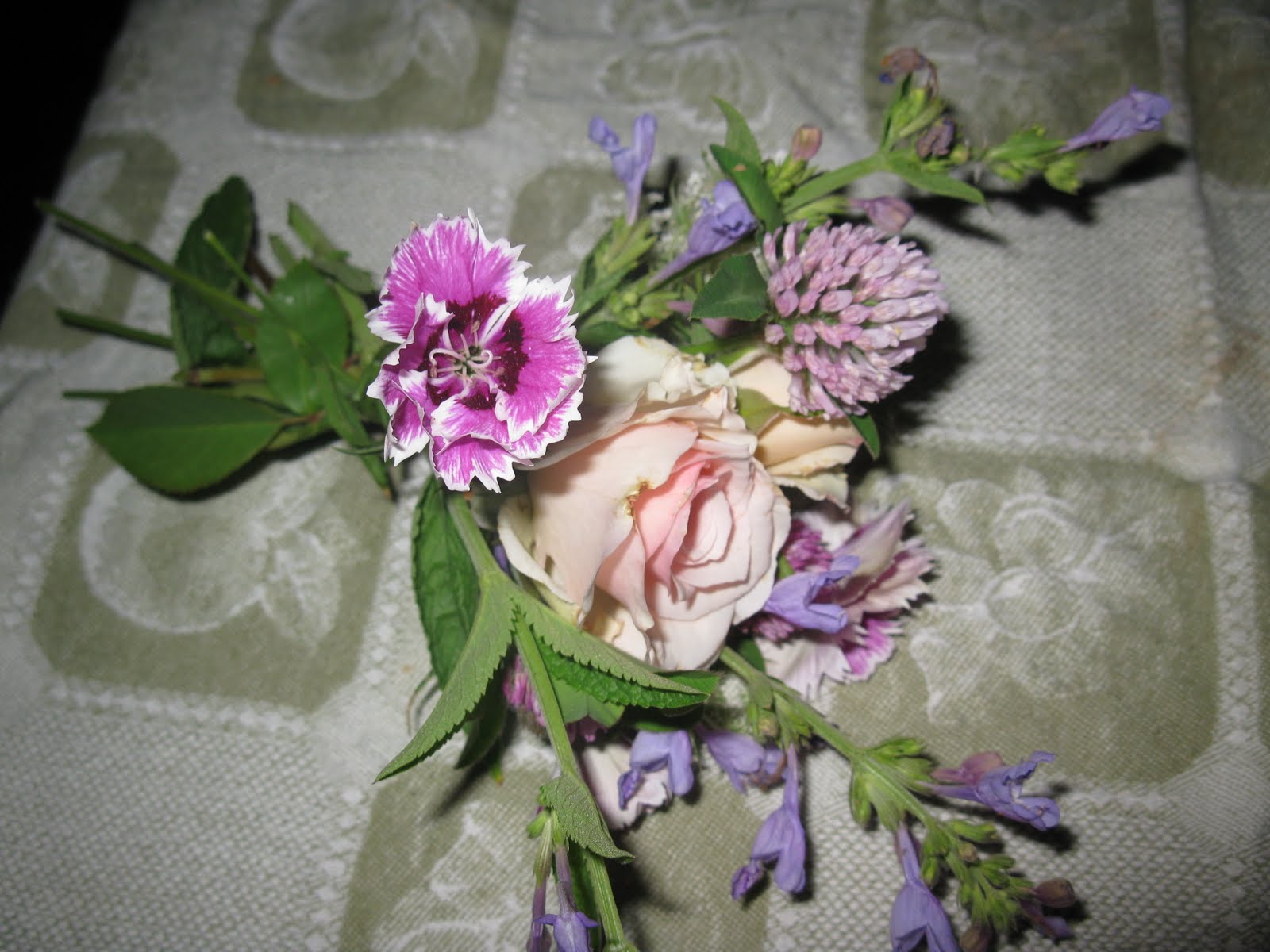
I blunted the thorns on the stems of the roses with a quick clash of the scissors, added red clover, Queen Anne's lace, a few clove pinks and several sprigs of Siberian catmint--to echo the long-ago bluebells of Grampa Mac's posies.
He was a quiet man of steady, hard-working habits, not much for jokes or small talk.
I like to think that during his courting of Helene, he may have washed off the dust and sweat of the hayfield, doned a clean shirt and set about assembling a posy for his love.
The same old fashioned flowers would have flourished in his mother's dooryard--the Adirondack farm tucked against the bulk of Tongue Mountain. 
My imagination pictures him, young, sturdy and handsome, stripping the thorns from a clutch of roses,
adding sweet clover and Queen Anne's Lace, binding the fragrant handful with a long green stem before he places it carefully on the buggy seat, picks up the reins and clucks to his horse.
Going down the dusty mountain road to spend an hour with the slender young woman he loves; a tall woman with hair the color of dark honey, who will play the piano for him as he sits in the parlour with her family. I fancy I see her walk with him down the path , to stand for  precious moments with him in the gloaming, until, ever mindful of the next day's early rising, Mac climbs into the buggy and turns the horse back up the mountain road.  Helene listens until the scrape of the buggy wheels is lost in the twilight. Her long pale skirt brushes the edge of the path as she walks slowly to the house.  She smiles and hums a thread of the melody her fingers  coaxed earlier from the piano. When Mac asks the question she knows is forming in his mind, she will answer him gladly.

Wednesday, July 27, 2011

Cousin Russell and The Spooly Army

 Beulah Lewis, Billy Lewis, Russell Brayton
My Mother smiled whenever she recounted the summer visits to the farm by the New York cousins.
'Aunt Emma' [sister to Mother's grandpa, Eddie Ross] had lived in Albany since her husband's passing in early middle age; 'Cousin Etta' was from Queensbury where she kept house for her husband Albert, her widower son Clifford, and grandson Russell.
There was scant affection between Eddie and his cousin Etta's husband, but that seems not to have troubled the annual pilgrimage of the two women and the little boy from the city heat and noise to the comparative calm of the Vermont farm.
Certainly the three children had a splendid time.
All three were possessed of great imaginations.
Billy was the eldest, born in 1914, Russell in 1918, and Beulah in 1919.
It seems likely that Russell may have been the ringleader in many of the undertakings.
He had a great interest in American Indians and considerable time was spent in creating 'bows' from slender springy limbs and lengths of heavy string.  Arrows were fashioned from carefully sharpened twigs.
The three, armed with these useful weapons, went on the hunt for buffalo [or other hostile Indians] stalking through the cow pasture and ranging along the edge of the woods, never too far from sight of the big white house that sat comfortably shaded by the dooryard maples.
As Mother told me decades later of her cousin's fascination with Indians I made a connection.
My sister and I in childhood, ranging over the farm buildings, had marveled at the drawings of Indians in feathered head dresses which adorned the greyed plaster walls of the 'woodshed chambers.'
"Of course," said Mother when I mentioned them. "Some days it rained, so we played in the hay barn or the woodshed.  Russell drew 'Sitting Bull' and his mighty warriers on the walls."


Beulah and Russell
with walking sticks, ready for adventure

Russell brought with him his 'spooly army' a collection of wooden spools in several sizes.
Large spools which had held coarse 'button and carpet thread' became 'generals.'
The sturdy spools from everyday black or white thread became 'captains', while the smaller spools which had once been wound about with colors for finer sewing became the rank and file soldiers.
In those days when all mothers, aunts and grandmothers sewed, Beulah also had her assortment of spools.
A cloudy morning might find the opposing armies lined up on the linoleum of the sitting room floor or arrayed on the dining table's slick oilcloth while Russell outlined grandiose battle plans.

The climax of at least one summer visit was the Circus Day Performance held in the haybarn with its doors rolled wide. While startled barn swallows wheeled overhead in the loft, kitchen chairs were lined up for the audience. The two grandmothers and Aunt Emma were summoned and settled to watch and applaud as the three young performers stood on their heads, flailed through almost perfect cartwheels, teetered along a plank set up on two sawhorses to serve as a 'high wire.'
The dog Shep was put through his repetoire of tricks--'roll over'--'shake hands' ---'play dead.'
'Tiger cubs' [the skittish barn kittens] were admired.
The crowning moment was when the long horizontal shutter of the bull pen was briefly lowered on its hinges and the astonished bull gaped through the confining bars, a tuffet of good clover hay dangling from his jaws.
The hatch to the bull's pen was swung into place and the wooden fasteners swiveled to hold it shut.
The circus was over and the triumphant troupers, each lugging a kitchen chair, processed to the back yard for lemonade and cookies.

Aunt Emma Ross Russell [left]
Cousin Elviretta Ross Brayton [possibly]
Mother reported that while Aunt Emma and Cousin Etta appreciated the clean airy farmhouse, the shade of the maples and the afternoons sewing in the cool parlor, they were apt to occasionally wrinkle their city noses at the barnyard odors--an affectation which caused Eddie to grin and refer to them as 'high and mighty.'
After a few weeks of bucolic vacationing on the farm, Eddie cheerfully took them across on the Fort Ticonderoga ferry and into Hague where his younger half-sister, Edna, kept a guest house.  There the ladies, with Russell in tow, could recuperate in genteel leisure before the waning days of August called them home.


Russell Brayton's high school graduation portrait.

Beulah Eliza Lewis,
yearbook photo

"Russell Brayton
grown up"
The last photo of Cousin Russell is labeled in my mother's handwriting.
There he stands, in his young man's glory of white flannels and dark blazer
in the driveway of the farm where he had played with Beulah and Billy during childhood summers.
[In the right background is the haybarn where the circus was conducted.]
I can't guess as to the occasion.  The maple tree is in leaf and the various barn doors are open suggesting summer or early autumn.
Russell Brayton enlisted 2 July, 1942 and records indicate he was married and employed as a salesman at that time.
My mother was married in August, 1941.
Mother gave me the family photos and enlarged upon the memories of the cousins and their visits in
2000 when I had become serious about family research.
She wondered "whatever became of Russell"--an indication that they lost track of each other as adults.
I learned from a noted Queensbury, NY historian, John Austin, that Russell Brayton had died in 1988.
This news seemed to astonish my mother.  For her, Russell was ever the cousin of long ago summers with his
passion for Indian lore and his spooly army.


Thursday, January 27, 2011

The Flu Epidemic of 1918

View from a vantage point above Rte 30 looking north west across the Green Mountains
toward the Adirondacks of New York state.
photo by C. deLancey

Autumn came to the Green Mountains of Vermont in 1918 as it had always come; war, worry, heartbreak, rationing, are no deterrent to the cycle of seasons.
In September the swamp maples along the stretch of Rte 30 running from Whiting to Middlebury  flamed into banners of orange and scarlet.  As the month wore on the rock maples, the beech, ash and oak made brave patches of brilliant color on Vermont hillsides, while the slopes of the Adirondacks towering above Lake Champlain on the "New York side" flaunted fall foliage among the ranks of hemlock and pine.

Middlebury is the shire town of Addison County, a bustling place of businesses, the courthouse, banks, and home of the illustrious Middlebury College.
Perhaps in that autumn of 1918 fewer footsteps rang through the "hallowed halls of ivy" for even the sons of the wealthy were required to register for the draft.
On the streets, in offices, in the gatherings of women, and in the quiet of family homes after supper the talk would have been of the war:  of sons, sweethearts, young husbands lost; of fear and of hope.


web photo view of the older part of Middlebury College as it appears from Rte 30
at the south end of town.

By the first week of October Addison County gardens may have felt the nip of frost. The warm golden afternoons offered time to dig  potatoes, load Hubbard squash into a wheelbarrow; time to carefully cull the last of the ripening tomatoes to line the windowsills of the back kitchen in the large white clap-boarded farmhouse standing across from the college campus.

Gilbert and Elizabeth Desjadon shared the back part of the Chapman's comfortable two-family house courtesy of their sons, Napoleon and Arthur, who were employed by Thaddeus Chapman, a retired merchant with a well-kept farm on the edge of town.
Napoleon had registered for the draft in June, 1917 and was now in France, leaving Ada, his wife of six years, in his parents' household. Napoleon and Ada had no children.
Napoleon's younger brother Arthur with his wife Mary and two sons, ages 2 and 5, were also part of the multi-generational family group.
Arthur filled out his draft registration card in June, 1917,
giving his employment as farm laborer for
T.M. Chapman.
Rounding out the household was Gilbert and Elizabeth's youngest child, Curtis John, age 20.
Curtis, unmarried, was Baggage Master for the Middlebury Depot of the Rutland Railroad.

There was nothing about this early October day to hint at what lay ahead for the Desjadon family.
Their anxious thoughts often turned to Napoleon in the trenches of France, but likely only his wife Ada would have written to him.
Gilbert and Elizabeth born in Quebec, Canada, were French speakers, possibly barely literate even in that language of their childhood. Surely their offspring had some schooling and were bi-lingual, but Napoleon's signature on his draft card appears stiff and clumsy--not that of a young man accustomed to much writing.

As the afternoon sun slanted golden through the yellow-leaved elms and crimson maples lining the streets of Middlebury, perhaps Gilbert, age 72, gave Arthur a hand with the farm chores, brought in wood for the kitchen stove or puttered at tidying up the garden.
In the house Ada and Mary were busy preparing supper. Elizabeth  may have rocked small Walter or 
pared apples for a cobbler.
The meal would be ready when Curtis arrived home from the station.

Curtis's greeting when he entered the kitchen from the back door was hoarse-voiced. Still wearing his jacket he pulled a chair to the side of the stove and huddled, shivering visibly. In anwer to his mother's anxious queries he croaked that he had felt ill since lunchtime, his throat sore and his head aching.  Quite unaccountably he had suffered a nosebleed. 
He wanted no supper, just a hot drink, but was sure that a night's sleep would see him able to work in the morning.
Family lore doesn't give the details.  At what point did the family realize that they were not contending with a heavy cold or with some form of grippe?  When was a doctor called?
I imagine the women of the family struggling to launder soiled bedding, tending the sick round the clock, offering tea or morsels of food.
It is said that Mrs. Chapman came from next door to help with the nursing.
It is not clear how many members of the combined households fell ill.
Curtis John Desjadon died on October 3, 1918, age 20 years, 5 months, 21 days.
His death certificate gives cause of death as broncho-pneumonia with influenza as contributing disease.
Curtis had registered for the draft less than 3 weeks earlier. 
 On October 9, 1918, Arthur Desjadon died, age 29 years, 3 months, 10 days.
His death certificate bears the same information for "cause of death."
The next day, October 10, 1918, Napoleon's wife, Ada, succumbed to the same illness.
Ada was 30 years, 2 months, 7 days of age.
All three death certificates were made out and signed by the same doctor, P. L. Dorey.
Peter L. Dorey was an osteopathic physician, Vermont born, of Canadian parentage.  It is likely he was bi-lingual and able to converse comfortably with his patients who had little English.

Many questions will never be answered. 
Were Ada's family called to her bedside?  They lived a few miles away in Cornwall.
Where were the little boys, Arthur and Walter during the time of their father's fatal illness?
Did their mother, Mary also have influenza and recover, or was she spared?
[Mary was an orphan who had been raised by Arthur's older sister and brother-in-law.]
It seems certain that at some point the house was placed under quarantine.
My late Aunt Helen, my father's older sister, believed that her grandfather Gilbert had the flu but recovered.

One cannot help but wonder how funerals were managed in a time of such widespread crisis. I have read that as the flu epidemic raged, public gatherings of all kinds were curtailed or prohibited.
Theaters were closed, meetings cancelled, even church services were sketchy.
Funerals may have been limited to the members of an immediate household.

 In Orwell, less than 15 miles from Middlebury, my father Larry was a month short of his 2nd birthday when his mother's brothers and sister-in-law were taken ill. My grandparents' last child, Elizabeth, was less than 3 months old.  Would my grandparents, even in a time of family extremity and grief have taken the risk of visiting the stricken household in Middlebury?
All of Gilbert and Elizabeth's surviving children, all with spouses and young ones of their own, lived in Addison County within a few miles of Middlebury.
I have no information on which of them, if any, may have become ill, but all lived for many years after the epidemic.
As for Napoleon Desjadon, he was not given word of his wife's death nor that of his two brothers until he disembarked from a troop ship some time after the Armistice in November, 1918.

One other death in the family of Gilbert and Elizabeth could have been attributed to the effects of influenza.
Their youngest daughter Helena [Lena] Desjadon Cameron, also a resident of Middlebury, had been pregnant with her third child prior to her death on January 10, 1919.
Her death certificate gives cause of death as pelvic peritonitis with contributing illness
"bronchitis followed by spontaneous abortion."
Lena was 24 years, 6 months and 20 days of age.
Helena's death certificate was signed by Stanton S. Eddy,
not Dr. Dorey who had attended the other flu victims.


The 1920 census for Middlebury, Vermont lists the depleted family of Gilbert and Elizabeth Desjadon
 still residing in part of the T.M. Chapman house.
Their son Napoleon, age 31, widower, is listed in the Chapman household.
With Gilbert, 74, and Elizabeth, 68, are their grandsons, Arthur J. age 7 and Walter J. age 4 1/2. Their mother, Mary, age 29, widow, is with them.
Also listed with Gilbert and Elizabeth is son-in-law Gilbert R. Cameron, age 31, widower, and Elizabeth M. Cameron, age 5, the daughter of Helena and Gilbert Cameron.
The census form on which this family was listed was enumerated on the 14th and 15th of January, 1920.
My great grandfather, Gilbert Desjadon, died on May 25, 1920.
His death certificate is signed by P.L. Dorey, the osteopathic physician who attended the deaths of Curtis, Arthur and Ada.
The cause of Gilbert's death was bronchial pneumonia with an underlying factor of arterio sclerosis.
Great grandmother Elizabeth died August 5, 1929 in Shoreham, Vermont where many of the family, including her oldest son resided.
Cause of death; myocarditis, chronic nephritis.

I found the following in a web article attributed to Scott Wheeler, although the same paragraphs appear in several seemingly unsourced presentations.
"The flu epidemic swept into Vermont with a vengence during the waning days of September."
From a source 1918, pandemicflu.gov/vt:
The largest outbreaks of flu occured at Middlebury, ST, Johnsbury, ST. Albans, Montpelier, Barre, Randolph, Northfield.
"During the final week of September there were over 6,000 cases in the state. The disease probably peaked in Vermont during the week of October 12 [1918]. Inflluenza remained prevalent throughout the state during the winter and spring of 1919.
The Public Health Service did not require states to report influenza before September 27 [1918.]
Vermont first reported the presence of influenza on October 19, but the disease was undoubtedly present in the state much earlier."
The official death toll attributed to the flu epidemic in Vermont is given as 1772.  It is certain that this does not represent the full count.
A survey taken in 1919 indicated that 440 children had lost both parents as a result of the epidemic.

 My father, Larry, holding portraits of his grandparents,
Gilbert and Elizabeth [LaValley] Desjadon.
Cropped from a photo by cousin Pat McG. taken at a family reunion in 1998.

I missed the family gathering organzied in Shoreham, Vermont by Pat Cameron McGrath and the chance to meet Cousin Pat in person, having moved to Wyoming from Vermont in the spring of 1998.
Pat and I have since connected via e-mail and I am indebted to her for her generous sharing of family information.
Over the years of my interest in family research I was not successful in prising much information from my father.
Whether he was not interested in his family history or simply hadn't paid much attention is questionable.
He stated that as a boy he was bored when "the old people" gathered on Sundays and "spoke French."
Living now many miles from Vermont I think of the hundreds, possibly thousands of times that I rode into Middlebury and unwittingly passed the house where such family tragedy took place.
Vermont has recently made photostats of vital statistic certificates available online to those who have a paid Ancestry.com subscription.
Records from the early 1900's to the present are fairly complete and have helped to piece together the details of my father's large extended family.

Tuesday, December 14, 2010

A Mouse in the Mincemeat

The smell struck Mac as soon as he stepped into the woodshed.  Pushing the outside door shut, he stood in the dark space sniffing.  Wood, of course, chunks of maple, beech, oak, curing in neat ranks along the  walls.  Drifts of the familiar farm smells: the horse barn, the tang of wood smoke, cold winter air and, very faintly, the suggestion of the privy attached to the far end of the shed.
He clumped up the shallow steps to the kitchen door and stood inhaling the scent of something cooking--he recognized apples, spices, something heavy and sweet and rich.
Mac lifted the latch and stepped inside.  The lamps had not been lit and he could see the glow of flames dancing beneath the lids of the black cookstove. The last light of a short winter afternoon pooled on the scrubbed pine table, melted away into shadows at the edges of the room.
"For pity sakes, Mac, close the door!  You're letting heat out into the shed!"
Mother turned from the stove, a large wooden spoon poised above a heavy cast-iron kettle.
Mac hastily latched the door and moved to his Mother's side.
"What are you making?" he asked.
Mother, carefully maneuvering the black kettle to the end of the stove-top, gave a small sigh of accomplishment before she replied, "Mincemeat. For Christmas pies. Andrew, light the lamp and Julia, fetch a sauce dish and three spoons."
While the younger children hopped to do their mother's bidding, Mac eased off his heavy overshoes and mittens, spread his chilled hands above the warmth of the stove.
He watched while Mother spooned a generous dollop of the mincemeat into the dish that Julia held.
"Let it cool a minute or you'll burn your tongues," she warned. "Then you each have a taste."
The children blew on their laden spoons, savoured the unfamiliar melding of flavors: the richness of beef roasted and ground fine; the tartness of apples; the deep sweetness of brown sugar, plump raisins, and the subtle mysteries of cinnamon and allspice.
"When will you make the pies?" inquired Mac.
"A day or two before Christmas," replied Mother. "When the mincemeat cools I'll pack it in covered pans and you can put it on the high shelf in the shed where it will stay cold til then."

Later that evening the mincemeat was spooned into two large enameled baking pans, pressed down and smoothed with the wooden spoon.  Mother wrapped the pans in several layers of cheesecloth and stood gazing with satisfaction at the result of her hours of chopping, stirring and tasting.
Andrew held the lamp while Mac carefully lifted the pans to the clean wooden shelf just beyond the kitchen door in the cold shed.
Waking in the grey-white gloom of a snowy December morning, Mac thought he could still decipher the scent of cinnamon, as though the essence of meat and fruit and spices had trailed up the stairwell and now hung in the unheated bedroom he shared with Andrew.
Rubbing sleep from his eyes he calculated that there were about 10 days before Mother would be making the Christmas pies.
Mac's chores before and after school took him through the woodshed, in and out the kitchen door many times a day.  Sometimes he glanced up at the shelf where reposed the pans of mincemeat and remembered how good it tasted. He fancied that even in the frigid air of the shed he could smell its rich aroma overlaying the pervasive aura of snow, woodsmoke and faint farmyard odors.
On the second day, depositing an armful of split dry maple in the kitchen woodbox, he found himself surprisingly alone in the big warm room.
With no premeditation, he removed a teaspoon from the flared glass vase which sat in the middle of the table and slipped it into his pocket.
In the shed he reached down a pan of mincemeat, tweaked aside a corner of the cheesecloth wrapping and goudged out a spoonful of the spicey treat, tucked in the covering and replaced the pan on the wide wooden shelf.
Each day thereafter he permitted himself a spoonful from one pan or the other, never thinking beyond the enjoyment of this stolen tidbit.

There came the Saturday morning two days before Christmas when Mother rose from the breakfast table with rather more than her usual purposeful bustle.
Julia was sent to bring all the pie pans from the pantry cupboard. Andrew made sure the woodbox was filled to the brim and Mac was directed to fetch the pans of mincemeat from their chilly isolation in the shed.

When Mac re-entered the kitchen, the pans balanced one atop the other, Mother had assembled her pastry board, the rolling pin, the canister of flour.
With no particular misgivings Mac watched as she pulled aside the cheesecloth that swathed the pans.
There was silence, then Mother spoke with a gasp of astonishment.

"Mercy sakes!  Something has been into my mincemeat!"
Mac stood rooted to the floor.  He was near enough to the table to see, in broad daylight, exactly what Mother was viewing.  He was surprised to note that he must have eaten more of the mincemeat than he thought.  All along the sides of the pans were uneven nibbles where the mincemeat had been scooped away.

Mother snatched up one of the pans, carried it to the window and turned it this way and that, peering anxiously at the contents in the stronger light.
Returning to the table she smacked the pan down and stood glaring at it, her cheeks pink and her blue eyes sparking.
"I do belive there has been a mouse in the mincemeat!" She held up one of the lengths of cheesecloth, shook it suspiciously.  She picked up her wooden spoon and prodded cautiously along the edge of one pan.
"I don't see mouse droppings and the cheesecloth hasn't been nibbled, but what else could it be?"
She stood, lips in a firm line, thinking, then let her breath out in an irritated huff.

"What a waste," she fumed. " I'll have to scrape out the mincemeat along the edges of the pans and throw it out.  I can't risk mouse dirt in my pies!"
Glaring, she reached for the big spoon again, clattered about in the pans on the table.

Although he hadn't moved from his stance beside the table, Mac's mind had been racing. 
He recalled the day early in October when the pedlar had made his last round of the mountain hamlet before winter, rumbling into the yard with his horse drawn cart.  He saw again the care with which Mother had counted out silver and copper coins from the small blue crock that held her egg and butter money.
The pedlar had handed over the bright tins of spices which had been tucked away in the big cupboard--"for Christmas baking", Mother had said with satisfaction.

Mac remembered the more recent trip to the company store that served the workers at the graphite mine.  He had driven the team, hitched them and waited with Mother while flour and brown sugar and the precious and pricey raisins had been scooped into paper sacks and weighed.
The clerk had entered the amounts in his account book, to be deducted from the wages Father would be paid as one of the mine foreman.
Waste: of hard-earned money, of special ingredients, waste of the hours which had gone into chopping, stirring and tasting.

Mac found his voice at last and spoke with urgency.
"Ma!" He took a stride closer to the table. "Ma, don't throw out the mincemeat!
There haven't been any mice in it!"
Mother, standing with the big spoon ready to dip into the pan, suddenly fixed Mac with a speculative gaze.
"You sound very sure about the mice.  Just how do you know?"
"Because," said Mac in a rush, "It's me that's been eating the mincemeat.  A little bit every day."
He felt his ears going warm as Mother continued to focus her attention on him, but he didn't drop his eyes.
"I guess I didn't want to wait until Christmas to taste the mincemeat again."
"Well!" said Mother, and the word was a small explosion in the quiet kitchen.
Julia and Andrew stood behind her, watching this unforeseen drama unfold.
The kitchen was momentarily so still that the soft crackle of the fire in the wood range seemed loud.
Mother moved with sudden swiftness and the wooden spoon slapped across Mac's knuckles.
"Really, Mac," said Mother crossly, "What a greedy thing to do!"
"Yes, " said Mac, and he rubbed his smarting hand against his jacket.  "Its awfully good mincemeat...and I ...err...I didn't think I'd gotten into it all that much."
Mother sniffed, rattled her pans, moved the pastry board into place.
"I'm glad you fessed up in the nick of time, " she conceded. "If something had to get into my mincemeat, I'd rather it was you than a mouse." 
The tension of the last few moments was over. The kitchen again was a warm and homely room.
Mother gave her apron strings a twitch and began scooping flour into the big green bowl.
"Put some wood in the stove, Mac. If we're going to have pies for Christmas, we'd better commence."

This is one of my Grampa Mac's stories of growing up in the little mining community of Graphite in up-state New York.
From all accounts my great-grandmother was not a lady to antagonize.


Thursday, November 4, 2010

The Prank

Stephen Joseph Desjadon
1872-1935
photo from a collage of family portraits
Pat Cameron McGrath

The week of spring vacation from school was nearing its end.  The April weather had been nearly as warm as May with a shower or two that hastened the greening of tender new grass.
Larry and Lizzie hurried each morning to finish their chores, Lizzie helping Mother to make beds and shake out rugs, while Larry raked up winter debris in the yard and trundled it off in the wheelbarrow to the spot at the edge of the pasture where Father planned to have a bonfire.
Their tasks finished they were free to play outside until dinnertime.
Larry and Lizzie were slender and wiry, quick and agile, the two youngest children of the family.
They played hopscotch and took turns in the rope swing.  They tore about the yard being cowboys and Indians and Pony Express riders. Their energy and imaginations were unfailing.

Every day they were joined at some point by Junior B. who trudged down the road from his home half a mile away at the edge of the little town.
Junior was only 8, while Lizzie was 9 and Larry 11.
Still, Junior was far bigger than Lizzie and even out-weighed Larry.
Junior was a solemn, sturdy boy, slow-moving, the only off-spring of parents who had waited long for a child.

As Larry crouched beneath a maple tree, pretending to stir a campfire on the western prairies, Lizzie popped from behind the lilac bush with a shriek--an Indian on the warpath.  She and Larry whooped as she chased him around the yard.  They spotted Junior, puffing up the driveway and skidded to a halt.
"We'll have to play something else now," said Lizzie.  "Junior gets too far behind and fusses when we're on the warpath."
The three children played nicely for awhile.  Larry and Lizzie let Junior be the conductor when they pretended to be the train that chugged into the small branch-line depot up the road.
They played a game of tag, letting Junior catch them a time or two, but then he tripped on his shoelace and sank to the grass in a whimpering heap.
Lizzie tied his shoe and sensibly suggested that he blow his nose and quit crying as he didn't appear to be hurt.
She rolled her eyes at Larry over Junior's head.
"I don't want to run anymore," stated Junior, "I'm tired."
Larry pondered, frowning.  Entertaining Junior had gotten wearisome.
"We'll be mighty hunters," he announced. "Hunters don't have to run, they go quietly through the forest to sneak up on their prey."
Warming to the idea he directed, "Lizzie, you hunt the territory below the garden fence. I'll scout around the barnyard.  Junior, you can circle the haystakes."
Lizzie skipped toward the garden; Junior lumbered to his feet, cheeks still pink with running and with smeared tears.
As Junior turned toward the haystacks at the edge of the barnyard fence, Larry, a spirit of mischief rampant, called after him, "Junior, look out for bears.  My brother heard a strange noise behind the haystacks the other evening.  It might have been a bear."  And fair warning given, he trotted toward the barns.
Junior's plump chin wobbled, he twisted his fists in his overall pockets.
"I'm afraid of bears!"  Junior's voice was a tremulous wail. "Bears eat people!
I don't want to play with you anymore.  I'm going home and tell my mother you scared me!"
Lizzie halted and called after him, "Junior!  There aren't any bears.  Larry's just teasing."
But Junior was on the road home, his short legs pumping, his words jerked out in panting gasps,
"I'm going home....I"m going to tell."
Lizzie shrugged, "Well," she said, "That's enough of Junior for one day. I'm going in and help Mother get lunch on. She promised I could ring the dinner bell."
Larry scuffed up the path, kicking gravel. 
"He'll be back after lunch, he predicted gloomily. "You know how Junior is."
Lizzie disappeared through the shed and into the kitchen ell.
Larry leaned against the end wall of the shed, soaking up sun and thinking.
A wooden ladder was propped there where one of his older brothers had left it, and Larry climbed up a few rungs holding on with both hands and leaning backwards to look up at the sky.
A few more rungs and he was at the edge of the low roof.  Above him the chimney loomed, seldom used unless Father or one of the older boys built a fire in the pot-bellied stove in the shed.
Suddenly a plan blossomed in Larry's mind.
He hopped down the ladder, darted into the shed and came out with Mother's mop pail swinging from his hand.  He sauntered to the pump at the end of the yard, filled the pail and tucked it away behind the ladder just as the dinner bell clanged.  He imagined Lizzie standing on a chair, tugging at the rope pull which threaded  through the shed roof to dangle just inside the door.  He thought of telling Lizzie his plan, then decided, better not.
After lunch Father gathered the older boys to mend fence before turning the cows into the lower pasture.  Mother had sewing to finish and Lizzie loved to sit with her, handing her pins, lulled by the sound of the treadle rocking to and fro and the machine's whirring as Mother stitched.
Larry dawdled in the shed until Father and the boys were safely out of sight, then he carefully climbed the ladder to the low shed roof, his bucket of water balanced before him.
Junior would be back shortly, he knew from experience, and he intended giving that boy something to cry about.
Larry inched across the roof slates with his pail of water, positioned it carefully in front of the chimney and crouched behind the tower of bricks, just out of sight.
He had been there only moments when he heard footsteps crunching on the path below.
This was going to be even better than he planned.
Arm muscles tense with balancing the bucket, he waited until the footfalls were close, then gave the bucket a mighty shove.
There was a satisfying clatter, a splash and a startled gasp from below.
Expecting a high-pitched wail from Junior, Larry crawled around the chimney to hear a familiar voice exclaim,
"Ce qui se passe?"
"Oh, NO," thought Larry. "It's FATHER."
[Father and Mother had grown up in French-speaking families, but with their children in school had made the transition to English in the home, except when older family members were visiting, or--in moments of stress.]
Larry pulled himself upright, clinging to the chimney and peered down.
Father stood on the path below, water streaming from his cap and dripping from the ends of his moustache.
"What is going on?" he repeated, in English.  "Larry. Descendre! Come__down__now!"
Larry slid across the roof, scrambled down the ladder and made his way around the end of the shed.
Father had flung his sodden cap on the ground and was mopping his face and neck with his handkerchief.  He looked rather stern.
"Larry, what is this, eh?" Father pointed at the bucket which had rolled to the side of the path.
"Oh," said Larry unhappily. "Errr. Ummm. Father."
He drew himself up and squared his shoulders.  Father was not a tall man and Larry could look him in the eye--almost.
"I thought that you were Junior," began Larry. "I wouldn't have dumped the water on you, Father."
Father picked up his cap, wrung water from it, waited.
Words suddenly burst from Larry.  "It's Junior," he said crossly.  "He's been here every day, morning and afternoon.  He says he wants to play with Lizzie and me, but then he whines, he falls over his own feet and then he bawls. He wants us to play baby games and then he fusses and goes home mad no matter what."
He paused a moment to gather his thoughts and a word he had heard came to mind.
"Father, Junior is so....so gullable!  I told him to look out for bears behind the haystack and he believed me.  He went home blatting.  I just thought when he came back I'd give him something to fuss about!"
Father sighed. "I see," he said.  "Mrs B. waited a long time for her little boy and I think maybe she would like him to stay a baby for a while longer."
Larry waited, wishing he had simply called his dog and taken a long walk after lunch.
Father ran his hand through his damp hair.
"Maybe it is good that I am wet and Junior is not here," he said finally.
"If you had caught Junior with your trick, he would go home wet, maybe with a bump on his head from the bucket.  He would cry.  Maybe Mrs. B. would visit your Mother and say what a mean boy we have.
Maybe it is better that I came back for my good hammer  and now I am wet."
He gripped Larry's shoulder rather hard.
"There are a lot of people in this world who will make you mad because they are slow or they are foolish.
You can't throw buckets of cold water on all of them!"
Father let go of Larry's arm.
"I will go in the house for a dry shirt and cap.  You will find my hammer and another one for yourself, eh?  If you are too big for little boy  games with Junior, I will keep you busy the rest of the week and Lizzie can help Mother. I think Junior needs to help his father or play somewhere else for a few days."
Larry nodded, bent to pick up the empty bucket.
He felt rather odd; working with Father until school started again next week was no real punishment.  He and Lizzie could still play their games after supper.  He was glad they wouldn't have to humor Junior for a few days, but he felt a bit deflated. He thought about the possibility of Mrs B. visiting Mother to defend her unhappy little  boy and was glad that wasn't going to happen.  He tried to imagine growing up with no brothers or sisters and gave up.
Father reappeared, settling a clean cap on his head.
"Father," said Larry, "I'm sorry I got you wet."
Father merely nodded.  "Come along then, you can learn to fix fences!"

My father, Larry, was 90 years old when he told this story.  It was the afternoon of my Mother's memorial service and we had reached that point in the reception lunch  when it was mostly family and close friends who were lingering.  Aunt Lizzie had stayed close to Larry, giving him the comfort of her affection. As they talked and nudged each others' memories I learned snippets of their childhood which had never before been shared.
I have taken narrative license in writing  this tale, for Larry couldn't recall just what episode had caused him to plan the water deluge to send Junior home for the day.  His remembered exasperation at having to play with Junior was plain and it was he who used the term "gullable" to describe Junior's personality as a child.
Like my parents, Junior [never known by his given name] married and lived out his life in the same small Vermont village.  He predeceased my father by 7 years.
I have shared this story in memory of Larry who was born on this date, 4 November, 1916.
My grandfather Stephen died in 1935, age 63, when Larry was in his late teens.
Larry's story of the misplaced soaking ended without a description of disciplinary measures.  He related ruefully that "father was not very pleased with me."   It is said of grandfather Stephen that he never raised his voice to his wife or children, so I have chosen to finish the tale with a rather mild "punishment."


Wednesday, August 4, 2010

Town Meeting Day [circa 1897]


Photo from our family collection.
Thought to be a portrait of g-grandfather William Lewis, circa 1911.

Town Meeting Day

When the morning sun broke free of the over-hanging mountains on that early March day in 1897, the breakfast time smoke from neighborhood chimneys had already spiraled into the cold, crisp air.

Cows had been tended and foaming pails of milk put through the separators; sleepy chickens had been prodded from their nests, eggs gathered and cracked corn flung onto the hard-packed ground of the hen yards.
Horses were hastily curried and led out from the stables, their snorting breath feathering into thin grey plumes, while their big hooves cracked the skim of ice that had formed overnight on dooryard puddles, as they were guided between the shafts of the family buggy or hitched to the tongue of a high-seated wagon.

Doors slammed, children milled about, the sound of metal wheels grated on the winding gravel roads, as the families of the small Adirondack hamlet prepared to gather for Town Meeting.

Every year since there had been organized towns in New England and upstate New York, the first Tuesday of March had been designated as the time when the men of the towns would gather to elect officials to serve for the coming year. Selectmen were needed to run the business of the town, a brave Constable to intervene in any cases of trouble or wrong-doing, a Road Commissioner to see that the narrow roads were plowed after heavy snowfalls, to level out the frost heaves and potholes of springtime.

The town needed a Dog-Catcher, an Overseer of the Poor, a Fence Viewer; a Pound-Keeper to round-up and care for any stray cows and horses until their owners could be located and charged with keeping their animals at home.

Weeks ago, posters announcing the time and place of the meeting and the business to be settled had been tacked on the wall at the general store, nailed to the door of the blacksmith shop. Notices were put in the paper.

Town Meeting day was important and every man who wanted a say in how the town would be run, was heading for the schoolhouse at the crossroads where the gathering would be held.

The women weren’t allowed to vote [although many of them had expressed their opinions to their spouses] and those who had babies or toddlers would not have taken them out in the chilly air. A few of them did quickly tidy their kitchens, ready to go along and help set out a cold lunch at noon.

For older school children, this was a grand holiday. Since the schoolhouse was needed to hold the meeting, classes were suspended for the day. Boys of ten or twelve years hurried to help their fathers “hitch-up” and then got under foot as clean horse blankets and baskets of sandwiches were handed up to be stowed under buggy seats.

At the Lewis farm, tucked at the foot of looming Tongue Mountain, young Mac and his brother Andrew helped their father with the barn chores, just as they did every morning.

They stowed away a hearty breakfast of sourdough pancakes, maple syrup, oatmeal porridge, home-cured ham and fresh eggs. While Mother and little sister Julia quickly washed the dishes and tucked the last items in the lunch basket, Mac stood outside at the horses heads, stroking their soft noses and brushing their winter-roughened manes, for Mac dearly loved horses and already “had a way” with them.

Vote or no, Mac’s mother was not one of the women who would stay meekly at home today minding the house! Bonnet firmly anchored, skirts held above the mud, she shooed her family in front of her, settled herself on the front seat of the buggy and nodded to father that they were ready to leave.

Father Bill Lewis was a quiet man, with a bushy grey beard and mild blue eyes that viewed life calmly and keenly through his wire-rimmed spectacles. He had gone west while still in his teens, one of thousands of men to work on the construction of the Union-Pacific Railroad that spanned the Great Plains. Mac loved to hear father tell of those days when the famous Buffalo Bill Cody had ridden into the railroad camps with his train of men and wagons, supplying buffalo meat which the camp cooks prepared for hungry workers. Bill Lewis had been among the crowds that thronged Promontory, Utah on the 10th of May, 1869, when the “golden spike” was driven to celebrate the joining by rail of east and west.

Young Mac had spent all of his 12 years in the shadow of Tongue Mountain on the hill farm first owned by his grandfather and great grandfather.

He was familiar with winding dirt roads and small steep pastures bounded by grey stone walls. He knew the over-grown paths that twisted through the hardwood slopes to Weed Pond and North Pond. He was learning where the blueberries grew and where in August to fill a lard bucket with fat blackberries in the dark and secret thickets of the woods.

Mac listened in wonder when Bill Lewis could be coaxed into a story-telling mood. Father described the plains of Nebraska where the wind blew every day, summer and winter, rippling through the short bleached grass, whipping across a landscape where no trees grew except the sprawling cottonwoods along the river banks.

Bill recalled the high desert of Wyoming, endless miles of sagebrush inhabited by jack rabbits and antelope, where summer heat shimmered and rocky bluffs loomed across countless acres of gritty sand. He spoke of the fierce cold of western winters when work crews spent as much time huddled around the fires in their tent cities as they did struggling to move the railroad tracks forward mile by agonizing mile.

Mac listened and pondered but could not picture these places that were only names on a schoolroom map. The shores of Lake George, the sprawling buildings of the nearby graphite mines where Bill worked now as a mine foreman, the old farms tucked into the steep hillsides—these were part of the familiar world where Mac lived.

Bill told his family of the Indians who sometimes attacked the railroad camps. It didn’t happen often, but the Indians were not happy about the invasion of the railroads into their hunting territory, and rifles for defense in case of a raid were brought along each day by the railroad crews as well as picks and shovels.

Mac had no concept of Indians as enemies. The only Indian in Graphite was a middle-aged man they called “The Old Indian”, a silent, dark-skinned person who wore a red-checked flannel shirt in all but the hottest weather and tucked his grey-streaked black hair beneath a shapeless felt hat.

Mac’s daydreams fell away as the horses trotted smartly into the schoolyard. He vaulted from the buggy, caught his little sister as she tumbled, laughing, into his up-raised arms, a warm bundle of woolen coat and bunchy calico skirts. Mother handed down the lunch basket, Andrew hopped over the wheel, and Mac walked along-side as father maneuvered for a place at the hitching rail.
Other wagons and buggies turned in, men called greetings, women smiled and beckoned to neighbors whom they hadn’t visited during the long cold days of winter.
Boys, freed from the tedium of arithmetic and reading, sauntered grandly toward the swings or found a dry spot in the thawing yard where they could shoot marbles.

By 10 o’clock the last stragglers had gathered and packed into the schoolroom. Town Meeting for the year 1897 had begun.
The morning went well. It was no surprise that the usual moderator was called to preside over the meeting, a respected old land owner known for his honest dealings.
The selectmen were reinstated, the town treasurer made his report and it was agreed that funds were available to repair the school woodshed.
Lunch time was announced and with only a few more articles of business to be considered, the men of the town were well pleased with themselves.

The boys came in, red-cheeked from playing in the wind, the women unwrapped sandwiches and opened jars of pickles, carved squares of gingerbread and applesauce cake. Talk was cheerful and neighborly. As the meal was finished someone glancing out the window remarked that the weather was changing. Clouds had rolled up from the lake, the wind had picked up, there could be rain or snow come evening.

Perhaps it was the uneasy change in the weather; maybe lunch hadn’t set well on certain stomachs. The cold wind soon drove the boys back inside to take up places near their respective fathers. The few women put away leftovers and retired to the back of the room taking sleepy youngsters onto their laps.

The fence viewer droned on about the need for certain farmers to better contain their cattle, then the final article came up for discussion.

The January thaw had resulted in a damaged wooden bridge on one of the more remote roads. The bridge needed to be repaired and a new culvert put in place. Who should be hired to do the work?

A name was put forth: “I move we hire John B., “ said a sandy-haired man.

“Well! What a poor idea that would be!” exclaimed another man, not waiting to be acknowledged by the moderator. “Everyone knows he’s so lazy he can’t get his own work done. How could he build a bridge before another winter?”

A mutter rumbled about the room. A voice, raised a bit louder than necessary, stated, “Now Joe, it couldn’t be you’d like to see your brother-in-law get that bridge job so he could supply the planks from his own sawmill and charge the town more than they’re worth?”

Another man, red-bearded and red in the face, shouted, “The road work always goes to the men on that side of town. There’s some of us up on the hill who wouldn’t mind a job if there’s money floating around!”

He was challenged by a large bald-headed gentleman who trumpeted, “The work goes to them on our side of town because there ain’t no one in your parts who could figure out how to lay a bridge that would hold up a horse and wagon!”

The rumbling voices broke into shouts. One bellowing farmer, his face nearly purple, waved his fists as he offered his opinions.
The moderator pounded on the desk with his gavel, demanding, “Order! Meeting will come to order! Only one man speaks at a time!”

Dozing children woke to whimper and cry. Women shushed them and glared in the direction of the men. The loud voices continued, roughly over-riding each other, as insults were traded. The moderator banged the desk again and again, shouting into the fracus, “Order! I say, ORDER!”

Mac stood wide-eyed at his father’s elbow. Bill Lewis sighed, but didn’t try to make his thoughts heard in the uproar. Mac let his eyes rove over the room. Several of the boys stood cowering by their fathers. One lad, whose father had just been called lazy, was staring miserably at his muddy shoes. Across the room another boy hunched his jacket up around his ears. It was his dad who had shouted the insult. Tom was his best playground pal, but would he want to be friends tomorrow? As the harsh voices jarred through the too-warm room, the boys fidgeted. Playground squabbles were frequent, but quickly forgiven. Grown-ups calling names and upsetting a meeting was a new and frightening experience.

From the corner of his eye, Mac caught a slight movement. He realized that Old Indian had been leaning against the wall just beyond father. Old Indian had taken no part in the meeting, had eaten his lunch with only a polite nod to the women, had given brief answers to the few men who greeted him. Now, as Mac watched, Old Indian began to slip carefully through the throng of jostling men a few unhurried steps at a time, calling no attention to himself. Bit by bit he made his way to the big chunk stove in the far corner of the room, looked cautiously around, then put his shoulder against the elbow of the stovepipe and nudged.

“What on earth is he up to?” thought Mac, but he made no move. Another shove of the big Indian’s shoulder and the stovepipe came apart. Un-noticed in the hubbub, Old Indian left the schoolhouse, shutting the door soundlessly behind him.

One by one, those men nearest the stove began to cough. Coughing spread, but no one seemed to notice that smoke was puffing gently but steadily from the open stove pipe. It filled the room, making eyes water and noses drip. Finally someone shouted, “Fire! The schoolhouse is on fire!”

There was a sudden moment of horrified silence as men turned to look.

Bill Lewis looked where Mac was pointing. Bill was calm and accustomed to handling men. Pushing toward the woodstove he called out, “There’s no fire, the stove pipe has come apart. Patsy, give me a hand here, someone open the windows!”

Everyone got out of the big Irishman’s way as Patsy strode to help Bill with the stovepipe. Men who had been shouting moments before ran to help neighbors who were pushing at the large windows which hadn’t been opened all winter.

One quick-witted young man wrenched wide the door and pushed it vigorously back and forth on its hinges. Other men flapped their caps at the smoke and said things like “Phew!” and, “What happened to that stovepipe?”

The freezing March wind whooshed through the room, clearing the smoke and chilling hot tempers.

Several of those who been loud and insultingly rude suddenly decided that perhaps they should start for their side of the mountain before it grew colder or sleet should fall. They gathered their families and scuttled sheepishly out. Others stayed, but looked uneasily about, for there was still the matter of the roadwork to be settled.
The moderator blew his nose, cleared his throat with a hawking sound and said firmly, “The meeting will come to order!”

Bill Lewis raised his hand. His quiet voice was clearly heard. “I make the motion that we turn the matter of the bridge and the new culvert over to the selectmen. Let them set a budget and decide who can best do the work.”

Another hand went up and another voice spoke, “I second that.” The motion was passed and the meeting was quickly adjourned. Town Meeting in Graphite, NY was over for another year.

No one lingered long in hitching up and hastening families into the buggies and wagons. The wind was cold and carried the tang of sleet. Men wheeled their horses, nodded stiffly to neighbors as they whipped out of the trodden, muddy yard. A few boys risked a tentative wave of the hand as they passed a wagon where a friend sat painfully straight beside his father.

Later, as they rubbed down the horses, milked the cows and settled the barn for the night, Mac thought about what he had witnessed that day.
He thought he understood in part why some of the men had been rude, accused their neighbors. There were always those who worked hard, took good care of what they had; others would be shiftless no matter what. And those who had less usually resented the families who had been here longer, had more say in how things went.
He thought that Old Indian had been clever to do something that had distracted the arguing men, but one thing puzzeled him. “Father, he said, “Why did Old Indian slip out the door and disappear? When the smoke cleared, he was gone.”

Bill Lewis turned the wooden peg which held the barn door in place, leaned against it and rubbed the ache from his shoulders.

“Mac, he said, “Old Indian don’t like to be noticed. He don’t quite fit in here and he hasn’t any folks of his own here-abouts. He minds his business and he expects people to let him be.”

He straightened and looked across the yard at the light wet snow swirling in the dusk; sugar-snow, heralding thawing days and crisp nights here in the mountains. The smell of the barn, of the horses and cows hung close and familiar on the damp cold air. In the house the yellow glow of a kerosene lamp blossomed and grew in the kitchen window.

Bill put a hand on the boy’s shoulder, noticing how Mac had grown in the past year. He would make a sturdy man soon and Bill hoped, a wise one.

Giving the boy a little push up the path he said, “Old Indian likes quiet. He could see that things were out of hand and there would be a fight. ‘Blessed are the peace-makers.’ Old Indian saved the peace today, but he didn’t want to be noticed or thanked. So, he just went on home.”

Mac couldn’t see his father’s face, but he knew there was a smile in his voice as he added, “Come along. Its supper time and if we’re late your mother won’t be peaceable!”

The bones of this story were told to me many years ago by my Grampa Mac. He referred to the man who dislodged the stovepipe and saved the meeting simply as "The Old Indian."  My search through the relevant census listings hasn't turned up a possible name. I have taken obvious liberties in creating dialogue, but have tried to make the details authentic to the times.
 The Graphite mines were closed for good in 1921 and many of the buildings were dismantled with the lumber sold as salvage.  The hamlet of Graphite disappeared, as did many of the old farms.  J. and I went exploring there in the early 70's with my cousin Will's father as guide. He drove us over a rutted woodland track and stopped where  tumbled foundations of fieldstone outlined the site of the Davis/Lewis farmstead. I could only imagine the house, the barn, the dooryard where my Grampa Mac grew to adulthood.
This is the area where generations of my mother's family settled in the late 1700's. My interest in the history of the towns and the people is on-going.
I am indebted to a privately published book, The History of Graphite which my g-uncle Wilford [Cousin Will's grandfather] compiled and wrote in his 80's.
Public Domain photo
Cousin Bruce DeLarm is a skilled researcher and historian who maintains  a multi-paged website full of information on the families of Graphite and Hague, NY.  His brother has a collection of postcards from the early 1900's which depict these towns.  If you would like to know what the countryside was like a hundred years ago, some of these photos are posted here.
http://freepages.genealogy.rootsweb.ancestry.com/~hagueny/hague_roads_and_other_sights.htm#Graphite_Road_traveling_West_from_the_Village_of_Hague  


Friday, September 11, 2009

Chelsea, Vermont

Blackberries
Meadowbrook School, Chelsea, Vermont


Old country store, Chelsea


The hardware store


August 29, Saturday, was cold and rainy, a day with no hint of summer lingering in the grey sky and chilly air. Our motor home was parked in my sister's yard which is a large space encircled with trees, saplings and underbrush. We crawled from under our blankets, fed Raisin the cat and trudged through wet grass to the house lured by the thought of hot coffee.

The arrangements for our Dad's memorial service had been made for the following day, we had gathered in groups to sort, pack, discard, clean at his house. We had thought this would be a good time to drive to southern Vermont and visit with J.'s aunt and his cousins. This plan bogged down when the cousins didn't answer phones and no reunion could be arranged.

J. sat staring glumly over his coffee mug, the rain dripped down, sister's dog and cat came in wet-footed from a brief and dutiful foray into the yard. I offered suggestions which were met with monosyllabic grunts.

Suddenly J. stirred from his gloomy reverie and stated, "We can drive to Chelsea." I wasn't immediately enthused. Chelsea, Vermont is the place that in his rather nomadic childhood J. considered "home." Our last visit there was undertaken about six or seven years ago. We had flown to Vermont, rented a car, and J. decided that an expedition should be launched with the idea of showing our daughter and her children the family home site. It was one of those occasions which joined the collection of "typical Whitehurst journeys"--memorable in retrospect for ridiculous things rather than for hallowed trysts. Daughter and grand daughter took turns whining that they were "going to puke", turning various unsavory shades of green with car sickness. Grandson bounced on the back seat announcing that he was hungry, interspersed with "when are we going to get there?" When we did arrive after swooping up and down dirt roads J found that the old logging road, scene of his adventures with his twin brother was overgrown with brambles and sumac. After an hour of plunging through the woods, disgruntled tribe in tow, he gave up on the family history lesson. The fresh air had restored daughter and grand daughter, everyone confessed to feeling starved. Driving from one hamlet to another in search of a meal, we discovered that it must be "off season" as every cafe and eatery had closed for the afternoon. Finally, after an hour or so of drifting we happened on an old brick building which offered an assortment of country store items and a soup and salad bar. Daughter made a beeline to lift the lid of the soup caldron from which issued a savory smell. Clanging the lid back in place, gasping with horrified laughter, she announced in a stage whisper that there was a FLY floating in the soup! I seem to recall that we had fresh sandwiches made and sat there eating them, meeting each others eyes and bursting into barely smothered snorts.

It was only J. and I making the trip on this rainy Saturday. We were both tired and said little as we drove over Brandon Gap. Wind whipped the roadside trees and green leaves lay plastered on the pavement. We passed through familiar villages where stately old houses clustered around the common. In dooryards, stands of golden glow, phlox and rudbeckia bowed nearly horizontal, colorful heads dragging on wet grass. Dahlias held proud blooms of dark red and purple above the sodden wreckage of lesser flowers. We noted how side-hill pastures were empty of milk cows, goldenrod and juniper and steeple bush taking over what had been grazing land a decade or two ago. Noble barns with upper bays for hay storage, lower stables for cattle stood empty, red paint peeling. Small graveyards encircled with spikey metal fences loomed in the dankness of mid day, white marble headstones black streaked with lichen.

J. drove on determinedly, turning onto the dirt road that would take us past the old home place. Running water had cut out the sides of the narrow track overhung with dripping trees.

"Do you want to stop and take a picture?" I asked. He slowed near the neat cottage which had replaced the small cobbled-together dwelling of a half century ago. Slowed and then drove on to the nearby school house. I asked why this particular place was special among the many places the family had stayed. "I suppose," he replied, "because this was the first place that my parents had owned and I was the right age to enjoy it."

When we stopped at the old brick store in town where J. took photos and bought wintergreen patties of a bilious pink, the store keeper told him that there had been so much summer rain that the rivers and brooks had overflowed their banks.

We drove slowly back, stopped for a late lunch at a restaurant we used to know. While we ate, an elderly man came in carrying black berries in a plastic cool whip container. He asked the young waitress if the manager would buy the berries for making pies. The girl explained that all the pies were made from canned prepared fillings. On impulse I pulled a 5 dollar bill from my wallet, having overheard the price the man was asking for his berries. They weren't the biggest berries I've seen or picked myself, but I thought of his labor, clamboring through wet underbrush, brambles clinging to his clothes. I looked at his knarled hands. He saw me eyeing a large bandaid on his wrist. "I got snagged picking the berries and it bled forever," he explained.

I paid for the berries. Blackberries, he told me earnestly, had more nutritional value than strawberries--"the darker the berries, the more goodness."

We watched him go out to his old van, a tall lean figure, only slightly stooped, eyes a far-seeing gentle blue under his shabby cap. That evening at my sister's house, we ate the blackberries with a splash of cream.