Wednesday, May 14, 2025

School Days; Part Two

Blogger displays the newest post on top, so if you've not read Part One of this saga, here is the link.

School Days, Part One 

Photo from family collection, early 1920's.
'Billy' with schoolmate Rita Fortier

'Billy' and his younger sister, my mother, both attended Young School.

Looking Back; School Days
Part Two
Recess and Recreation

School opened at 8 A.M. with a break after about two hours for morning recess. Unless the weather was truly horrid this was the time to rush outdoors, shout, gallop about, take turns on the swing set; if we needed a drink of water or to visit the privy, this was the opportunity After 15 or so minutes teacher came out to the front steps and rang a hand bell to summon us inside. The hour and a half before noon was devoted to arithmetic classes. The upper grade students worked problems at the blackboard, there was written work to be completed and passed in. For the primary children there was learning to recognize numbers and eventually to learn simple addition and subtraction sometimes with visual aides to demonstrate the process.

There was a sense of relief when the hands of the big wall clock moved to 12 noon, books could be put away and lunch boxes brought out.

Lunches prepared early in the morning, held in a metal lunch box [or a lard pail or paper bag] were rather spartan. A sandwich curling in a wrapping of waxed paper, an apple or banana, a cookie. Milk, even with chocolate syrup added, tasted 'off' after several hours in a small thermos. I picked at my lunch not realizing there were children in the room whose lunches were so meager they would have enjoyed what I rejected.

With lunch over we had nearly 45 minutes left to be outdoors. The boys usually threw or kicked a ball. The older girls were good at organizing games for the younger children, London Bridge, jump rope, hop scotch. The whole school played Red Light, Green Light. In winter we tramped out a messy circle in the snow for Fox and Geese, or slid and slogged about, falling, wallowing in wet snow until we were red-cheeked and cold. Winter boots of the day were clumsy things pulled on over shoes; snow pants made of wool were thickly bulky and once saturated with melting snow took many hours to dry. Mittens became caked with snow, the fingers within chilled.

When the weather was too cold or wild to be outside we learned to square dance. The school owned a set of the Durlacher records ['Honah your Pahtnah'] desks were pushed back and we happily stomped our way through 'alle-mand right and left' and 'do-si-do.'

Afternoon classes began with a quiet time. With everyone back in their seats the teacher read a chapter from a storybook chosen to have appeal for both the older and younger children. Some put their heads down for a quick nap. [Heads on desks could also be commanded if the school room had gotten noisy or children weren't settling well.]

During the last 15 minutes of the school day the classroom was tidied. Books and papers were put away, chairs straightened. Children took turns to erase and wipe the chalkboards, the felt erasers were taken outside and 'clapped' to rid them of the day's accumulation of chalk dust. Two of the older boys had the privilege of bringing in and carefully folding the flag. The floor was swept, windows closed and fastened; in winter the coal fire was banked with a last hod of coal.

Hot Lunch Program

I was in 3rd or 4th grade when a free hot lunch program was provided for Young School. I expect this was at least partially government funded on a state or local level, though I recall a card party held in the cafeteria of the Village School as an effort to raise funds. The meals were prepared and brought in by a woman in the neighborhood whose pay for doing so was likely a mere stipend. Some of the food items were 'commodities,' other components would have required a trip to the nearest large grocery store. The meals were carb and calorie laden, hearty, plain and delicious, similar to what many of us would have been served at home. For the big families with meager means the hot lunch probably provided the best meal some children had for the day.

Laura O'Brian served as the first cook; in the following years Grace Christian took over the role of lunch lady. Laura worked a late shift at the local plywood veneer factory, had her own car. Grace's husband, Lambert, assisted her with packing in kettles and covered pans. Did he wait outside in the car or drive back the scant two miles to their home and then return?

While auburn-haired Laura was quietly efficient in serving food, Grace, a lanky, plain woman, had a loud and cheerful voice. The content of the lunches didn't vary greatly, but the savory smell of hot food being set out on the table at the front of the room made concentration difficult for the last few minutes of arithmetic class

There was a tray of sandwiches, peanut butter and jelly on white store bread; usually a large towel-shrouded kettle of mashed potato; thick gravy made from canned beef or pork [the commodities!] canned veg—corn, peas, green beans with an occasional substitution of canned applesauce. Dessert might be a square of frosted yellow or chocolate 'sheet cake.' Fridays were meatless—both cooks and many of the children were Catholics—with mac and cheese a standard offering. There must have been a few menu variations I don't remember—surely baked beans might have figured in a New England community, perhaps a pan of apple crisp made from the abundant local apples. Milk was served in half pint cartons to wash all this down.

I think we were required to bring at least our own silverware, possibly also an unbreakable plate for each person. There was never any question of each child paying for their lunch.

There was no running water at the school; I hope we lined up before lunch to whisk our grubby paws through a basin of cold water and dry off with a brown paper towel.

Programs and Parties

A Christmas program and Memorial Day 'exercises' were held each year. Both were anticipated events to which parents and neighbors were invited.

Preparation for the Christmas program began as soon as classes resumed after the four day Thanksgiving recess. Cut-outs of black Pilgrim hats and hectically crayoned turkeys came down from the bulletin board to be replaced through December with Santas, stars, Christmas trees and bells cut from red or green construction paper. The off-cuts of construction paper were sliced into ½ inch strips to be looped and pasted [that delicious paste!] into festive paper chains.

Teachers of the day subscribed to a magazine, 'The Grade Teacher,' and from their hoarded copies came the poems, skits and acrostics to be laboriously committed to memory. Rehearsals went on for days with children nearly frantic with anticipation during the last week before 'the program.' Someone's father would bring in a small hemlock or pine cut from a back pasture and an after lunch session was dedicated to trimming the tree with our construction paper chains, wobbly stars and a string or two of Christmas lights supplied by teacher.

One memorable year there was to be a skit in which the younger children were meant to be pajama clad [these to be pulled on over clothing] a sort of waiting for Santa presentation. One grubby little girl from the poorest family innocently confessed that she had no pajamas or nightgown as she went to bed in her slip. On the day before the program there was the quiet presentation of a new flannel nightgown for Patricia; on the night itself most of us turned out in suspiciously new and nappy flannels.

On the evening of the Christmas program parents, grandparents, younger siblings and neighbors crowded the over-heated schoolroom; those grownups who could fit appropriated our desks as seating, a few chairs were put into use, many of the dads leaned against the back wall. We sang our songs, popped out from behind the improvised bedsheet stage curtain to speak our pieces, teacher always just out of sight to prompt anyone suffering stage fright.

I was usually taught a vocal solo meant as a surprise for my mother. Since I could never keep a song to myself and would unwittingly sing it at home Mother had to feign surprise. After my debut performance while a first grader various grownups patted my head telling me I had sung beautifully. I recall that when the last exiting mom praised me saying, 'You sang good,' I wearily replied, 'Yes, I know I did!' [Insufferable little creature!] She immediately reported this to my Mother and on the way home I was given a lesson in the more appropriate response.

As the final song of the evening was belted out there was a great stamping and 'ho-ho-ing' from the entry—someone's dad or uncle had slipped out, squeezed into a red suit, pulled on a cotton batting beard and was prepared to hand out gifts from the tree. There would be tokens from the teacher [who would receive frilly handkerchiefs and jars of hand lotion or, from some child's talented mom perhaps a crocheted doily.] Children could expect colorful boxes of hard candy, popcorn, a nice small gift from the teacher. There was also the custom of 'drawing names' so that each child could give and receive a gift from another student. During the years of the large French family there was an unspoken feeling of dread, for if one of those children drew your name only the cheapest and most disappointing trinket could be expected.

The Memorial Day presentation was a more solemn occasion though no less preparation was made. Some fathers of students had fought in WWII, there had been family members lost to war. Memorial Day exercises were an afternoon program with most of the fathers away at a job or deeply involved in the push of spring work on the farms. Some of the women who attended brushed away tears as we recited our poems, declaimed the Gettysburg Address, waved our little flags and stamped our way through flag drills. We sang, “Mine Eyes Have Seen the Glory of the Coming of the Lord', voices rising jubilantly on the chorus, 'Glory, Glory, Hallelujah' while petals fell from the white lilacs we had cut that morning from the bushes that grew in the schoolyard.

For the program in my final year at Young School I memorized 'The Blue and The Grey' and for quite a few years after I could recite the entire poem; now only a few lines remain if memory is jogged.

By the flow of the inland river,

Whence the fleets of iron have fled,

Where the blades of the grave-grass quiver,

Asleep are the ranks of the dead:”

We were fervent in our singing and marching and recitations, with no concept of the history of war behind us or yet any hint of what was to come.

Though never as elaborately prepared as the Christmas or Memorial Day programs we did observe Halloween and Valentine's Day with school parties. On the day, afternoon classes were suspended. We wore masks [Halloween] bobbed for apples [a messy and unsanitary game which I despised] ate great gobs of candy corn, chocolate, popcorn and apple cider. No one spoke in those days of excess sugar consumption and the behavioral or health issues associated; we went home for the weekend hyper and half sick.

Valentine's Day was a quieter afternoon, a crepe paper decorated box into which we had placed our cards, many homemade, the passing out of heart-shaped pastel candies inscribed with flowery sentiments.  

Changes

I don't recall what year the Young School enrollment was reduced to six grades. During Mrs. Disorda's final year with us [my 4th grade] the 'big kids' had moved on, the unruly boys were gone. Several families contributed first graders nearly every year, there was little change in the surnames of the group.

When school opened for my 5th grade year, there was an unfamiliar teacher greeting us. Mrs. Lois Sullivan traveled from her home in Salisbury. This may have been a return to teaching after a hiatus of some years. . She didn't have prior acquaintance with our families, was just learning our names and personalities, establishing a routine when after several weeks she left us. I later learned that she had a household of husband and young children, was active in the family business and in town affairs. It would seem that she thought better of adding full time teaching to her life at that time.

We were surprised to return to school on the last Monday in September and find another new teacher already seated at the desk.

Mrs. Arlene Gray had served in the military as had her husband. They had been struggling to make a going concern of a lake property with a seasonal restaurant catering to the yachts that trawled along Lake Champlain.

Mrs. Gray conducted classes in a more relaxed and unstructured way than her predecessors. She was quietly firm and there were no discipline problems. Mrs Gray wasn't musical, but she read aloud well and the time formerly spent in singing was now a story time.

She dressed simply in twill skirts and plain blouses. For the Christmas Program or other formal meetings she appeared in a well-tailored dark suit that may have been a remnant of her military years.

That first autumn of Mrs. Gray's tenure coincided with a seeming explosion of the resident squirrels who scampered through the bare branches of the shag-bark hickories outside the schoolroom windows. Mrs. Gray encouraged us to notice the antics of the squirrels and to acquaint ourselves with the names and habits of the birds we could see. Her appreciation of the outdoors resulted in a December trek to a nearby neighbor's snowy woodlot where with his permission we selected the schoolhouse Christmas tree, carefully cut down by the older boys.

In May she led us along Knox Hill Road below the schoolhouse where a variety of wildflowers grow.

Fifth grade brought the introduction of fractions and my faulty grasp of math concepts began to emerge. After days of frustration—probably both for me and the teacher—Mrs. Gray had each of us cut a large circle from 'oak-tag' as a base. More circles were created from colored construction paper and we were shown how to use ruler and compass to mark each color into pie-shaped wedges representing halves, quarters, eights, thirds, sixes. Layering these 'slices' in different configurations I could begin to see the relationships. It probably resulted in the most comprehensive vision of math that I have retained.


School Days; A Memoir

Young School after its closure in1960
Photo credit Christy Alger

Many generations received their primary education in one-room schools. One of the first actions in a new township was to designate school districts for rural neighborhoods. Usually a landowner/farmer donated an acre or so of land for the purpose, space enough for the building, the privies, and a play yard. Often the school teacher wasn't much older than her oldest pupils; teachers were most often single women, perhaps still in their mid-teens, the only requirement seemingly an 8th grade education and a willingness to teach. When a woman married, that was the end of her teaching career! 
If she remained single, she might be labeled as a 'school-marm.'
In the era of limited travel teacher boarded with a local family, either one who had children in school or an older couple with a 'spare' bedroom.

My sister Christy recently became involved in a hometown project, the brain child of several people working with the local library and historical society  [housed for more than a century in the same elegant and venerable building on the main street of Orwell, Vermont.]
The plan was to interview or otherwise collect the memories of the increasingly few individuals whose early education took place in three one-room schools that remained open during the 1950's before all were closed and students bussed to the 'Village School.'
Knowing of my interest in history and my penchant for writing, Christy passed the assignment on to me.
I began with a search using my subscription to newspapers.com, an affiliate of ancestry.com. 
I was able to collect news notes from local papers spanning 1920-1960 [Young School closed its doors after the 1959-1960 school term] and created a chronological review before starting on the composition of a personal memoir of my own school years.

I've decided to post the memoir in several installments; that way I'll have it accessible for as long as blogger and I are around. 
Nostalgic essays aren't everyone's favorite reading, so you are fore-warned!


Sharon, Christy, Margaret, circa 1953
I remember that dress--a yellow and brown print with a peplum and brown piping trim. 

Looking Back: School Days
Part One

The one room white-painted schoolhouse faced west onto Young Road, fronted by a rutted wing of gravel that gave way to wiry well-trodden grass. A transomed door accessed  by shallow cement steps, led into the entry, a matching door opened to the coal bin,  A long divided ell connected the back of the main building with two attached privies, one for the boys, one for the girls. Fences on the north and east separated the schoolyard from the Stacy farm's pastures. A hedgerow of trees at the north boundary cast shade over the back windows of the building in spring and fall. 

The unheated entry had rows of hooks on the left wall for jackets and caps; on the right wall were shelves to hold students' lunch boxes and the heavy blue-striped crock with a spigot for dispensing drinking water; each day two of the older boys would carry between them a water pail filled at the Stacy milk house.
Stepping inside, across from the door was a bank of tall windows which covered about 2/3rds of the east wall. Blackboards were mounted on much of the right hand wall, with a low table and small chairs arranged there for hearing the youngest children's reading classes. A closed cupboard to the right of the doorway held various supplies of paper, boxes of powdered 'poster paint,' paste jars, extra pencils. 

I don't recall my official first day of school in September, 1950. I'm thinking that for at least the first week Mother would have driven me the ½ mile up the road to the white clap-boarded building, maybe even collected me in the afternoon.
A fragment of memory persists of a late afternoon during the previous year when my hand firmly in Daddy's grip, we walked up the dirt road and Daddy pointed out the school I would soon be attending. 
The schoolhouse door was open and when we stepped quietly into the entry we discovered that the teacher, Miss Ruth Goddard, was there as was Phyllis Stacy who lived next door.

In my mind the sense of autumn persists: warm afternoon sun, goldenrod blooming in the rough verges of the road. The walk home after my father had exchanged a few pleasantries with Miss Goddard is not in the picture.
 
During May, 1950 Young School held a 'visiting day' for children who would enter first grade in September. Mother arranged with Iris Stacy that I would go home to lunch with Phyllis, then in 4h or 5th grade. At the Stacy home I was shown to the bathroom, then served a light meal in the Stacy's pleasant kitchen, after which I  followed Phyllis up the slope, through her grandparents' yard and so back to school. There would be several other children in my first grade class; were they present on that day? Did Miss Goddard give us crayons and paper? How did we spend the hours?

As the new school year got underway I walked the half mile most days, trudging behind an older girl, Betty O'Brien. Betty was a stolid person, taciturn and studious, probably not impressed with having a first grader tagging behind. Conversation with her was not encouraged. 
The next year my younger sister Christy started school and there were other neighborhood children straggling up the road, singly or in family groups: Downeys, Labsheres,and then later the two Quenneville girls, Simone and Jane.

The teacher for the first four years that I attended the Young School was Mrs. Viola Disorda of Sudbury, the next small town to the east. Mrs. Disorda, a seasoned area teacher, was age 45 in 1950. She was a buxom woman with lavender-grey hair that curled about her face. She wore crisp dresses, neat cardigans, a brooch at her collar, colorful earrings. She used a peachy face powder, a hint of rouge and red lipstick.
One of the most memorable things about Mrs. Disorda was her musical ability. There was no piano at the Young School, but within weeks of Mrs. Disorda's installation she must have put out a plea for an instrument. 

In what was referred to as 'the old house' across from my Grampa Mac's farmhouse, long since used as a storage space, there was a parlor pump organ. This was offered to the school, conveyed there, dusted off and put into immediate use. Mrs. Disorda played well with a lively beat. [I learned much later that she was in local demand as a 'rag-time' pianist.] Mrs. Disorda didn't drive and was conveyed to and from school by her husband, Alfred Disorda, a wiry rusty-haired man who drove an ancient pickup truck. On winter days, Alfred came in to deal with the coal stove before going on his way.

The songs with which we opened the morning session [after the flag salute] were standards from the Golden Book of Songs: patriotic numbers such as 'America the Beautiful,' 'Tramp, Tramp, Tramp,' old sing-along favorites such as 'Red River Valley' and 'Clementine.'. How did we learn them? Were the words written on the blackboard? Memorized by rote? I could learn words and melodies quickly and found these 'morning exercises' to be the best part of the school day. 

During the tenure of Mrs. Disorda the school accommodated 8 grades. The great hurdle for first graders was learning to read. I had an advantage in already recognizing and being able to print the alphabet. We were drilled on simple words by the use of 'flash cards' and then began the adventure of putting those words together in the very simple tales of 'Dick, Jane, Sally, their dog, Spot, their cat, Puff.' [Look, look, see Spot run!]  With reading class over we turned to workbooks featuring exercises such as circling the non-matching object in a pictured group. As a way of stressing the alphabet we were handed a big sheet of paper, a folded paper towel with a gob of paste, and directed to cut pictures from a stash of old magazines and catalogs—the idea being to identify the letter of the day and paste our examples onto the paper. We applied the glue with our fingers and there were those who found the sticky residue tasty. Learning to write was accomplished by at first tracing and then copying upper and lower case letters on specially lined yellow paper.


Photo credits Christy Alger


I was quiet with a studious nature and as my difficulties with math comprehension were yet to be revealed I could complete my work quickly and neatly. Learning to read and write opened a world of exploration and adventure.

Many of the students belonged to a large French Canadian family who didn't speak English at home. For these children first grade was a struggle of learning to comprehend English, a process which meant that each in turn repeated the first grade to get on with the rudiments of using a language that was foreign to them.

Disturbances

The first weeks of school were a delight. Girls in the upper grades were kind to the younger children and I became friends with two girls a grade ahead of me. If my remembered count is accurate there were 23 students in attendance in the 1950-51 school year ranging from first through eighth grade. Eight of those pupils were from the French Canadian family, four were from a sizable family lodged in the Quenneville tenement house. 

From these two families there were six boys who began to 'sass' the teacher, or create distracting noise and disruptions. My desk with the other primary children was in the front row and I seldom saw what started the disturbances which quickly escalated to full-on battles between the boys in question and Mrs. Disorda. When reprimanded they refused to obey, 'talked back,' grumbled. On such occasions Mrs. Disorda might approach the culprit with a ruler or blackboard 'pointer' in hand, her voice raised in scolding. During one fracus she snatched up the stove poker and brandished it. After such confrontations she sometimes retreated to her desk at the front of the room, angry tears streaking through her face powder as she attempted to compose herself before continuing with the next class recitations.
 
One chilly morning after a day of more than the usual series of disruptions, Alfred Disorda waited inside the school room for the older boys to arrive. Taking a stand beside his wife he lectured the boys on their disrespectful behavior. Alfred was a man of small physical stature with little command of words, but he was plainly indignant. After he left the boys shuffled, smirked, swaggered to their seats, unrepentant.
These altercations had a frightening effect on me and so I began a spell of fussing that I didn't want to go to school. I wasn't able to articulate to my parents why the tense atmosphere was spoiling school for me. What I could do was to balk, wail, sit solidly on the floor and protest that I no longer wanted to get ready for school and out the door of a morning. My mother's distress was great and her patience with me was laudable. In the end, each day after my stint of unhappy rebellion my tears were mopped up, my face washed and I was delivered to the school house door. I don't recall how long I continued to stage my miserable protests; in the end, I understood I was expected to attend school and make the best of it. I may have eventually realized that the unpleasantness wasn't a daily occurrence, no one was likely to be physically harmed, and I couldn't waste each day in dreading what might happen.

It is interesting to look back and realize the combative boys ranged in ages from 8 to 12. Three of them were from the French-speaking household. While they had learned to communicate in English most of the school subjects involved reading and writing, likely still a challenge. Their home situation was turbulent, they carried responsibility for many chores; sitting at a desk with a book opened before them likely had little appeal. The remaining three boys seemed alternately surly or mouthy. Neither of the families would have been approachable to discuss behavior problems if the teacher had even wanted to admit that she wasn't in control of her classroom.


Monday, May 12, 2025

May 12


Wherever in the house I happen to be working I frequently glance out the nearest window. 
On Thursday, turning from stove to kitchen sink I caught sight of the rippling grass of the meadow. 
Wind blowing through a stand of grass, bending the stalks, creating a sheen of moving light, has always captured my attention.
For a brief instant I was transported to other meadows, other times and places, struck by the recognizable prickle of delight.


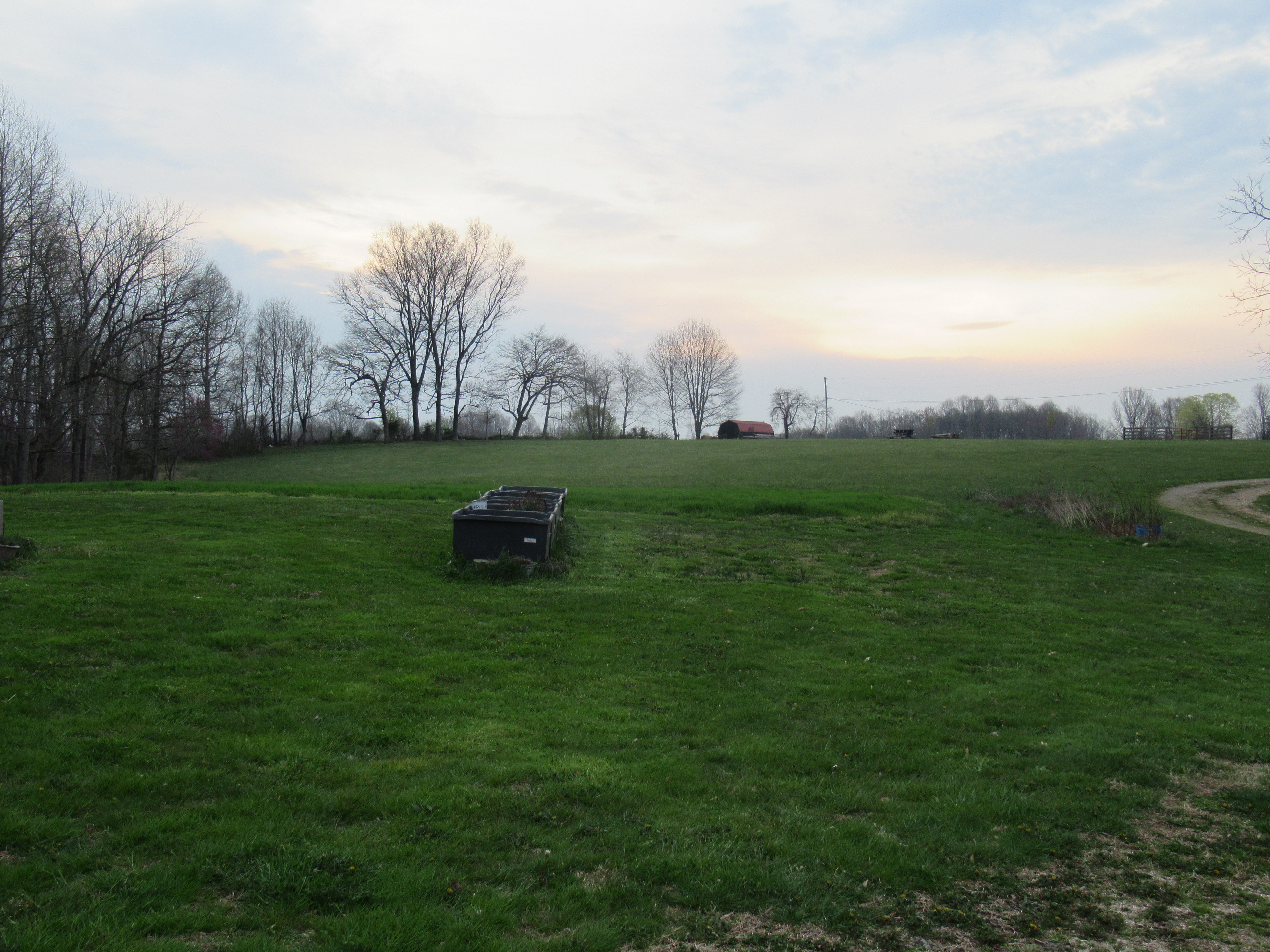
By the time I walked outside with my camera the riffle of wind had dropped, the tall grass barely moved. The hay is ready for mowing. Our good neighbor Titus Beachy and his boys have managed the hay crop for several years. 
When the local Beachy Amish church decreed a division of membership, lots were drawn to determine which families must relocate to start a new church.
The lot fell, among others, to Titus and Lillian.
Their fresh produce sales and the surplus grocery store are already missed as well as their presence in our lives.
Titus assured Jim that a cousin [or is it a nephew]  still nearby would take over the care of the meadow, and the man in question did roar in earlier to spread fertilizer.
Frequent rain has slowed the hay harvest in the area and as I walk the boundary loop the scent of ripe grass mingles with the perfume of blossoming blackberry canes, of invasive wild roses and the exotic sweetness of honeysuckle, all rampant in the hedgerows. 


Jim's potatoes are up and growing. 


In my untidy west wall garden perennial foxglove is making a statement. 
The prolonged mild and wet autumn brought decay to several of the parent plants and the usual crop of seedlings was tardy in emerging. Each time I walk by the wall I stop to tweak out a few weeds, clearing space around each tiny volunteer plant. Some, too near the edge of the retaining wall, will need to be relocated when they are larger, others will be allowed to grow where they have sprung up.
May--the season of headlong growth, the rush into summer.


Wednesday, May 7, 2025

Garden Progress

Queen of Denmark

I was outside before breakfast this morning a bit inclined to feel grumpy after a night with little sleep.
My two surviving David Austin roses are loaded with half-opened buds and the sight of them banished my mental cobwebs.
I made two trips with scissors clipping blooms to bring inside. 


The Poet's wife [yellow]


White single peonies, the first to open.


Jim retrieved the repaired tiller this morning and decreed that we would set out the tomatoes and peppers.
This we accomplished with the usual disagreements about spacing. He plants things too closely and we end up with a mid-summer jungle. I suspect it can't be helped.
Another row of sweet corn went in; this has become a partnership of planting as J. contrived a device made from a length of hollow pipe with a funnel attached to the top. My job is to drop seed into the funnel as J. pokes the pipe at regular intervals along the row.
It beats getting on my knees to plant. I did get down to pick up spilled corn kernels [I didn't spill them!] and had to be ignominiously hauled up onto my feet.
Jim was anxious to put in cucumbers and winter squash--I produced enough small plants for a hill of each, leaving the rest of my seedlings to grow on for another week.
I've pricked out signet marigolds and teddy bear sunflowers from their trays and potted on, as well as the largest of my second crop tomatoes.

Time spent in my tiny greenhouse is always precious. Working in there, handling soil, seeds and plants I am content, almost forgetting that I am 'old,' temporarily shelving various worries and concerns.  
Early yesterday evening as I was tidying the benches before going inside for supper, I felt a stirring as though a breeze had brushed through my hair. 'That's odd,' I thought and half turned to the open door to see if the wind had come up.
It hadn't, but a bluebird had swooped in, its passage creating the small draft I had felt. It fluttered against the roof in the far corner, flailing for a second before reversing and heading back outside.


We weren't familiar with starting beets in cell packs. Matt bought several trays at the Amish auction last month and shared with us. I was dubious, but willing to try as our beet crops from seed have failed the past two seasons. These have taken off sturdily in the raised bins. Yesterday we discovered that the beet seed sowed on April 17th has sprung up. Gardening is full of surprises!


Broccoli and early cabbage plants also from Matt's auction haul. The wire panels are meant to keep cats from investigating. 

We were finishing our garden work when M and G stopped on their way home from today's auction.
We were presented with 2 gallons of strawberries, several hothouse tomatoes.
Berries and cream--before supper--and sliced tomatoes with tuna salad on homemade bread.
I have sliced and frozen about half of the berries, the rest have been tenderly covered with moist paper towels and refrigerated to be dealt with tomorrow. 

I realized late this evening that we had forgotten the Wednesday run to tend Howard's cats.
While they won't have starved I'm chagrined to realize that this responsibility so easily slipped my mind.
We will visit them first thing in the morning.
No time today to read or write.
Thimble-kitten is gearing up for her nightly activities, whacking a large green bottle cap about the room. I am too tired to play 'chase the bottle cap!'
 Tomorrow is another day.


Friday, May 2, 2025

April Review


First strawberries from the commercial berry farm. 
I follow them on Facebook so that we can decide when to drive to the farm stand half an hour away. The stand opens about 8 a.m. and the berries quickly sell out. 

There was heavy rain on Tuesday [29th] evening and when I awoke Wednesday around 6 a.m. the meadow below the house was thick with fog. 
I considered getting out of bed, but there seemed no good reason, so I curled up with Rosie-cat under my arm. I was jolted awake later--that feeling that someone is looming nearby--I focused blearily on Jim who was demanding to know if I intended to go after berries.
I fumbled into yesterday's clothes, poured my half cup of morning coffee into a travel mug and stumbled out the door. 
Its a pretty drive of winding rural roads, past farms, crossroads churches and then a short distance on a main highway.
I felt anxious that we would be too late, but we wheeled in while there were still a few gallon buckets left on the wagon.
I set our bucketful on the console between us, carefully selecting and hulling berries one at a time--one for Jim, one for me. 
We detoured to take in the South Fork shops on the way home, stopping also to see if J's Troy Bilt tiller had been repaired. [Still waiting as the decision was made for a replacement engine]

I wandered happily about in my favorite garden center, spending my birthday gift certificate for two sturdy planting tubs. 
Howard is working on a job out of state so we drove to his place to check on his cats. Two of them were happy to see us--two, predictably, hid as though we might be dangerous intruders.

On to the nearby huge sprawl of greenhouses at Sunny Day where we encountered Mary, one of our Amish neighbors when we lived at the farm. 
I collected more plants for my tubs to go with those donated by Matt and Gina from their latest auction haul.
Finally I have two pots of calendulas!  Every spring I poke seed into trays, every spring I have to buy calendulas. I will undoubtedly buy seed and try again next year.
Nursery tomatoes and peppers earlier potted on and nurtured in my small greenhouse are ready to go into the garden. Two tomato varieties new to me, from Southern Seed Exchange have germinated quickly in plastic packs, likewise bush cucumbers and melons.
Jim has replanted his corn, grumbling that it didn't germinate, while I try not to smugly retort 'I told you the ground was too cold!" 


I finished the essay I was asked to write concerning my attendance at the Young School, the last one-room school in my home town to be closed. 
I began this project by clipping news items re the school, its teachers and pupils from 1920 through its closure in 1960. I used my subscription to newspapers.com for this. Not surprisingly for every 'hit' about the school I had to read the entire column of 'news notes' relating the joys and sorrows, the outings and tasks of the neighborhood. 

As I wrote I felt that my effort was taking on a tone of nostalgia, and yet--what else could it be with looking back so many years! My essay wound up at 11 pages, a highly personal look at the years of my education process.
I had some idea of sharing the writing here  in serial fashion, but perhaps not an idea that could work well.

My current writing project involves a diary kept in 1904 by a woman who lived her entire life in my home town. I've had the diary for perhaps 20 years, had read it previously. I feel it should be returned to the place from which it came, but with notes to identify the families and relationships mentioned. 

I admit to a [weird?] propensity for perusing old documents, census and vital records, peering at vintage maps while attempting to mentally recreate the town as it was more than a century ago. 
The names of these long-dead folks trip through my wakeful mind in the wee hours, their 'stories' more interesting to me than a novel. 

As a child I loved to listen to the tales of older people. I was 'the little mouse in the corner' gathering and storing up the memory crumbs of another generation--and to what good purpose?
As my grandson fondly remarked a while back, 'Meme, when you die, a lot of useless information will go with you!'

As I finish this April diary, the green darkness of rumbling thunder and spattering rain has moved in; the sage bush by the front steps, heavily in bloom, has splayed its branches beneath the onslaught. The small flowering plants tucked into the tubs yesterday are thus far holding up.
There is yet another hapless bird scrabbling in the stove pipe.
The temperature has plunged by 10 degrees and I think a mug of tea would be welcome.


Garden Sage


Duchess of Edinburgh
I noticed that the date and time setting on the camera had reverted to December.
I'm using a different Canon 'point and shoot'--one that Howard brought to me, discovered when he was sorting things. My older camera still takes the usual quality of photos but the contact point for the lead cable is worn and it has been an ongoing battle to transfer photos to the PC.


Pinks along the west retaining wall

May Apple

Spiderwort in the shady edge of the south ravine


Wednesday, April 23, 2025

April Diary


Today has been as nearly perfect a spring day as anyone could want.
52 F. as the sun was climbing above the barn roof, a slight breeze, pillowy white clouds in a calm blue sky.


I've just read through the scribbled notes I keep in the small space allotted for each day on my calendar.
 Each jotting serves as a record of what we have done in the house and outside, lists any outings we've made, tracks weather and temperatures. I've been saving these calendars for several years; sometimes they are a useful reminder when a date or event needs to be verified, prodding my memory of other events or happenings not elaborated upon.

When I began blogging in August, 2008, I created a post at least once a week, sometimes more often. 
These posts were usually written in what I would term a 'personal essay' style; words were carefully chosen, photos selected to enhance the 'story' I wanted to share.

Frequency of posting slacked off when blogger changed their format resulting [for many of us] in an unwelcome spate of vile comments that left me feeling sullied by seeing them only long enough to delete.

A habit once broken is difficult to resume and as days/weeks lengthened between blog entries I excused myself by thinking that perhaps my life in retirement wouldn't be of interest to readers. 
[Never mind that those bloggers I most enjoy following write to share the tasks and thoughts of their daily lives from one season to the next.]

I think I would benefit from keeping a weekly journal in blogger format, collecting the trivia of my days into something more easily reviewed than the abbreviated scrawls on the calendar.
I've procrastinated with learning to transfer photos from my iphone to PC or for use in messenger.
Perhaps I can find the patience to work around that.
Resolution made--but don't hold your breath!


Three pots of violas aka 'johnny-jump-ups' set out on March 28 are in colorful bloom. 
Each year these 'pop' seeds into the surrounding areas. As they 'jump up' in the following spring I carefully lift them from the gravel or a nearby pot with an old spoon and tuck them in to grow on with the latest nursey plants.
When hot weather sets in the little plants languish, but with cutting back and modest watering they will bloom again in autumn until hard frost.


Clematis Dr. Ruppel is blooming exuberantly.


Heirloom 'Candida' is always the first to bud and this year, in spite of frost warnings the early flowers were unblemished. 


Poppy, 'Lauren's Grape' has moved with us from one homeplace to another in Kentucky. 
I planted several varieties of 'papaver somniferum' in my first KY garden; although I collected seed heads from each, Lauren's Grape was the only one to reestablish.

Most years I begin noting the emergence of tiny poppy seedlings in late January or in February. By March several colonies are flourishing sturdily undeterred by frost or even a late snow.
This year I feared the poppies were lost. 

I found the first few ever so tiny and fragile, during the last week of March. I barricaded each little seedling with a ring of small stones, hedges of plastic cutlery--anything to protect them from the cats who have questionable uses for exposed garden soil.
As the season has progressed I'm finding more poppies. Some seeds landed in containers used for annuals; a few emerged outside the barn door sill, only to be washed away during one of the torrential rains which plagued the early days of April. Half a dozen have sprung up in the gravel just inside the barn.
Last year the volunteers that grew there were wiped out overnight by an invasion of hungry green cabbage worms. Perhaps a powdering of diatomaceous earth will discourage the caterpillars.


April 15th Jim planted potatoes and a short row of sweet corn--early for that, but sometimes it germinates and provides a meal or two before warmer weather sowings go in.
Matt donated cabbage and broccoli plants from his haul at the produce auction; those have been set out, some in the garden, others in the large black bins used as raised beds. He also bought a flat of beet seedlings, those are in and beet seed sprinkled in rows alongside.

We purchased tomato and green pepper starts at our favorite nursey and I transplanted those into larger pots to grow in the shelter of our little greenhouse until the soil in the garden is warmer. 

I insist on sunflowers every year, choosing those that are designated as 'dwarf.' Most of them grow as tall as standard varieties. They lean crazily, fall over in wind and rain storms, topple into Jim's plots of cucumbers, annoying him with their untidy ways.
When he tilled the garden he announced that there was a small strip designated for sunflowers, near--but not in--the proper garden. 


Tilling the garden, April 1st.

The sunflower seeds were planted in their allotted strip late yesterday afternoon. 
Jim has devised a way of dropping seeds without crawling on the ground and was pleased to demonstrate his new method. A length of 3/4 inch metal tubing is marched along the row and the seed dropped down the tube at intervals.


In other news, within the space of a week two bluebirds have gotten down the chimney. 
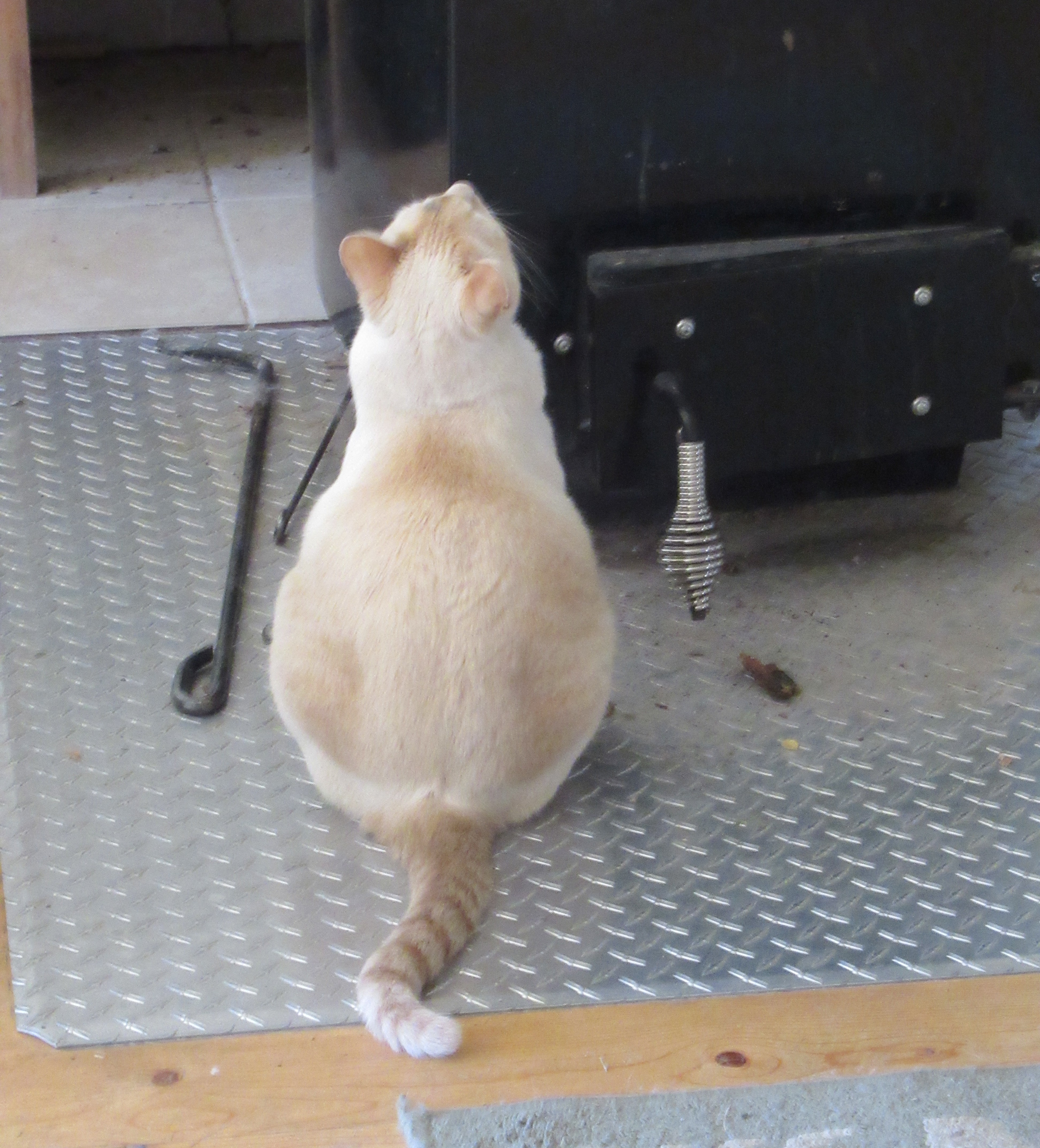
Elmo-the-eejit [pictured] and Thimble-the-kitten alerted us each time the bird scrabbled in the heavy stove pipe. After two days of this the first bird was discovered sitting on the inner ledge of the door when Jim opened it and he was able to gently grasp it and toss it from the front steps.

The 2nd bird [I'd like to think the first bird learned a lesson] didn't have as kindly a fate. It flew past Jim's head when he opened the stove door, fluttered toward a window and was snatched by Thimble who ran with it, pursued by Jim. It was several moments before he could catch her and when he took the bluebird from her it had died. He brought it out to the garden where I was working and showed me the little thing, limp and still, brightly blue in his gloved hand.
Such small deaths grieve us--and yet, Thimble-kitten was merely acting on catly instinct. 

Thus the April days have rolled by, marked by quotidian tasks that must always be done: care of the cats, meals prepared, laundry pegged on the back porch lines when weather permits, a daily walk if rain isn't pelting down; church on the weekend.

I have two research/writing projects on the go that need to be finished. Perhaps I'll share those by way of a record--both have a flavor of nostalgia, one deals with personal memories.
The thought of converting the projects to blog posts is a bit of a goad to finish!


Wednesday, April 2, 2025

Wind and Weather


I closed the front door, stepped out into the windy dusk. Behind me the house smelled of pan-grilled salmon overlaid fortunately, with the dark spiciness of molasses cookies cooling on the counter.

The heavy evening air held the reek of wild onion, that ubiquitous invader making itself known whenever the grass is mowed.
There is a hint of sweetness from the lilacs coming into bloom. 
[Lilac: the quintessential scent of my native New England in May, harbinger of April in Kentucky.]

The wind has blown in great gusts all day.
I went with Jim in the pickup truck this morning on a mission to look at something he'd seen on marketplace. Our route took us off the main highway into farming country. Tree branches flushed with the new green of emerging leaves swayed with each buffet of wind. Flowering redbuds tucked against hedgerows, wore their twisted and brittle branches in vivid defiance of the grey sky and swiftly scudding clouds.
Rounding  curves in the road the wind broad-sided the truck. A convoy of crows rose from a pasture, tacked into the gale, aimed for a straggle of trees behind a derelict and leaning barn.

Back at home the cats were restless. those with indoor/outdoor privileges couldn't decide where best to be, dashing out whenever the door was opened, sitting with flattened ears and ruffled fur waiting for readmittance. 
Thimble-the-kitten hovered while I mixed cookie dough, twined about my feet 'talking' to the salmon fillets as I placed them in the pan.

Determined to walk before dark I headed up the flank of the big meadow, trudged south along the eastern boundary line, turned westward bracing as the force of the wind blew my hair across my face. 

 Willis-the-cat joined me where the lane curves into our drive, plodded gamely behind as I strode through the gathering dusk. He paused with me to marvel at a colony of  redbuds, rosy in the twilight.

No sound of sleepy birds settling for the night, no barking of a distant dog, no sound of vehicles up on the road.
Nothing but the soughing of the wind.

Jim has checked the doplar map several times during the day and again this evening. I read the weather forecast cringing inwardly at the possibilities. 

The worst of the projected storms often bypasses us, but somewhere, perhaps not too far away, this night may bring damage and difficulties.
It will not be, I suspect, a night of restful sleep.