Sunday, November 3, 2013

Looking Over My Shoulder--A Week In Photos


J. was expected home on Tuesday, but I had no idea what time that would be or whether he would stop for
 a meal on the way.
The kettle of soup made on Monday was waiting in the fridge--and isn't soup all the better the next day!
I set a batch of anadama bread to rise, then trundled the vacuum around, did some much-needed tidying.
Early in the afternoon I prepared oatmeal cookies to go into the oven as the bread came out--feeling marvelously efficient and frugal.
At 6:30 I decided not to wait longer for J. before having supper. I had washed my bowl and plate and settled to read by the fire when I noticed that J.'s elderly Siamese cat, Raisin, was suddenly sitting alertly on the sofa with her ears pricked.
Seconds later I heard the familiar roar of Snort'n Nort'n's diesel engine.
I had moved the van out of the carport, knowing that J. would be returning with tools and such on back of the truck and likely not anxious to unload them in the dark.
The back door opened and J. came in laden with his suitcase and several boxes.
Raisin clambered down from the sofa and launched into a long litany of feline complaint.
"What?" said J. 'Hasn't Mommy been feeding you?"

He ate soup, fresh bread, sliced tomatoes salvaged from the frosted garden, meanwhile telling the news of his finished projects and the on-going visit with our niece and her husband and daughter.


The cats and I were up at our usual early hour on Wednesday morning, keeping quiet so J. could 'sleep in'--and adjust to the difference in time zones.
When I stepped into the carport, spoon and tin of cat food in hand, the world beyond the porch light was still in that transition time that is neither full darkness nor yet daylight.  A slender sickle of a moon rode the billows of  fast moving clouds.


Inside I burrowed into my down vest and fetched my camera.
This was a time when understanding more of the camera's capabilities could have resulted in some stunning photos. I used the EXR setting and was interested to note that although I was snapping pictures only seconds apart, the f stops on the camera were automatically being changed.


The sun was slow to rise and mist cloaked the landscape.

As the sun crept up behind the trees its glow illuminated a tracing of contrails amidst the soft clouds.

J.'s loaded truck was taking most of the room in the carport. 
In the near dark I had needed to be aware of edges and overhangs, lest I brain myself during my clambering about for better photo vantage points.
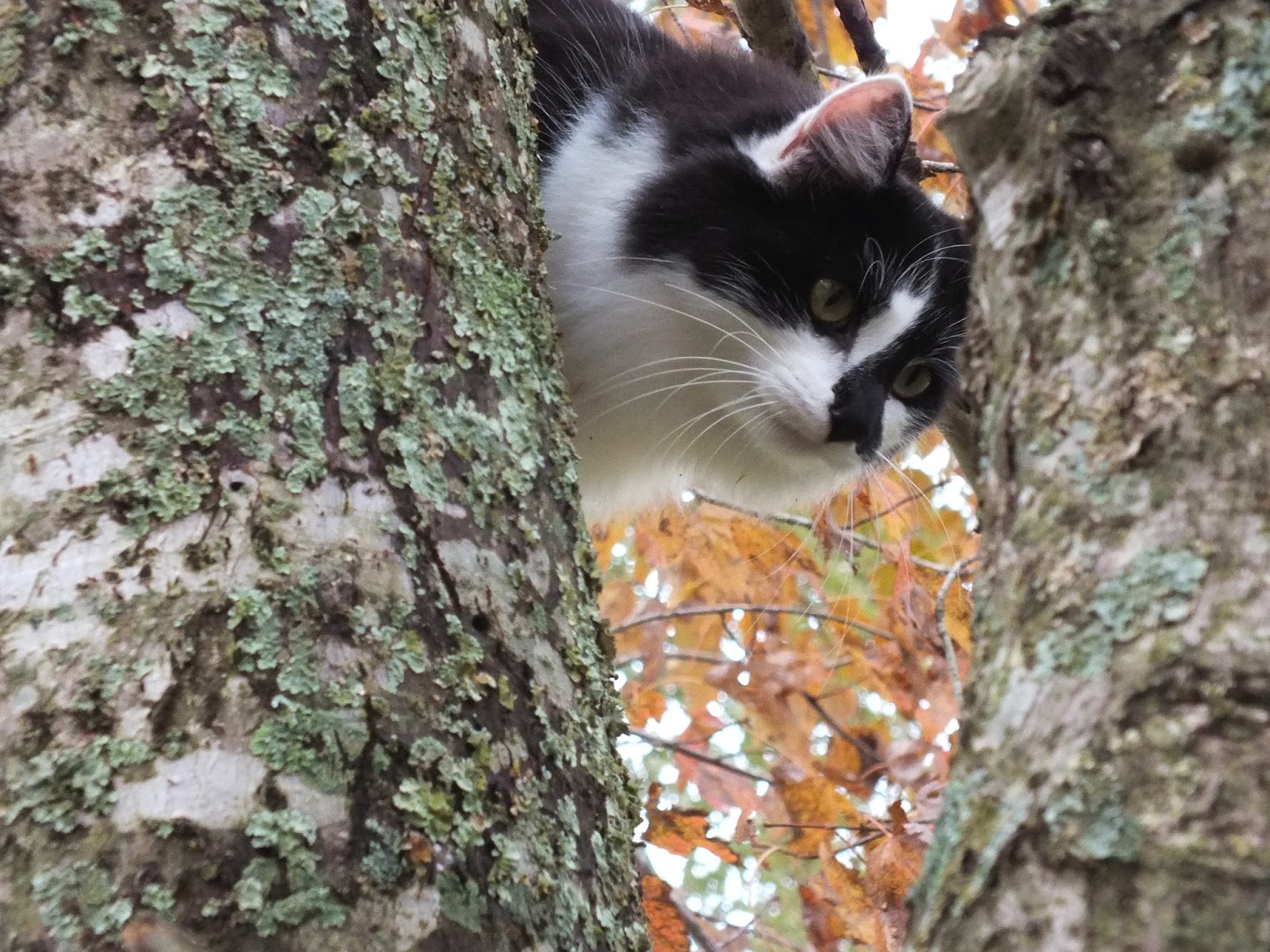

 I went in to start the coffee, but was captivated by the sight of Bobby McGee happily exploring upper branches of the tree which is in direct line of the kitchen window.
It was Edward gazing up at his brother--too fat and indolent to climb the tree himself--who alerted me to Bobby's gymnastics, so back out with the camera!

J. had errands in town, so when I had tided the kitchen I brought out graph paper, colored pencils, rulers and a calculator.
I need to produce a quilt from these stunning Laurel Burch fabrics, have it finished in time to send to our granddaughter in Colorado for Christmas.
I've been trolling through quilting books and magazines for several weeks hoping to find a pattern I could use just as it is written.
I bookmarked several possibilities, but wasn't convinced they would result in the effect I wanted.
I decided to integrate elements from two different patterns.
I traced lines, filled in blocks of color--and suddenly the solution popped into my head.
Late in the afternoon I started a fire downstairs and began happily cutting and stitching.


I was assisted by Bobby McGee.
He appears here as an innocent onlooker, but moments before he was prodding at the rotary cutter, or switching his feathery tail into its path.


Several hours of work resulted in completion of the quilt center.
I need to produce 16  smaller [8"] star blocks to place around the center, then add borders.
It may not be what an E-Q program would suggest, but I am thus far pleased with the effect.
I wanted the outer triangles to be the same black print as the inner quarter triangles--I was 2 inches short of sufficient black print, thus they are in the purple print.
I have to pretend that's what I designed all along!


On Thursday morning, with animals tended, we decided to do some yard work.
J. got out a ladder and climbed up to sweep leaves and debris from the eaves gutters, then moved his ladder to the apple tree.
I cleaned leaves out of the outside stairwell, dumping them into a corner of the cat yard.
[The cats have their own nefarious uses for a pile of dried leaves!]
I began raking leaves under the maples in the back yard only to have them tossed and swirled as the wind began to pick up. As the morning wore on, the sky darkened and the wind developed a chill bite.
Abandoning my piles of leaves, I decided to transplant some of the excess lavenders that have been bursting out of their small pots.  I tucked some around the stepping stones at the lower end of the herb garden, planted several more in the barrel planter.  Neither are ideal locations, but at least the lavender will have a better chance of surviving til spring. 
By the time I straightened my back and brushed wet dirt from my knees rain was coming down in 
fitful bursts.
J. brought in a bucketful of apples from the old gangly tree and suggested we collaborate on apple pies.
By the time my friend Gracie arrived for help with a creative project, the house smelled deliciously of 
apple pie. 
The wind increased as evening came.  Darkness fell  early, and it felt good to settle by the fire after a 
busy day.
I was aware of the increasing velocity of the wind and got up several times to turn on the outside light and watch the thrashing branches of the dooryard trees.
A bit after 10 the telephone rang with an automated call from the local weather service: a tornado warning was in effect until 1 A.M. 
J. pulled up the doplar weather map and pointed out the red line of a storm moving rapidly in our direction.
A few minutes later the electricity went off!
Outside the wind moaned and rain buffeted the house.
We decided going to bed as usual would be safe--rather than cowering in the basement room.
It was a restless night--trying to sleep and yet be aware of any changes in the storm.


Morning dawned with a rain-washed brilliance and utter calm.

I fed Pebbles, who cantered up to the barn like a youngster, pawing and snorting for her ration of grain.
Beyond the barns the woods and fields glowed with a rich amber light.


Although the nearest sycamores stand within the woods, I discovered this leaf resting in the wet grass far down the west pasture.

The herb garden was still in cool dappled shade, the newly planted lavenders fresh, the rain-pummelled lemon balm scenting the air.


More leaves covered the stepping stones and the area beyond which I had raked only 24 hours earlier.


Puddles reflected the blue sky.


The backyard was strewn with fallen branches and blown leaves.
I began gathering the branches, dragging them to a pile near the carport where I will break them into kindling.
Willis and the bully boys were entranced. 
Willis followed me, landing heavily on the ends of branches as they twitched through the wet leaves.


Willis and the boys played hide and seek in the branch pile--until their capers roughed up a stem or two of catnip--where-upon Willis turned fierce.


And so--to the end of a rambling and photo laden post, the end of a week of wind, sunshine and rain, a week of sewing, reading and baking.
I need to catch up with myself, sort the small happenings and thoughts of my quietly busy days into more manageable segments--daily doses rather than a weekly wrap-up!


Monday, October 28, 2013

Morning Frost/Morning Rain

I woke Saturday morning in the predawn, warm beneath two quilts and a pile of furry felines.
I lay there contemplating the day ahead until I heard the furnace kick on.
I had loaded wood into the fireplace stove before 10 the previous evening--an early bedtime for me.
Mindful of the electric meter, I pushed aside quilts and cats, hurried into a motley assortment of warm clothes and padded into the living room to switch off the furnace and deal with the wood stove--before doling out breakfast to the cats.
The three young boy cats are served in the carport as they tend to gobble.
Out there I could see my breath in white wisps. Beyond the carport and the pool of light from the automatic yard lamp, darkness still hung, dank and chill.
I didn't need daylight to know that there had been a heavy frost.
An hour later, when the sun had climbed far enough to shine over the field, each blade of grass, each stem and twig, blazed with a crystal shimmer.


With the fire pushing warmth into the living room, the house cats tidying their whiskers after their fishy breakfast, it was time to pull on boots and a down vest before venturing to feed the barn cats and
 Pebbles the Horse.
Pebbles snorted and tossed her head, her breath wreathing around her face. My boots left slick trails through the silvered grass. 
My 'chores' done, I went back inside for my camera.

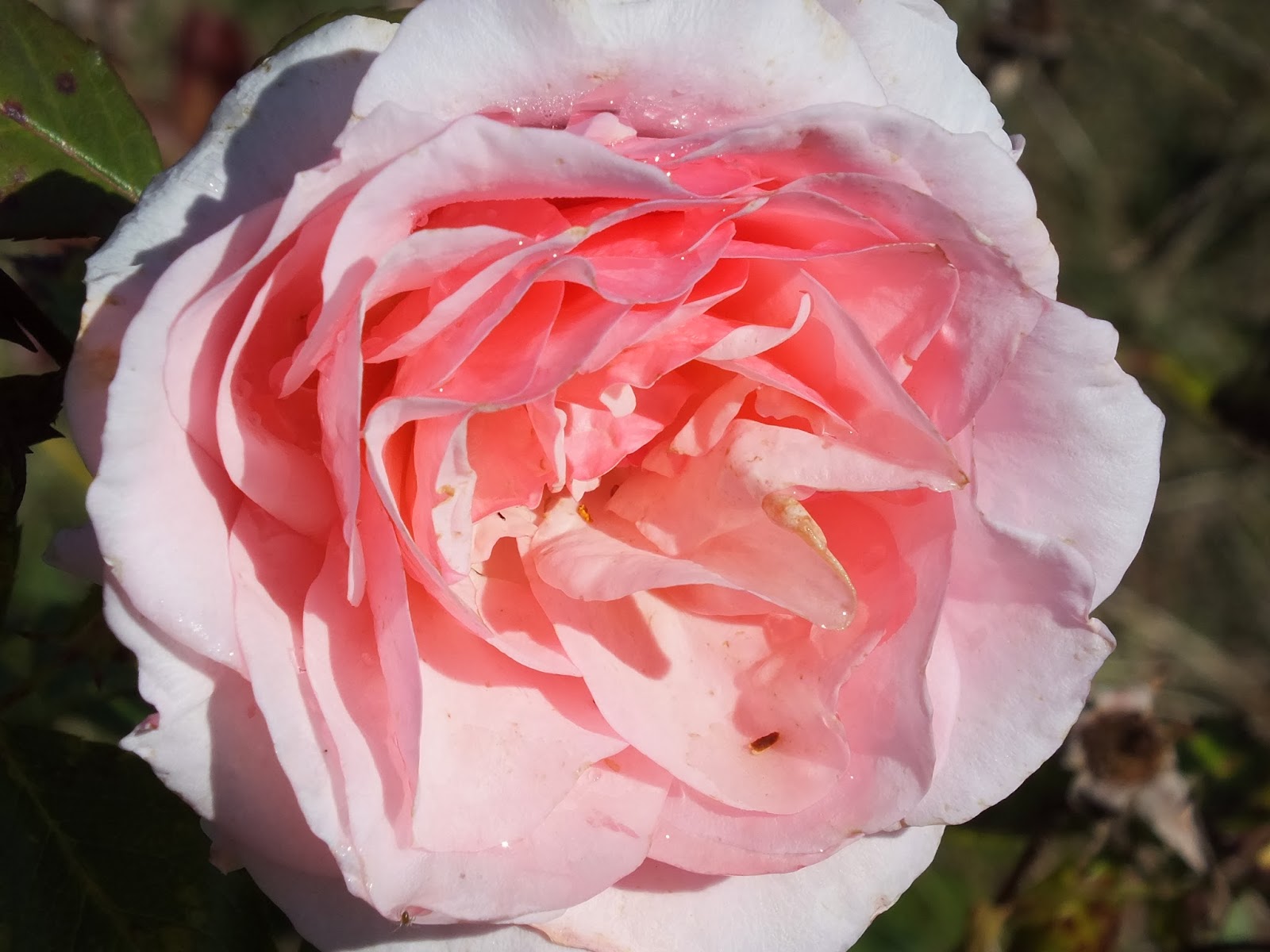
Half open blooms on the coral pink rose [the one whose name tag is forever lost] drooped, heavy with cold.

Beside the coral charmer, Roseraie de l'Hay wore a frosting of diamonds.

Below the roses the cabbages had caught the frost in every bump and wrinkle of their huge outer leaves.

The low slanting sun crept across the pasture, turned ice on the clothes pins to suspended droplets.
In the shade of trees and buildings, the ground was still white.

The flower strips, wind tumbled, frost bitten.

The maple and the sweet gum tree in the side yard still cling to some of their leaves, but leaves from the box elder and the silver maple have been blown along the drive.


As usually happens once the killing frost has put paid to the gardens, the weather has turned again.
Sunday was a warmish but moody day weather-wise.
M. and G., had planned a neighborhood gathering, a sort of potluck meal to be held in their dooryard.
They were anxiously watching the sky.
Most guests arrived wearing a sweater or light jacket, with back-up wraps in their vehicles.
Those of us who stayed through the afternoon were glad to draw chairs close to the fire pit where M. had an intricately stacked fire of slab wood from the Amish mill.

I could hear a soft shush of rain when I woke before 6 this morning. 
The cats [for once!] weren't clamoring for early breakfast, so we lay, warm and drowsily content.
There was no sign of the sun when I opened the curtains a half hour later. 
No wind stirred the trees; the air was still, heavy with mist--a 'soft' day.
Morning chores were no burden although the grass was wet and moisture plopped from the trees onto my shoulders, sometimes spattering the lens of my spectacles.

This lovely head of achillea caught my attention in the sodden perennial strip.

The daisy flowers of the feverfew shriveled in the frost but the leaves are still a brilliant swath of color.

Bobby McGee, undaunted by damp, paced up and down the drive.

His brother Nellie crouched by the big rock where the ruined signet marigolds still spill their 
distinctive citrus-y perfume.

A 'nose-to nose' confrontation--I could see that imminent in the owlish gleam of Nellie's eyes!

I ran out of excuses to stay outside.
The misty drizzle had seeped into clothes and hair.
A hot shower and dry garments was welcomed, and soon after I had a kettle of macaroni soup bubbling on the stove.
My Mother made this soup often during cold weather: ground beef sauteed with chopped onion; diced celery and carrot added with a quart of canned tomatoes and another qt of hot water. I add sea salt, freshly ground peppercorns [a medley of pink, green and white] garlic in some form, thyme and bay leaf.
When all has had a good simmer and the veg are tender, turn up the heat to a boil and toss in a handful or two of small pasta. 
I enjoyed a bowlful with a corn muffin left from yesterday's feast.
As I finished, J. phoned to say he would be home sometime tomorrow.
I don't think he has minded that the handyman jobs for our niece have taken a day or two longer than anticipated.  These small refurbishments have likely been a relief after nearly three weeks of labor to replace the leaking roof on his sister and BIL's rambling house.


This photo, taken Friday afternoon, is typical for chilly weather.
Eggnog is at the back of the pile with Chester and Mima--the dim-witted offspring of Charlie and the late Maisie. At the moment Fat Edward is sprawled alongside this heap of 'regulars' on the sofa and Teasel is draped across the back.
Charlie took advantage of my lap as I typed, his damp pale fur harboring the clingy seeds we call 
'devils' pitchforks.'
I worked the small wedge-shaped burrs out of his long hair and he has gone to nap in the laundry basket.
A glance out the back door places Bobby patiently sitting in the rank grass that fills a slight ditch below the gardens--ever watchful for a meadow mouse. Nellie has just returned from padding along the mowed path that leads to the cat litter dump at the back boundary.
Willis has abandoned his post as overseer of the dooryard to curl up in a tweedy ball on the old quilt folded over the daybed in my sewing room.
With all this comfortable somnolence around me I think I'd best head for my sewing room and a project before I'm tempted to drowse away the afternoon.


Saturday, October 26, 2013

Frost Warnings

The first frost warning was posted last Saturday--with a projected 34 F as the overnight temperature.
We have learned the hard way that the presence of Big Creek winding along the road below the house often leads to temps a few degrees colder than experienced at the gardens of a friend who lives about 3 miles away and removed from the vicinity of the creek.
The day had been blustery and dark.
G. and M. arriving an hour before dusk on their nightly walk volunteered to assist in bringing in the houseplants which have summered on the front porch.
Begonias still in flower were crowded onto an old table in the basement beneath a hanging florescent strip.
Geraniums and a Christmas cactus lined the floor awaiting another table, another light.
The huge heavy pots containing the Angel Wing and Beefsteak begonias are ranged in the tiny front hallway.
The rosemarys and the potted lavenders remain on the porch, which looks bare and forlorn, bereft of the colorful flowers.
What I am to do with 17 small lavenders is a conundrum. I think every seed in the packet must have germinated!


It was well after 7 when I arose on Sunday morning; the sun was shimmering through the trees that border the creek. The grass shone with wet, but didn't appear frosty.
M. marched up the drive moments later, getting his walk in at the beginning of the day and informed me that there was white frost on the grassy strips still shaded by the trees.
When I ventured outside I found that the zinnias--so bold and coarsely handsome, had succumbed to the light frost and now were grey and limp.
Roses still bloomed and a few bees moved sluggishly over the Michaelmas daisies.

Sunday was an example of October's 'bright blue weather'.
The air was crisp, but the sun had warmth.

The pink cosmos still shone in their tumbled row, a bit frayed about the edges.

The hardy Knock-Out roses by the garage were unfazed by a chilly night.


All week the weather was fitful--often with dark and ominous clouds filling the horizon in one direction while the sun cast long shadows in another.
It seemed warmer outdoors than inside the house and I prowled, restless, anxious to record what must surely be almost the last blooms of summer.

A vulture glides through a billow of grey cloud.


I brought in the last of the green peppers.
We picked the center heads of broccoli two weeks ago, but there were delectable side shoots 
ready for harvest.
I went out with a large bowl to gather seed heads from the ravaged zinnias and used a smaller one to collect still more of the cosmos seeds.
Noticing that the catnip had made a flourishing come-back after the rather spindly stalks formed [and cut down] in the wet summer weeks, I cut bundles of it and spread them on baking sheets to dry in the oven.


Coming into the kitchen from my outdoor labors I was met with the heady scent of catnip gusting from the oven vents. Cats hovered in the kitchen in various stages of glassy eyed intoxication. 
I fought them out of the way while I stripped the crisped leaves from the stalks and rubbed them through a sieve.  I tossed the dried stems onto the mat outside the kitchen door where Nellie and Charlie promptly wallowed in ecstasy. 


Each evening brought chilly temperatures and winds that whisked fallen leaves about the dooryard.
I draped old tablecloths on the two cherry tomato plants which have been living in the carport, kept an old quilted spread over the one producing tomato plant in the upper garden.
I made up a fire and sat beside it in the evening, reading or stitching.

Thursday was cold, scarcely 50 degrees F. The wind bit meanly through my jeans, whipped hair loose from my braid, huffed its cold breath down my neck.

I walked again along the edges of the garden, camera in hand, with a sense of 'last time for this season.'
Fuzzy seed heads of clematis decorate the trellis.


Feverfew, new this year, makes a brave show with its chartreuse leaves and small white daisy flowers.

Salvia and achillea compete for room in a corner of the top perennial strip.

Still a few blooms on the phlox.

Blanc Double de Coubert--one of the most fragrant, now unmolested by the Japanese beetles that destroyed earlier bloom.

Wise Portia--a bit leggy, un-pruned since the summer rains.

I found my stout garden fork and up-earthed some of the achillea which in one season has crowded along the front steps.  I carried it down to the lower perennial strip and set it in where the ill-fated dianthus 
failed to flourish.
Edward offers his assistance--while hoping  to make use of the crumbled and over-turned soil.


I left the bedraggled gardens to the inevitable ravages of the cold wind.
Inside I built up the fire, stood gratefully under a hot shower.
I found clean clothes--layers of snuggly pullovers, a pair of wooly socks.
I got out my favorite mug and set the teakettle to heat.


It was necessary to dispute Teasel's claim to my rocking chair.
M. coming in a few minutes later chuckled to find me tucked up by the fire with cats sprawled on the hearth rug, curled on the sofa, close to the warmth.
'You'd think it was winter!' he exclaimed.
When the frost comes, can winter be far behind?


Wednesday, October 23, 2013

The Passing of a Gentleman

Jim with Haskell Rogers on his first visit, May 2010


The Passing of a Gentleman

The phone rang this afternoon as I was slicing apples into a pan for apple crisp---a fitting and homey dish for a chilly day.  I laid down my knife, and caught the phone on the second ring.
Our neighbor, Dale Hayes, never identifies himself when calling, but we know his voice. “Mrs. Whitehurst”, he said, “I’m calling to let you and Jim know that Haskell passed away this afternoon.”
Such news is not unexpected when someone has lived well into his 90’s, still my reaction was an immediate, ‘Oh, no!’
A heart attack on Monday, Dale recounted, into the hospital then, and death had come on this Wednesday. ‘He was out driving last week!’ Dale’s tone was wry.

We purchased our farm on the Old Gradyville Road in March, 2010, from J. M. Shelley who had bought the place at auction in the fall of 2009 and taken on the task of clearing out the barns and shed. At the closing J. M. handed over the soil maps and a large framed arial photo of the acreage and farm buildings as it had looked in the early 1980’s soon after the new house replaced an older one.
“You’ll want to get acquainted with Haskell Rogers,” he advised. “He worked that farm for the last 30 years and he’ll tell you more about it than I can.”

In our first weeks here as we made the rounds of bank, insurance office, seed and fertilizer business, we had to explain just where we had come to live. We were told--and retold--"You need to stop and see Haskell. He could tell you history."

Those were busy weeks—gardens to till and fence; berry plants to order and set out.
In the house, the faded blue carpets were ripped up, replaced with hardwood. I painted the kitchen even as Jim was uncrating the new cabinetry.  Neighbors stopped by to introduce themselves and make us welcome. Haskell’s name was mentioned often, but we hadn’t found time to go in search of him.

We weren't sure who was arriving when a blue Chevy Blazer turned slowly but confidently up the drive. It was the first week in May, a few days past the deluge that sent Big Creek flooding onto the road.
‘Who on earth?’ I wondered.
Jim peered out and replied, "That must be the man who used to live here!"

We hurried out to greet our guest as he pulled to a stop near the carport.  Haskell Rogers wouldn't get out of the car, though we urged him.
"I had an errand in town," he said, "and then I decided to see what damage the rain had done. Thought I’d stop to meet you."

He shook our hands--his slender, dry-skinned and warm.
Jim had been wondering about the exact location of the old well.  Mr. Rogers pointed it out.  He told us about the wonderful harvests from the old pear tree--"over a hundred years old--I remember it from when I was a boy in the neighborhood."

I enjoy history and I asked eager questions--about the flood, about life as it had been lived here decades before.
Mr. Rogers admitted that he didn't remember moving here with his parents. He was born in 1916, in Metcalfe County a few miles away.

His father bought farmland here and Haskell grew to young manhood in Gradyville.
The new house that Doctor L.C. Nell built [on higher ground] after the 1907 flood took the lives of his first wife and all but one child, was within easy walking distance of the Rogers’ farm and young Haskell was intrigued with the doctor's practice.

"I don't know just what Dr. Nell saw in me" admitted Haskell, "But he made me welcome around his office and put me to work. Later he recommended me for work as an x-ray technician and since there was no large hospital in town then, emergency cases were often brought in to the same office that housed the lab, and I worked beside the doctors to treat the injured"

World War II interfered with any plans Haskell might have made for a more formal medical training.  Still, folks who knew and respected him continued to seek his skills when they were injured or ailing.
"I never pretended to be a doctor," he assured us. "If I could help someone, I did. I was never afraid to say that a problem was beyond what I could treat and that the person needed to see the qualified doctors that I worked with."

Haskell chuckled softly, a sound we soon learned was the preface to a story.
A man had come to the clinic where he worked one evening, Haskell recalled.  He had been brawling—and probably drinking--- his face and mouth were bruised and cut.
Haskell assembled antiseptic and gauze, sutures and needles, which he saw would be needed. He began carefully to cleanse the man’s battered face only to have his patient shove him violently away, upsetting the tray of instruments.

Quietly Haskell explained that the man needed to sit still so he could assess his injuries.
The man struck him.
Haskell’s blue eyes twinkled. ‘It wasn’t very professional,’ he admitted, ‘but I’d had enough.  Without any thought to the matter I back-handed him on the undamaged side of his head!’
Startled, the man had glared at Haskell.
“You one of them Rogers from o’er ‘ere in Metcalfe County?” he grunted.
“I don’t know what he’d heard about us,” Haskell mused, “But he sat quiet on that stool til I had cleaned and patched him up!”

Mr. Rogers returned for another visit the following afternoon.  Knowing that I was interested in Gradyville history, he brought with him a copy of his late wife's book.  "I want you to enjoy this." he said.

He also brought apples he had picked the year before from one of the trees in this yard, sliced and dried.  Several heads of garlic were presented in a plastic sack. He emerged from his car and led J. over near the grape arbor to point out the garlic growing there in clumps.

Haskell agreed to come in the house to see what we had done, pleased to see our small treasures already displayed on the shelves he had made around the fireplace--"for my wife's antiques.  She loved old things." He created the shelves and cupboards that grace either side of the fireplace, using lumber from a cherry tree cut down on the property.

The sight of my piano inspired Haskell to tell us that day of his mother and sisters who had played hymns at home and in church.  I listened, delighted, as he told of choir outings, all day singings, when church choirs from the area gathered to praise.
“I’ve played for church services most of my life,” I told him, “Shall I play for you?”

 Dale Hayes stopped by a few days later and we fell over ourselves telling him that we had met Mr. Rogers.
”I knowed that already!” Dale grinned. “I got something in my eye and went to have Haskell take it out. He told me he paid a visit and that you played hymns on the piano for him.”

It was Haskell who framed up the little garage. He had heard a tale of the yellow poplar lumber having been salvaged from one of the flood-ravaged houses.  He wasn't sure he credited that tale, until he dismantled the older building and saw the marks and nail holes in the boards, indicating they had been used in another setting.

He smiled wryly as he admitted to Jim, “That garage isn't as straight on one side as it should be.  The wind blew when I was framing it and knocked one side out of line.  I had to take the tractor and pull it back.”


When Haskell left after his second call—the only time he came in the house--he paid us the ultimate compliment.  Pausing on the threshold he smiled. "My wife would have appreciated what you are doing with this house.  She would be pleased to know that you are taking care of things here."

There were other visits.  We would look up to see the blue Chevy trundling carefully up the drive. Haskell always had something to share—seeds saved from a favorite heirloom watermelon—the kind he had raised here and taken to a family reunion.
He told me how to make pear honey from the bounteous harvest of pears. We gave him jars of pear honey, canned pears, homemade bread still warm from the oven, tomato plants.

Several weeks before Thanksgiving in 2011 Haskell turned up with a container of shelled pecans.  He admitted he’d gotten dizzy stooping to pick them up so his daughter-in-law, Wanda, had gathered the nuts.  He had shelled them out, sitting on the porch in his rocking chair.  He hinted that he was fond of pecan pie—and I made sure that we delivered one a few days later.

We shared things as country neighbors have always done—talked of weather and seasons, gardens, animals. Haskell commiserated over the problems of stray cats, but confessed that he always fed them.  Jim occasionally made up a basket of fresh stuff from the garden and dropped by with it to sit and chat for a few minutes.

Once as we sat with him on his porch, Haskell spoke of the Depression years.
As a boy, he wondered why his family had so much company.
"We had no money,” he explained, "No more than anybody else.  But we had food--meat hogs, a beef, garden stuff and fruit in jars.  We had a springhouse with shelves built all around and they were full. Folks knew where to visit and be fed."

Generosity and kindness were surely as much a part of Haskell Rogers as his humor, his integrity and his appreciation of all that was good about country life.
I think that Richie Janes summed up Haskell in a few words, when his name was mentioned one day at the fertilizer plant.
‘Haskell Rogers” said Richie, ‘is a fine man.”
He paused for emphasis, “A fine, fine man.”

We have been blessed to know Haskell Rogers these few years.
We shall miss his visits, the twinkle in his blue eyes as he recalled a tale of other times.
He was a vital part of the neighborhood that welcomed us home.