Showing posts with label museums. Show all posts

Wednesday, September 7, 2011

Pleasant Hill Shakers, Part 3

The Shakers were an innovative people who often designed or improved farm and household tools to make common tasks more efficient.
Above is a part of the large wash house.

This cast iron stove was designed to heat a number of flatirons at once.
When one iron cooled another was hot and ready to be used with no wasted time.

A closer view of the flatiron heater.

A woodworker using vintage hand tools to create some of the smaller Shaker reproduction items sold on the premises.
He was making dozens of wooden clothes hangers.

The Shakers became well known for their wooden storage boxes in many sizes.
You can read more about the contruction of these boxes by following the link below.

A tower of finished Shaker pantry boxes in the gift shop.
[As I witnessed the resident black and white cat being pursued by some unruly children I thought what an excellent opportunity was here for disaster: think of cat fleeing children and perhaps careening through a stack of boxes!]

A large area was devoted to a vegetable garden and berry patch.
This is a stand of sorghum.

The cut stalks of sorghum would have been fed into this crusher.
A horse or mule hitched to the whiffle-tree provided the power to run the grinder.
After crushing, the collected 'juice' was boiled down into syrup and used for cooking or to drizzle on griddle cakes, biscuits, or muffins--it can be used in the same way as honey, but is darker and of stronger flavor.

The exterior of the Shaker Meeting House with separate doors for men and women.

Plain benches are arranged in ranks around the room--men on one side, women on the other.
The center space was left free for the ritual of 'dancing' which was a hallmark of Shaker worship.
To read more about Shaker rituals and daily schedule you can follow this link.

Reproductions of Shaker furniture can be had by custom order--if one can bear the cost.
Items such as this chest of drawers can be made in cherry or pine.
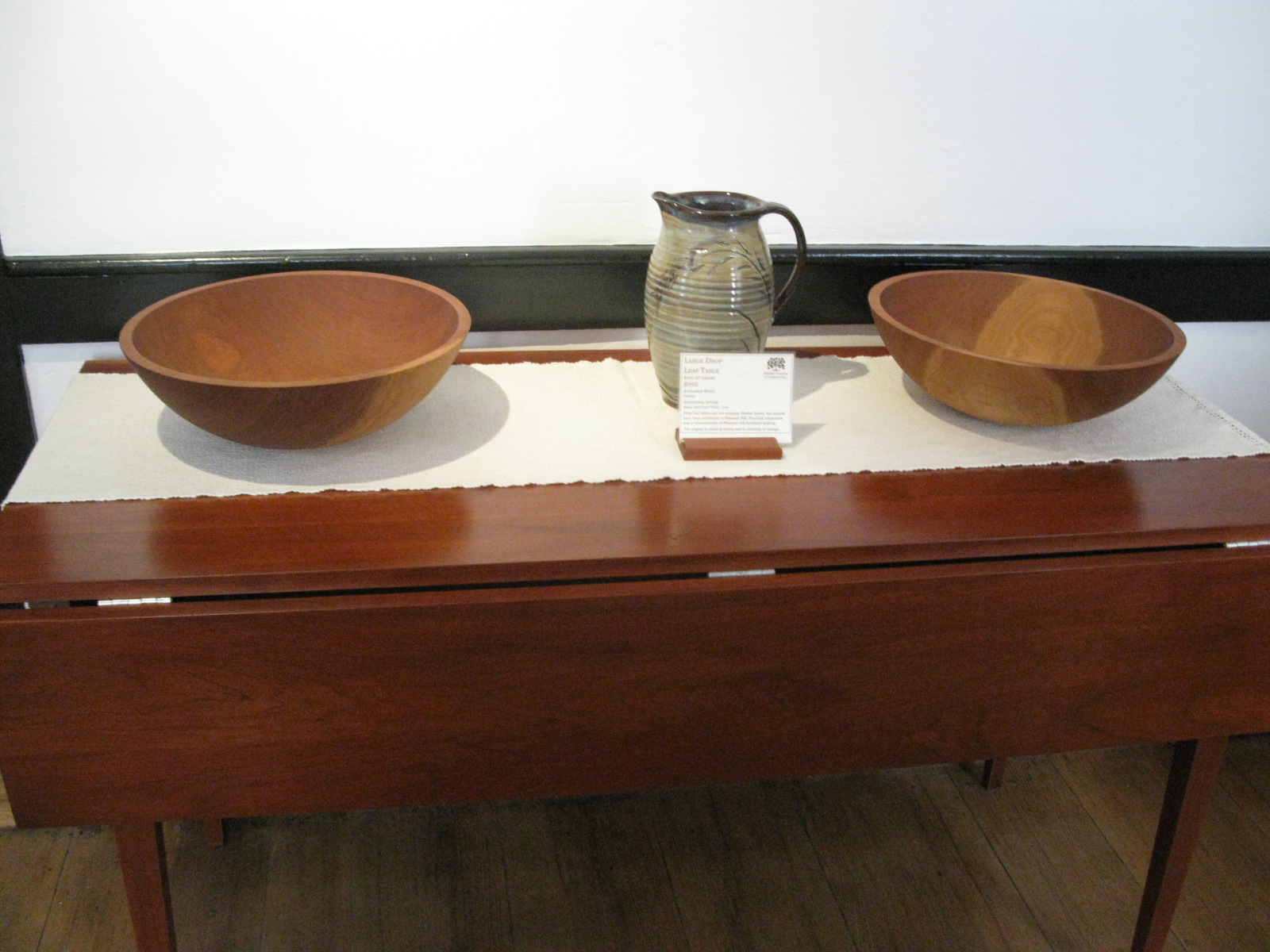
Reproduction Shaker drop-leaf table.

The craftshop of the broom maker.
The Shakers of Pleasant Hill grew broom corn and had a thriving industry making sturdy brooms for sale to 'worldly' customers.
This old fellow demonstrated the making of a broom while keeping up a running commentary which he had obviously memorized.

These colorful and whimsical bowls and balls are made from large dried gourds--the same we have seen locally crafted by the Amish and Mennonites into birdhouses.

The style of the cat paintings reminds me of the work of the late artist Laurel Burch.
[I have a small stash of the fabrics which were an off-shoot of her work.]

If I had room for one more decorative item in my little house,
this cat would surely have come home with me!

Thursday, September 1, 2011

Pleasant Hill Shakers [part 2]

I found the tourist brochure of Pleasant Hill [think excavating top of dining table!] and scanned the map.
I think if you click on it you can enlarge it enought to read the legend.
The buildings colored in green are open to the pulbic.
The others are used as administrative buildings or as accomodation and meeting rooms for paying guests--one of the ways of funding the restoration and upkeep of the village.

This large building is made of quarried and dressed limestone.
It's original purpose was the Center Family Dwelling.
The ground level windows allow light into the deep basement which contains the kitchen and storage areas.
The herb garden looks more presentable in this shot, but was in need of some care--and some water.

Kitchen tools in a rather dark corner.
At the left on the bottom shelf are wooden 'slaw' cutters--one places the cutter over a tray or large pan, runs a halved or quartered head of cabbage along the sharp blades to make 'cole slaw' or sauerkraut.
[M and G purchased a similar vintage kraut cutter at a local Mennonite store.]

I think this workroom was on the ground floor at the back of the building--still rather dark with the shade of big trees outside.
I admired the corner hutch and the worn wooden bowl.

Another work room.
Note tools neatly hung on the peg rail and the simple yet lovely proportions of the storage cupboard.
[J. and I are partial to this style of cabinetry and have installed reproduction units {fitted kitchens} in several of the houses we built. We replaced the existing kitchen units in our small Kentucky cottage with this style.]

Upstairs in the hallway of the Center Family Dwelling.
I suspect each occupant had a drawer in this large built-in unit for storing small items of clothing.
On either side the railings of the double stairway are visible.
Men and women did not use the same staircase!

I could have made myself at home in this workroom.
Wouldn't some geraniums and potted herbs do well on the windowsills?
I don't suppose the Shakers would have allowed a cat house privileges, yet
I can imagine a feline happily stretched on the sill soaking up sun.

This workroom especially appealed to me.
The Shakers conducted a thriving business in the sale of seeds and plants.
The slotted racks would have held seeds carefully weighed and folded into neatly labeled paper packets.

Another view of the light and airy seed room.

Across the hall from the seed packaging room was the domain of the herbalist.
Bunches of dried herbs and medicinals hang from the pegs; mortars and pestles are on the work table.

Glass bottles neatly ranked on shelves behind closed doors would have held potions and powders
and more tools of the apothacary's trade.

This room was devoted to the cobbler's work.
I wondered if the original workrooms were located here or in some of the smaller outbuildings.
You can read more about the Pleasant Hill Community at the link below--which leads to other pages if you are interested in more Shaker history.

Monday, August 29, 2011

Pleasant Hill Shaker Community

Last weekend Jim and I made the hour and a half drive to Pleasant Hill near Harrodsburg, KY.
This is an outing we've been promising ourselves since our move here last year.
I took quite a few photos so will break this into several posts rather than one lengthy photo-heavy session.
Most of the buildings have a wooden sign in front describing the original use of the structure.
I wish I had thought to include those. 
The Pleasant Hill website is not especially appealing, more tourist info than background on the Shakers.  I've collected a number of informative links and will include one at the end of each post.

Walking from the car park toward the first building--where we needed to purchase tickets--we encountered a large black and white cat making his way up the grassy slope.
A few moments later we noticed that he had slipped into the building, which serves as a gift shop as well as dispensing tickets. One of the sales clerks spoke coaxingly to the cat--I think suggesting that he might like to go back outside.
A couple with two very young children spied the cat--and the children swooped noisily while the mother trilled, "Be nice to the kitty."
Cat flattened himself to the floor, then, with a grim backward look scooted for the exit.

The Bluegrass Region of Kentucky is lined with beautifully kept stone walls.
We were told that these were contructed in the late 1700's through the mid 1800's by Scots/Irish
stone masons.
J. posed for me here at the gate.

This simple stone building houses examples of Shaker-crafted furniture.
Pleasant Hill, at the peak of its vitality, was known for its thriving farming industry, while the Shaker communities of New England and Western New York produced more of the beautifully crafted furniture for which the Shakers are famous.
I wonder if the longer winters of New England fostered more indoor work.

The interior of the stone building was dim and my camera flash didn't do much to compensate, yet I found the floor lamps rather intrusive.  Peg rails were a common feature of Shaker buildings and were used to keep chairs off the floor during the intervals between meals.
Tidiness and simplicity were hallmarks of Shaker life. Everything had a place and order was kept.


A vintage plow.

This imposing building was constructed of quarried limestone.
The herb garden was not as well-tended as I expcted, and suffering from drought as are gardens
in the entire state.

A sprawl of thyme, a familiar scent for a sunny noon.
The garden contained both medicinal and culinary herbs.

A dormitory room in one of the family houses.
The Shaker 'families' who occupied these dwellings were seldom related by blood.
Men and women were strictly segregated!

A rocker and side chair both have distinctive seats of woven twill tape--a Shaker trademark.


This room was fitted out as an office.
Each item in a room served a purpose and was sturdily and beautifully constructed.

Note the deep windowsills which accomodate the thick brick or stone walls.
Many of the rooms had small black cast iron stoves.
The desk and chairs shown in the last photo are at the right of stove.

Examples of a cooper's workmanship--buckets, firkins, churns, tubs.

The basements of the family dwellings were deep and vast.
The kitchen area seen here is large and laid out well for a number of women to work together
preparing meals or
putting up garden produce.

A stately clock in a dwelling hall. Beyond is the dining room with long narrow tables.
Below is the link to the best of the articles I found giving background on Shaker beliefs and way of life.
Good reading for those who enjoy history.