Showing posts with label harvest. Show all posts

Monday, October 3, 2011

Harvesting

On 8 September Devin and I rescued the sunflowers from a spell of damp weather, cutting them down and hanging them in the hay barn loft to cure.
Yesterday we brought the heads down to the front porch and began removing the seeds.
While some of the seeds rattled out easily into a collander or big bowl, others had to be pried loose.
Above are seeds from the various dwarf sunflowers.  With the petals curled and dried there was no telling whether the flower had been burgandy, gold or a brown and gold bi-color. 
Interestingly, all had shiny black seeds.

Friends gave me a generous quantity of sunflower seeds in the spring--I had room to plant only a portion.
These are from  the classic grey-striped mammoth sunflower. 
Most of the seeds around the edges of the flower head were well filled out, plump. Nearer the center there were seeds in which the kernals hadn't developed.
I wonder if this was due to the prolonged drought during July and August.

D. and I were fascinated by the intricately formed pockets that held the seeds in place.

D. holds out two of the sunflowers he is shucking.
Who knew that those honeycombed seed heads have tiny spines!
The pads of both my thumbs suffered from these stiff slivers as I popped the seeds free--those that didn't fall out when the sunflower head was tapped against the bowl.
I used a needle and tweezers to remove a number of splinters last evening.
By morning several more were visable.
I worried at one deeply imbedded in my left thumb as I rode this morning with G. to the Sunny Valley Bulk Foods Store.
We stopped first at the greenhouse and produce stand which is part of the complex.
Since a greenhouse seemed a likely place for workers to get splinters I asked one of the Mennonite women clerks if she might have a needle I could borrow to remove a sliver.
"No," she replied, "But I have a straight pin."
She whipped a pin from a fold of her crisp white cap and within a moment I had pried out the deep-set sunflower splinter.

G. slowed the truck so that I could take a picture of this man using a horse-drawn machine to cut sorghum.
I had to aim the camera through the back window--a closer shot was runined when a man on a motor scooter whizzed by.
There is a local sorghum mill that produces and bottles this sweet stuff.

Although we weren't planning to linger, G. pulled in at the produce auction barn for a look at the mums being lined up for sale.

I stayed in the truck for the few moments that G. explored the auction floor.
She came back wondering, "What on earth are those big striped squash looking things?"
They are cushaws--apparently widely grown in the southern Appalachian regions and prepared similarly to winter squash or pumpkin.
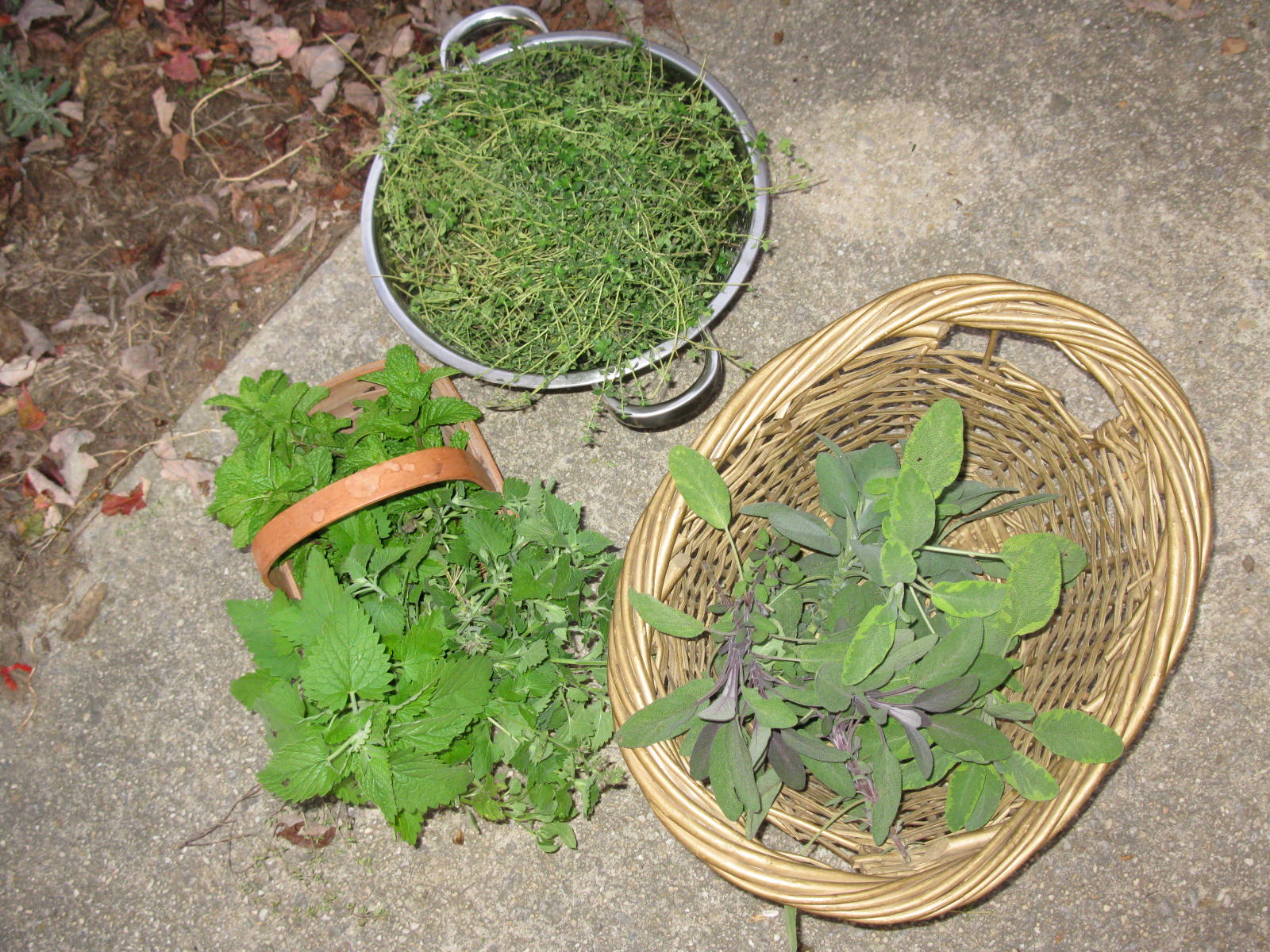
At home, I snipped a harvest of herbs, bringing them in as the sun slid behind the woods which mark our western boundary.
Years ago I dried herbs by the time-honored method of hanging them from a nail [or a curtain rod] in the kitchen. I always felt they gathered dust--and a cat hair or two--before I cut them down and crumbled them from the stems.  Last year I placed them on trays and slid them into the oven set to its lowest heat.
Tonight, using that method,  I have dried thyme, sage, spearmint and catnip.
After removing any damaged or yellowed leaves, I rinsed the stalks and whirled them in my salad spinner to remove the moisture, and except for the thyme, pulled the leaves from the main stems and arranged them one layer deep on baking sheets.
I checked the herbs for dryness about every 10 minutes, shuffling them about on the trays.
The catnip dried fast, as did the mint. The heavily textured leaves of sage needed to remain in the oven for more than an hour.  The wiry stems of thyme were fiddley to deal with--I swirled the dried stems around in the bottom of a collander--which allowed the leaves and some of the finer stems to pass through.


As soon as I entered the kitchen with the basket of catnip I was mobbed by felines.
Teasel's performance last year was a reminder that it isn't wise to leave
a tray of catnip unguarded, even for a moment! 

I bought tiny zip-lock plastic bags at the bulk foods store so I can make up packets of herbs
to share with family and friends.
I have more sage to dry as well as marjoram, apple mint and lemon balm---pleasant harvest tasks after the messier and more intensive labor of canning tomatoes and applesauce.

Monday, November 1, 2010

The Demands of a Bountiful Harvest [Or Why I Don't Answer E-mails!]

Some of the windfall pears, gathered prior to the wind and rain of October 26th.
J. carried them into the basement where they exuded an increasingly fruity scent.
We tackled them as a team, with J. peeling and coring while I made two large kettles of  light sugar syrup, [frequently replenished] simmered the pears and ladeled them into jars ready for the water bath canner.
Whenever I had the canner filled and boiling away I turned to peeling pears.
The path between table, sink and stove became a sticky route.

J. took a ladder down, secured it somehow on the back of the truck and carefully hand-picked some of the largest pears to save for eating fresh.
I have absolutely no head for climbing and decided I didn't care to watch him clambering about in the branches.

We bottled 30 quarts this round.
Since this is my blog I'm allowed to whine a bit and tell you that my
feet hurt for hours after this marathon effort!
Mr. Rogers who lived here before us, told us that he made "pear honey" from the windfall pears.
His method was to put ripe pears through a sausage grinder, cook them down over low heat, adding water as needed to keep them from sticking.
He admitted to "a little sugar" as well.
I found several recipes on-line which, typically,
demanded the addition of more ingredients: vinegar or lemon juice,
powdered pectin, pineapple juice, ginger.
After reading several I decided to experiment.
I peeled and cored pears, put them through my hand-cranked food grinder and measured out 8 cups.
I added 1 cup of pineapple juice, since I felt this would help preserve a natural color.
Most recipes called for equal amounts of  chopped pears and sugar, which I was sure would create a too-sweet product.
I added roughly half that amount.
I let the mixture stew over very low heat for about two hours, occasionally stirring with a wooden spoon, then bottled it in pint jars.
I didn't take photos, although the filled and processed jars are still sitting on the counter.
I think the "honey" will be good on toasted home made bread or baking-powder biscuits or scones.

We cannot be in the vicinity of the pear tree without Pebbles begging for a pear or two.
I wish you could hear the crunching and smacking noises that accompany her enjoyment of her fruity treat.

J. M. Shelley [from whom we bought the place] came last weekend to claim a bucketful of pears--which didn't make a dent in the amount to be used.
He mentioned to J. that there are several black walnut trees on the place, waving a hand rather vaguely at the remains of the old hedgerow.
We walked the boundary line at the wooded back edge of the property and located one of the trees which yielded a 5 gallon pailful of nuts.

Next day I found the second tree not far from the road where J. is finishing the clearing that was started before we bought the place.
I filled these two containers and laboriously carried them across the field and home.
I suspect the nuts are difficult to crack and have been told that the hulls will leave a black stain on anything they touch.

Veggies brought in this morning to go with a small roast of beef.
I chunked the onions, potatoes and carrots around the beef in a glass pan, added thick slices of the sweet potatoes from the Mennonite produce auction and a few cloves of the pickled garlic which our DIL makes.
Olive oil drizzled on the vegs and a sprinkling of herbes de Provence.
A hearty complete meal to pull from the oven when we came in famished from outdoor work.

I am re-reading the "Autumn" entries in a favorite book of seasonal essays, "Hill Song; A Country Journal"
by the late Lee Pennock Huntington.
The Huntingtons restored an old farm house and created gardens on the Rochester side of Brandon Gap in Vermont, moving there in 1970.
These essays were published in 1985..
Here is one I can relate to.

"Every autumn there comes The Harvest Day.  It is unscheduled, arriving when the first serious warnings of "hard frost" persuade us to gather in. This year, as always, it came too early for us.  There was stinging cold rain with intervals of cranky sunlight.  We picked bushels of chard, baskets of beans, the last of the ears of corn. We probed beneath the still-rank leaves for hidden acorn squash.
We took baskets to the orchard, shoes squishing on windfalls, climbed ladders and thrust the long-poled apple-pickers to the high branches.  At dusk we brought it all under cover, some in the shed, some in the back corridor, some in pantry and kitchen.
It seems an overwhelming accumulation.
The squash in their homely shapes and colors from jade to topaz are the least demanding, requiring nothing more for the moment than ranging on benches and tables, but so much else cries out for processing, the sooner the better.
The kitchen is a fine confusion of produce piled on every surface.  All pots and vessels are in service, all stove burners working away as we stay up until midnight doing what can't be post-poned. The freezers are filling rapidly, we are running out of containers and jars.
Thank God the apples can wait."

Tuesday, September 14, 2010

"All Is Safely Gathered In"

J. hooks up to the trailer, ready to pick up the baled hay.

J. has been considering that a bale wagon with a loading chute and stacking mechanism would be a good option for our small hay operation. Ideally it would work as a "one-man" system.
In the time-honored way of the male local "grapevine" he learned that a farmer on the next crossroad had one he would like to sell.
We drove over on Labor Day with the old Dodge, Snort'n Nort'n.  I was prepared with a book to read while the men discussed the possibililties.
The owner was quite willing that J. "try out" the machine and if he liked it then the money could change hands.
All afternoon J. cleaned, greased, tinkered the thing.
Later he hitched to it and began the round of the nearer field.  I noticed frequent stops, bales repositioned, more tinkering.
Eventually the machine was parked and J. came in to announce that some of the mechanisms were not operating smoothly and he suspected that also it was designed to work best with heavier, larger bales than he is producing.
Tuesday was another hot clear day once the morning dew had burned off.
J. with an eye on the extended weather forecast, mowed the front field and was able to have Joseph Yoder's help in the late afternoon to bring in two loads of hay and stack them in the upper barn.

My contribution at such times is to drive the tractor slowly around the field, threading between the rows of bales. When J. and I work alone, I keep watch both sides behind me as J. lopes from one side of the trailer to the other, heaving bales aboard and then climbing up to stack them--a craft in itself, of wedging crosswise and length-wise so that the bales don't topple as the load grows.
When we have Joe to help, one man works each side of the trailer. Without discussion, they spell each other as the stack of bales grows higher--changing off the tasks of one heaving the bales higher with each tier, the other clambering to the top of the load to stack.
As a girl, trailing my grandfather and the neighbor men to the hay field, and again during the years that we ran the dairy farm, I marveled at this unspoken synchronicity--an age-old pattern of harvest where each worker has known since boyhood just where his strength is needed.

J.M . Shelley had this bit of the land bulldozed shortly after he acquired the place at auction last September.  I gather there was a substantial hedgerow of trees and shrubbery.  Whatever the intention, the work was left unfinished when winter froze the ground. This stand of yellow daisy-like flowers has taken over the area. I have not been able to positively identify them from my wildflower book--perhaps coreopsis [tickseed?] 
Chugging along on the tractor I became so caught up in the look of the late sun shining onto the golden flowers, I missesd my cue to halt the tractor while J. and Joseph tended to a cluster of hay bales.
I suspect that Joseph's Amish mind-set may ponder the unsuitability of an aging woman who presumes to drive a tractor.
I do not preseume to bring the tractor and the heavily loaded trailer across the wide drainage ditch and up the slope to the barn!
When J. signals that the load is high enough, I set the hand brake, clamber down and trudge up to the house to fetch a pitcher of ice water or lemonade for the sweating men.

A closer look at the plant in question.
J. and I worked together to get the last of this "second cutting" into the barn on Wednesday.
A run up to the Yoder place at the end of the road saw J. back without Joseph, who according to his wife, had accepted a "landscaping job" for the afternoon [this after his 7 or 8 hour day at a local furniture factory.]
The sky was murky with gathering clouds and a nervous wind aggitated the leaves of the trees.  A strange musty, dank, dead smell hung in the air.
I steered the tractor in slow ponderous rounds, standing to put my full weight against the clutch and brake pedals, halting so that J, could load from both sides of the trailer.
The fidgety hot breeze twitched strands of my hair loose from its clasps and fanned them irritatingly into my face.  Several times we felt drops of rain on our bare arms, but as the last load was trundled slowly to the upper barn, still the storm held off.

On Friday morning, with J. packed and ready to leave on a necessary trip back to Wyoming, the rain began.
It pattered softly in the dooryard trees as he carried belongings to the truck, gave Pebbles her morning grain, gave me last minute cautions and instructions. 
I plodded up to the barn again after he drove out, taking fresh water to fill the kittens' bowls.

Moments later I stood at the edge of the carport, looking up at the orange leaves on the maple, watching them flutter down to rest on the thirsty ground.
There will be warm days, blue-sky afternoons of hot sunshine, but the long sweltering summer is over.

Excerpts from Henry Beston's "Northern Farm."
"It is summer, the season of leaves and grass and the ever-changing fancies of the flowing winds, and all day long there seem a thousand things to do.  Weeds and pests are to be fought, and the hay mows filled against the winter: the bright sunshine and the warmth must be made every use of while they last.  The scissor-clatter sound of mowing machines begins the working day; and the afternoon sun beats down on bare backs, the steely gleam of hay fork tines, and the lifted bundles of hay falling into the old hayracks swaying and rolling over these hillside fields.  Thirsty afternoons, and worthy of the pause by the deep well or the battered enamel cup standing by the spring."

" The week began with two hot and 'muggy' days.  So lifeless was the hazy air that there was scarce enough higher wind to float the woolpack clouds through the dulled heavens, and such a breeze as moved low upon the earth stirred no curtains at the open windows of the farm. A third day began with grey cloud and the same passive air lying almost stagnant upon the heated land, but at noon came a change of the wind, a darkening overhead, and the first small, scattering drops of rain.
Oh blessedness and wonder of the rain!  Not for weeks had we seen such drops, and with their appearance the long tension of a dry spell broke like a thin globe of imaginary glass.  Calling and replying to each other across the rain-pitted water, loons began their quaverings and trills: they always have something to say when rain begins. Then to the senses came that first country smell of wet earth and rain, and this was presently followed by a cool breath of air moving with the rain along the fields and fragrant with a faint, cool smell of grass.  A moment later a neighbor's cat slunk past me in the garden, and took shelter under the barn."