Showing posts with label gardening. Show all posts

Thursday, June 20, 2013

Flowers for Mid-Summer

We have had rain showers, mostly at night or early morning, nearly each day since the weekend.
My white tree lilies began to open as the huge orange ones faded.

The fragile poppies delight me.
I photograph them quickly as a few hours can spoil their beauty.

Monarda lambada.
I grew this from seed our first summer in Kentucky. The plants reappear each season in slightly altered groupings.

Elderflower.
So lovely and so quickly over.

The elderberry bush near the clothesline.

One of the few deeper hued poppies.

Achillea raised from seed in 2012.

Shasta daisy, also from seed, in its first season of bloom.

My seed-raised clumps of coneflower are a joy, sturdy and vivid.


Another seed-grown achillea. This opens as a soft yellow, fades to cream and finally an off-white.

This achillea, "Paprika" was puchased at a local nursery. I divided it into two clumps last year.
It is not as vigorous a spreader as some.

Trumpet vine runs rampant.  This one grows from a thick trunk and reaches to embrace a nearby crabapple.
 In spite of the cheerful note of color it adds to the dooryard, trumpet vine has to be restrained.
In this zone 6 climate, it romps over everything, stretching out ever more tendrils.

Two shades of pink achillea in the shadow of the elder bush.
The elderflowers have rained tiny white petals onto the ferny foliage.

This is a fine season for the hydrangeas at the west side of the house.
Last year frost blighted the emerging buds and we had no flowers.


This blossom has a hint of lavender.

Two leaning stalks of yucca have blossomed this week in the shade near the carport.

A view of the unidentified vine which has twirled its way up the yucca stalk.
The above photos were taken during the past few days.
A 10 minute torrent of rain and whipping winds this afternoon has altered the garden landscape.

View from the carport toward the backyard during the fury of the brief storm.

The heavy rain and wind which rode in from the north, knocked over our two rows of sweet corn.
As soon as the rain quit, I hauled on my boots at J.'s request and we slogged to the upper garden.
Gathering the wet stalks in bunches I held them upright while J. used a hoe to pull the muddy loam around the roots, mounding it at the base of the plants to firm the stalks into a standing position.
Melon plants sprawled in pools of muddy water.
I was glad we had picked berries early this morning.
In the lower garden strips, squash vines, potato plants and my stalwart rows of sunflowers had been thrashed about.
I attempted to shore up leaning stems of cosmos, but the mud was too slippery.
I will go out tomorrow with the hoe [providing there is no more rain tonight] and resettle the cosmos, pull a bit more soil around the sunflower stalks.
The yuccas by the carport are keeled over, a sunflower which seeded itself at the edge of the front porch was snapped off at the base; clumps of achillea have been whipped and hang heavy with water.
It doesn't rate as anything like loss or devastation--merely some minor messes to tidy up when the storm front is safely passed.

Thursday, September 22, 2011

Autumnal Equinox

J. and I decided on Monday to drive to the next county to an apple orchard we had seen advertised.
It was an old orchard, family owned, and located on a spur of road off the main highway.
We had expected to pick our own apples--a prospect which lost its appeal as a chilly drizzle turned to bursts of hard rain.
The elderly proprietor of the orchard had several bins of ready picked apples in his sales shed and we opted to take a bushel of Red Delicious and a half bushel of Winesaps.
Our second destination was the Mennonite produce auction.  We were early [not having to pick our apples] so went up the road a mile or so to the bulk foods store for whole wheat flour and a few items to stock my baking supply cupboard.
Produce was being arranged on pallets on the auction floor when we returned.  Some of it is brought in from away, but as we watched, several local Mennonite farmers arrived in buggies, bringing small amounts of their home grown produce.
I was intrigued to note that one fellow came clanking down the road on his iron-wheeled tractor, a huge umbrella fixed in place to shelter him from the drizzle.
His wife huddled on the trailer, seated amidst crates of squash and pumpkins.  She wore a zipped sweatshirt with her sprigged calico dress and apron and had a headscarf over her requisite white cap---but
 she had no umbrella!
The flowers were sold first--mostly ranks of mums in every possible color.  I liked the flats of pansies with their rain-dampened faces.

A gnarled and bent old fellow with a leathery face wheeled in several dozen of these potted mums. They were lovely in their full-blown state, but wouldn't 'hold' long if bought for resale.

Peppers have been an abundant crop this year.  These red ones stood out on such a gloomy day. 

Most of the produce in this aisle went in lots--the highest bidder being allowed to declare how many boxes he wished to purchase.
I had J. buy me a single box of sweet banana peppers.

J. likes the pickled sweet peppers in sandwiches and I have bought them before ready made.
It was tedious removing the seeds and slicing these, but once that was done it was quick work to bottle and process them in brine.

This stand of tall Michaelmas daisies must have been planted years ago.
They fill the space between the old grape arbor and the clothesline.
The recent rains have weighted them down.

These are likely one of the many hybrids available.
In the northeast where I grew up, the wildlings along the roadsides are known as New England Asters.
I have noted that in different locations the color can vary from a blue-purple through a clear deep purple.  Traveling through Ohio years ago in September I found asters of a deep dusty pink growing in roadside clumps where the thru-way rolled through farming country.  I'm guessing that the type of soil may alter the coloration within related wild varieties.

Hawkeye Belle.
I wasn't expecting to be so taken with this hardy shrub rose.
It has continued to bloom in spite of heat and drought and invasions of Japanese beetles.
With the return of cool moist weather it is producing a steady show of lightly scented blooms.

Double Red Knock-Out is likewise proving her worth as a landscape rose that takes all weather in stride.
Nearly every local dooryard that has flowers has a hedge or speciman plant of these tough survivors.

Yellow Simplicity has also appreciated the recent rains.
Some of her foliage is looking tatty but the blooms still captivate me.

A red salamander on the rain-wet steps that go out and up from the basement level.
I was on litter box duty and nearly put my foot down on the sally, noticing it at the last moment.

September is my favorite month of the year. Where ever I have lived I have noted the week of the autumnal equinox, stirred to restlessness by the storms of wind and rain which so often accompany this season.
I am Christian in my belief and practice, yet have empathy with those who honor the turning of the seasons from a pagan's perspective.
I grew up in the country, well versed in the folklore of weather and seasons. My father and my Grampa Mac who lived next door were men who knew and noted the harbingers of seasonal change, hoarding the recollected wisdom of other years which informed their predictions of weather to come.

With the hay crop stored and the oats harvested and threshed, Grampa Mac spent sunny autumn afternoons digging potatoes, lifting the onions and spreading them on the newspaper covered porch floor to dry.
The wide door to the dirt floored cellar stood open while the potatoes were trundled to wooden bins in the cooler chamber beyond the wood furnace. Great chunks of maple, beech and elm
[Grampa pronounced it 'ell-um'] were ranked along the walls opposite the squatting furnace.
The big crocks which would once have held a winter supply of sauerkraut or dill pickles or salt pork, stood empty now save for a few spiders.  The few glass jars of currant jelly and ripe cucumber pickles produced by my Uncle Bill lined the wooden shelves of the small first floor entry to the cellar just above the
 crooked wooden staircase. 
I loved the nose-crinkling reek of the place--packed earth, the homely smell of potatoes and onions, the slightly sour tang of the firewood. It was a small-scale labyrinth of damp rock walls which jutted unevenly, of beams and the furnace duct work to bump the heads of those adults who forgot to bend low.

Grampa Mac grew pumpkins in the field corn rows which had to be harvested by hand before the corn could be cut and chopped for silage.  These were laid tenderly on horse blankets in the bed of the horse-drawn wagon which was left parked near the porch until Grampa had time to sort the pumpkins and take them down to the cellar shelves. He kept seed of winter squash [Hubbards] from year to year, throwing some each spring onto the richness of the horse manure pile, sowing a handful in hills at the bottom of the vegetable garden.  Over the years the squash plants had "crossed" and we never knew whether the squash rinds would be deep orange, blue grey or dark green, whether their skins would be warted or smooth. If a squash when baked proved to particularly 'meaty' and sweet the seeds were set  in an old tin in the warming cupboard of the wood kitchen range, to be saved when dry in a carefully labeled screw-top jar.

Autumn sobers me with rainy days that seep into the early twilight of a chilly night.  Autumn exhilerates with afternoons of such golden light and warmth that to stay indoors is unthinkable.
Delicate woodland flowers and the blowsy heady-scented blooms of the summer perennial border
have given way to the astringency of Michalemas daisies and goldenrod,
 the tannin of wet oak leaves, and the rich scents of ripeness which stops short of decay.

Misty mornings are tinged with wood smoke, a fire more to comfort than a necessity.  In New England we watched the sky, listened anxiously to the weather reports especially as the September moon waxed full.  Many a September twilight found me tucking old sheets and towels and tattered grain sacks around tomato plants and tender herbs hoping to extend the harvest for another few weeks.
Here in Kentucky I am wary, not yet well acquainted with warmer seasons, but alert to protect my fall plantings of vegetables.
If I could have my way, where-ever I have lived, the joys and the harvest labors of September would be extended, shrinking winter to a mere month or two of cold and darkness.
As it is, each of these fleeting autumn days is savored to the full, stored in memory like the apples and the squash and the bins of potatoes are stored in the cellar, to be taken out as sustanence during the weeks when the earth and my garden sleep.


Sunday, September 18, 2011

Autumn Afternoons

The rains which moved through early in September left our summer-parched world greening and refreshed.  The grass which had been shriveled and brown sprang back to exuberant life.
Grandson D. volunteered to mow the lawn the day before J. was due to return from his Wyoming stay.
I left the over-due book keeping which has so vexed me and quickly used a boxed mix to bake a pan of brownies, timed to be ready for D. when the mowing and raking were finished.
Energized by chocolate and sugar, D. looked about for another task.
The sun was beautifully warm--not hot, and the dooryard smelt sweetly of freshly cut grass.
I eyed the makeshift trellis standing lop-sided against the bricked wall of the porch storage cupboard.
It was contrived by Mr. Rogers, the former resident, a rather splendid example in its day of making do.
Several metal posts were jammed into the ground and chicken wire had been lashed in place with a variety of ties to support two clematis vines--and rather oddly--a grapevine.
The grapevine had clambered up into the porch eaves, wrapped itself about the nandina shrubs, trailed across the clematis, threatening to throttle everything in sight.
D. and I yanked out much of it in late July--which didn't do anything good for the chicken wire support.
During the drought weeks the clematis vines  shriveled after producing seed pods.
I removed the flat stones at the base of the trellis and D. began yanking on the metal posts--which obliged by bending instead of coming straight out!

After considerable effort to remove the old support, D. fetched a post hole digger and began preparing a place to set in the sleek new black trellis which M. bought for me at auction in the spring.
We found that the stump of the grapevine had to be wrenched out to allow room to set the new trellis.
I suspect that in the process we damaged some of the clematis roots.
In the spring there was a tangle of flowering vine as well as seedlings that had sprouted and never been tied into the chicken wire frame.
I can only hope we'll have new seedlings come spring which can be properly trained.

I pulled off the rusty chicken wire with its clinging bits of dried vine and seed heads, and bundled it out of the way on the grass.
Willis, helpful cat that he is, immediately came to investigate and wormed his way inside the heap of wire.

We have noted that Willis's tweedy coat provides him with excellent camouflage.
As he trails us around the yard and garden he manages to disappear and reappear rather like Alice's Cheshire Cat.
Early twilight was falling by the time the new trellis was carefully leveled and fresh dirt compacted around the legs. I gathered up the old wire, collected tools, while D. trundled the wheelbarrow to the garage.
"Meme," he shouted, "Look at this!"
Peering into the gloom of the garage I didn't at first see where he pointed.
There it was--a mantis.
This is one of the best of the photos which D. took.

On his return J. immediately expressed a wish for apple pie.
I didn't get to making pie on Thursday, but began to assemble ingredients on Friday afternoon after J. D. and I did errands in town.
"Shall I run home and get dad's apple peeler?" suggested D.
I remembered suddenly that I own one--even knew where it was!
This is a lovely gadget which can be used to peel and core apples and set to slice them as well.
The depth of the peel is even adjustable.

The peeled and cored apples sometimes need a bit of trimming--the device being designed with a perfectly symetrical fruit in mind.
J. trimmed while D. ran the peeler and I rolled pastry.
D. sampled a long swirl of peel.
They were still happily churning out sliced apples when I ran out of pastry.
D. decided that the extra apples could be heaped into his pie!

Not hard to see which pie D.planned to take home!
Pebbles was delighted to have a tea-time treat of apple peels and cores which disappeared
 in several greedy gulps.

Willis, who has a distinct preference for male company spawls with D. on the sun-warmed drive.

Who knows whether this venture onto the garage roof was D.'s idea or the
inspiration of the brilliant Willis.
D. came inside for the camera while I was washing up the pie-making dishes.

Willis parades across the woodshed roof.

Safely on the ground Willis prowls through the rough grass at the edge of Mr. Rogers' old rasied bed.
Does he wonder at the disappearance of the sunflowers which grew there in the summer?
I suspect he is simply content to busybody and oversee all that takes place on a sunny autumn afternoon!


Friday, July 8, 2011

Gardening Rants and Raves

If you look closely you may notice the brown foliage on some of the tomatoes.  I'm not sure if we have "wilt", "blight" or maybe both!  What I do know is that for the second year, the quality of tomatoes is not what it should be. 

The angel wing begonias had recuperated nicely from their winter slump, which included being eaten as "salad" by Charlie cat and his tribe.
Gina and I put them on the front porch which faces east.  J. moved them near the edge while sweeping the porch and I thought they would be fine. An early morning rain was followed by sun and the leaves, where still
damp, were scalded.

Matt bellowed from the porch for me to look at this thing: a tomato horn worm with strange 'growths" covering it.
An internet search provided the following:
Timothy J. Gibb, Insect Diagnostician, Dept. of Entomology, Purdue University

Finding a large green tomato hornworm caterpillar on your tomato plant is never a good sign – unless, that is, it has small white capsules attached all over its back. The white capsules on its back, frequently mistaken for "hornworm eggs" are actually the pupal stage of a tiny wasp called a Braconid. As Braconid larvae, these wasps fed on the insides of this hornworm and have now completed that feeding and are preparing to emerge as tiny wasps. Under such circumstances, the hornworm caterpillar might be capable of slow sluggish movement but is incapable of further feeding and will die very shortly. In the meantime it serves a very valuable function as a nursery for these wasps. When they emerge, the adult wasps will fly off to hunt for other hornworms to parasitize. So, if you leave the parasitized hornworm in place and allow the parasites to emerge, you are in effect killing many other hornworms in the vicinity.


The Charles Albanel rugosa is still not as thrifty as it should be, but it is alive and flowering.
The roses must be enjoyed early in the day--by noon the Japanese beetles have renewed their attacks.

Earlier, tiny green caterpillars damaged the leaves of the hibiscus.  J. sprayed the shrub with Sevin which left it looking a bit mottled and ragged.
The first of the pink blooms opened this week--lovely in spite of the less than handsome foliage.

The first of the sunflowers in bud.  That center has such a design appeal.

The magnolia is blooming. The scent floats on the heavy humid air.

A gaudy zinnia, self-sown from last season.

The cucumbers are doing too well!
We eat them, we give them away.
I have made 11 1/2 quarts of pickles using my friend Claire's recipe.
There are more cukes cooling in the fridge. more on the kitchen counter.
And I am too tired to start another batch of pickles!

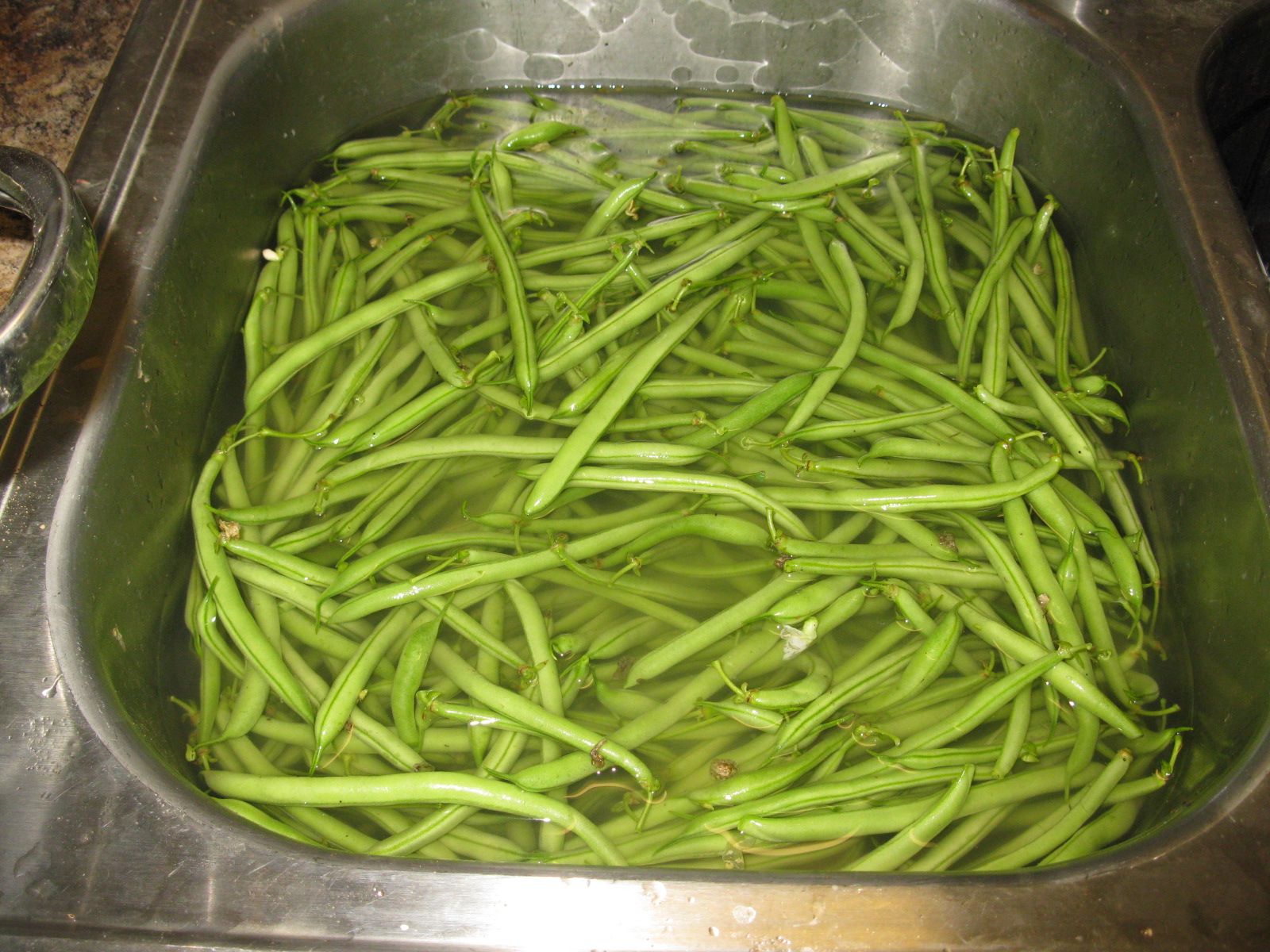
The green beans needed picking yesterday.  I stood at the sink, rinsing, then snipping tails and stem ends.
I sat at the diningroom table to break the beans [as they say in Kentucky!]
then into the pressure canner, 7 quarts.
The ktichen was steamy and cluttered.
I think about next winter when the beans will be appreciated.
I pulled up zuchinni plants which had been invaded by vine borers--nasty creatures, and invisible til the damage is done.
I admired the fat stripey watermelons ripening on the strong green runners.
Just now, for these hot weeks of high summer, the garden, with its triumphs and failures, rules the household.