Tuesday, July 26, 2022

July Heat


More rain in bursts throughout the day; during a lull this evening I stepped out into air so steamy that the lens of my camera fogged and had to be wiped between each photo.
79 F. at 8:30 p.m.--which is 20 degrees less than most evenings last week.


My hedge of sunflowers has held up well to frequent rain. The earliest blooms have set seeds and the goldfinches are beginning to find them.


A close-up taken during an hour of sunshine. Sunflowers charm me in every stage of their development: from tight buds through unfolding petals, then the ragged fringe around the ripening seed heads.


Rain has inspired the hybrid Jane magnolias to fresh bloom. Their spring blossoms were devastated by a late frost and snow. 


Up close only a few of the flowers are at their fresh best. 


The front door planters became stressed and shabby in spite of nightly watering during June. Several of them have perked up with the frequent rains. 
The dainty signet marigolds were languishing in the green house until I potted them on and brought them outside last week.


Our first planting of green beans was a flop--only three plants germinated and grew in a long row.
I've now picked twice from the second planting of Roma beans. Rosie offers to help with snipping and cutting. 
My cats have always attacked fresh green beans, snatching them from baskets or buckets, gnawing on them, skittering them around the room. 


During the second week of July there was a run of days in the mid 70's F. 
I was able to work on the back wildflower garden, digging above this area to create space for transplanting volunteer seedlings. I moved some coneflowers, a few of the blackberry lilies before the weather heated up again.
I discovered several struggling plants of white phlox in the rough strip along the drive and moved them to the large raised container that serves as a nursery area. 
When temperatures climb into the 90's F. I can't stay outside. Weeds have burgeoned in the recent heat and humidity.

Blight has overtaken the early tomatoes, but the second planting of cucumbers has produced long smooth-skinned cukes lacking the bitter taste of the ones that ripened earlier in dry weather. 
We suddenly had a small glut of green peppers which have been diced and frozen. 
Peaches from the Carolinas available through our Beachy Amish neighbors, along with their fresh sweet corn. Jim has dug several buckets of red potatoes to share with the family. I boil a kettle full of them, skins on. We eat them hot, then use the leftovers to make home fries for a late breakfast on the next few mornings. 
I spend many hours reading when heat and humidity keep me indoors.
I've reread a favorite series of old books after acquiring three that continued the saga, though written years after the first six were published. 
Last night I finished reading a memoir of life on an island off the Maine coast during the early decades of the 1900's. 

Nostalgia has overtaken me at times this month. A lovely home where I spent much time as a girl--a mile to the west of my own home--has gone on the market after a decade of empty neglect. The listing photos show ceilings damaged by a leaking roof, familiar antique furniture shoved out of place, barns empty, paint peeling. It was a grand place in its day, made warm and welcoming by the family who lived and worked there. It was a family, who as Grampa Mac would say, 'died out,' the son a casualty of WWII. 
A good friend of my girlhood is in our mutual hometown on family matters; as she travels about she shares photos of the back roads, the old houses, places once so familiar.

The first house we built and lived in during our Wyoming years has recently changed hands. My 
SIL sent the listing link. The interim owners didn't change my paint scheme, the kitchen is the same. I recall how I loved the living room alcove with the double windows looking toward the Wind River Mountains.  The look of a room, a dooryard, a landscape, bringing a rush of recollections--scenes that shift like the particles of colored glass in a kaleidoscope, captioned collages of time and emotion.

Changes come--of course they must! We absorb them with our heads--not so quickly with our hearts!




Friday, July 8, 2022

Rain Came Down


After weeks of being teased with the promise of showers which never arrived it was almost startling to hear rain beginning to drum on the roof late on Thursday afternoon.  It was not a gentle rainfall. Wind rushed in from the southwest, driving the rain in sheets, lashing leaves from trees, 


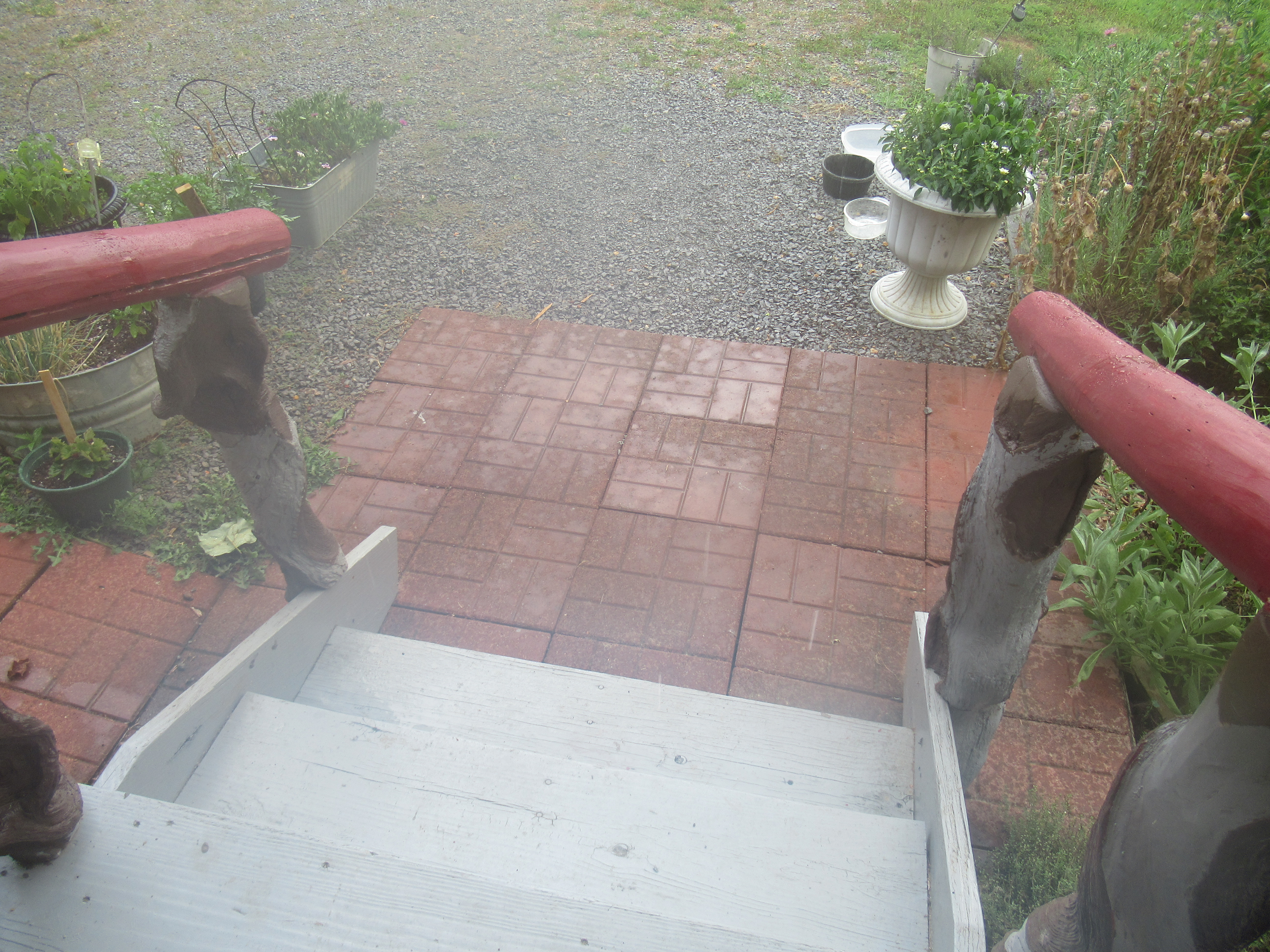
The front steps glistened with wet; The porch roof provided little shelter when I stepped out with my camera. Horizontal rain!
The dishes alongside the white planter, used nightly to feed stray cats and raccoons, were quickly filled to overflowing.
Thunder rattled sending the house cats to hide in the rooms on the lower level.
The internet went out.
At the height of the storm I spent a few minutes on the screened east porch.
Hummingbird feeders hang under the wide eaves. As I stood there listening to the din of rain on the roof, two hummingbirds appeared. They hovered just beyond the sluicing sheets of rainwater, moving forward, then backing off, approaching the feeders again and again, only to be daunted by the pelting rain.

When the first heavy deluge was over, showers fell intermittently through the night.


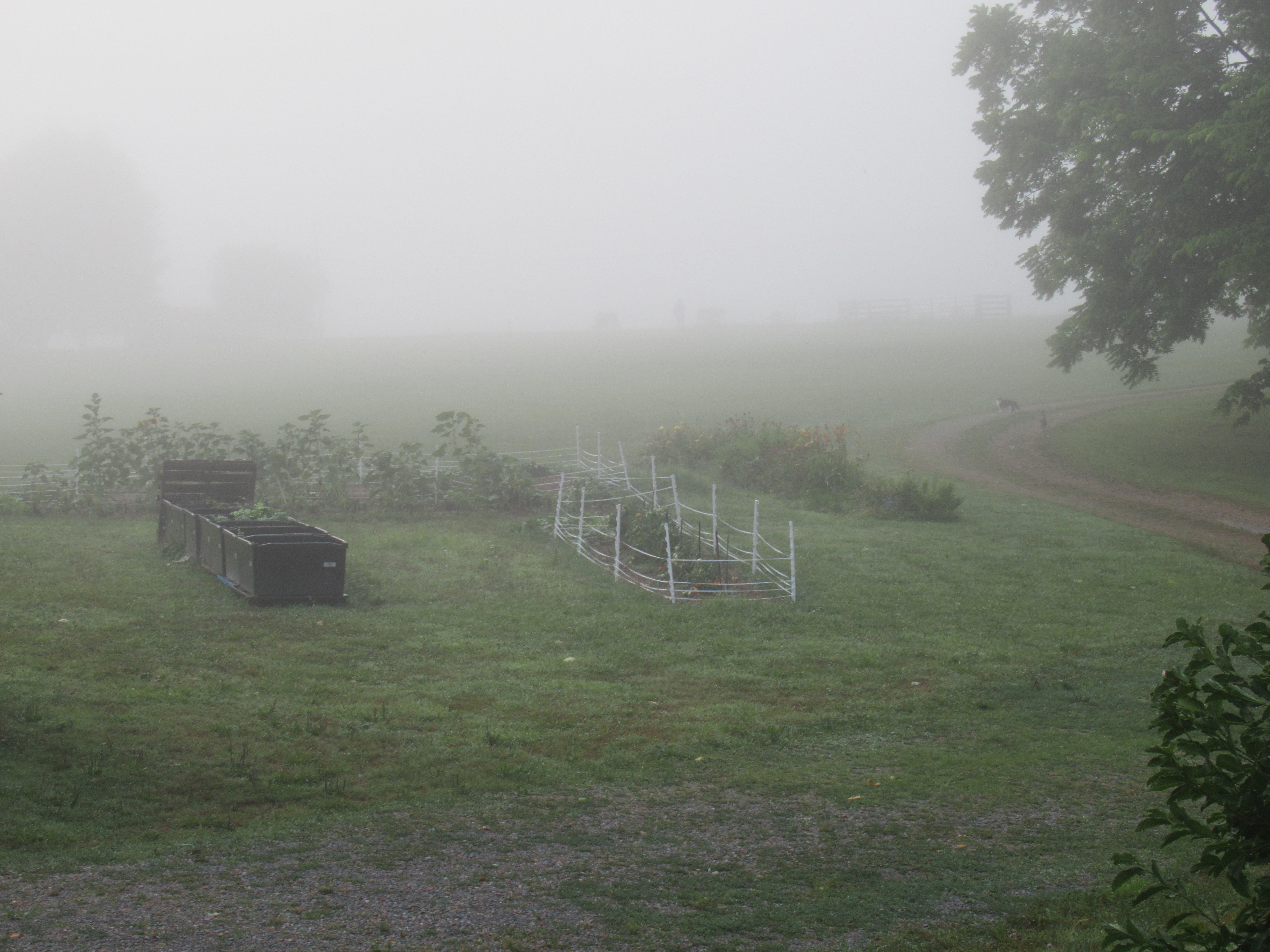
I awoke at 6 a.m. this morning to dense fog. My bedroom window was open and the essence of the fog, grey and chilly, seemed to have seeped into my bones. The east porch was damp and unwelcoming, but the hummingbirds were making their usual whirring dives at the feeders.


I pulled on my wellies, rolling the cuffs of my jeans high, and went out, camera in hand to see what the wind and rain had left.
Coneflowers have seeded randomly in the east wall border; I've left them where they sprang up, including this clump too near the edge of the wall, toppled by the wind.


These coneflowers have been flattened across the nepeta.


In the west garden wildflower strips the delicate spindles of cosmos have been dashed to the ground.


  Double Knock-out roses have put out tentative new shoots since my severe pruning last month. Every leaf and thorn was spangled with raindrops; A dainty spiders web clung in tatters to the outermost branch.


Coneflowers and Monarda in the west wall garden.
The rain will give great encouragement to the weeds which have overtaken the stone-flagged path.
I took out my heavy-tined garden fork and made a few stabs at the earth behind the coneflowers where I plan to add more plants.
There is now depth of moisture to allow digging, but 10 minutes of prodding about while wrapped in a wet blanket of humid air convinced me that this was not a gardening kind of morning.

There have been rain showers moving through, distant thunder, riffles of wind. Sheets and towels pegged on the lines in the ground level covered porch had to be brought in still damp and stuffed in the dryer.
Tonight cooler air has plunged temperatures into the low 70's F. 
The veg garden is an expanse of sodden mud,; my sunflowers cant at unstable angles.
At dusk I dug several hills of Yukon Gold potatoes, rinsed off the clinging earth at the spigot by the greenhouse. 
If the soil dries enough to work by the first of the week, more beets and green beans will be planted in the hope of a late summer harvest.
July--high summer--heat--humidity. 
Sometimes, as now, a few hours when the air is freshly clean, offering revival of plant growth, bringing encouragement after the long drought. 
I shall try not to think of the burgeoning weeds.


Saturday, July 2, 2022

We Pray For Rain!


Our last rainfall, noted on my calendar, was an afternoon shower on 10th June. Heavy rain on 26th and 27th May shattered roses and foxglove, splattered muddy soil onto tomato plants.
For more than two weeks Jim has watered the garden each evening. I carry water to planters near the front steps; rosemarys  summering on the east porch are watered each morning.


Nearly every afternoon the sky is overlaid with grey clouds, a hot restless wind stirs the trees that rim the north and south ravines. The weather ribbon that runs across the bottom of my PC screen declares "Rain Coming"--but it doesn't. 
There was a brief moment last week when the wind carried a scent of rain--an elusive promise never fulfilled. By mid-afternoon the sun strikes the back porch, beating in hotly from the south-west. Laundry pegged out earlier stiffens in the heat.


The west wall garden has to survive on its own without supplemental moisture once plants are established. The soil is shallow there; in the right foreground of the photo you can see that the blue prairie sage , not yet in bloom, is starting to wilt at the tips.


During lunch today I glanced through the little window at the top of the front door--and noted a flash of color in the sunflower row.


The back of a sunflower is nearly as intriguing as its face.
Some of my sunflowers are from saved seed; last August goldfinches descended on the flower heads as soon as seed began to ripen and there was only a little left for me to glean.
I picked up several packets of novelty sunflowers from an inexpensive line of seeds; each season I try for a few that are a bit different hoping that I can salvage seed for another summer.


New England asters started from seed last year. This color surprised me. If you look closely you can spot the more conventional purple behind them. I suspect that our hot dry weather has forced them into bloom ahead of time.


This front bed needs to be over hauled. The asters and other prairie wildflowers are too tall and lanky for this shallow raised bed--they flop forward and overwhelm plants at the edge. 
My plans for extending the west garden as well as moving plants from this space are on hold until cooler weather and the end of the drought. 


A flock of eight guineas appeared late in January. I first heard their distinctive chatter and saw them near the pond at the end of the lane. They became regular visitors, usually strolling through as a group, sometimes with a few straggling behind.
Often on my way back from the mailbox I saw them trundling across a neighboring field.
In early May I realized they had gone away. I know that guinea fowl refuse to 'stay home' and are prone to disappearing, still I missed them and hoped they hadn't become a meal for foxes or coyotes.


Two weeks ago I heard guineas chattering in a gulley below the pond, but until last week we hadn't seen them. Walking up the lane past the neighbor's cow pasture I noticed a heap of white feathers lying out in the rough grass. Prudently, I didn't climb the gate and prowl amongst the cattle to verify that one of the two white guineas had likely met with disaster.

All this past week three speckled and one white guinea have made their rounds through the dooryard. Today another speckled bird was with the group.
Do we consider that only the five remain of the original eight? 
Jim is watching to make sure they don't show an interest in the ripe tomatoes!


Daylilies and bee balm hold their own against invasive weeds and rough grass in the strip along the drive. Many hours of strenuous digging, many bags of bark mulch, have not deterred hardy native weeds. A few roots of gooseneck loosestrife hastily poked in with the first transplants proved to be a mistake. I regularly yank it out from around the peonies and the three shrub roses, but it thrives on abuse. I moved a clump of dwarf monarda before it was completely engulfed and rescued two phlox. A white coneflower bloomed in the tangle last week and will be somehow tagged so that it can be moved. 

I can no longer garden in day-long marathons, but I can doggedly salvage and tend a few plants at a time--if only we have rain.


Wednesday, June 22, 2022

Heat Wave; Solstice


We hoped for rain this evening. The 'weather ribbon' that runs at the bottom of my screen proclaimed 'rain coming' and then 'rain to stop.' Neither forecast came to pass.
At about 6 p.m. dark clouds billowed to the north and west, there was a faint mutter of thunder, then the sky cleared to a saffron sunset.

8:30 p.m., the air heavily moist and warm.


This is not an accurate coloring of the sky to the east, but makes for a strangely interesting photo.
Our beachy Amish neighbors cut the small field on Monday--a lighter cut than the first one in mid-May.
June has brought scant rain; the gardens are dry.


The glory of roses and foxgloves is several weeks past. The David Austin roses have been pruned, foxglove cut back leaving only shorter stalks to set seed. Bees still hover around the fading blooms.


This strip of my planned back garden was planted May 15th, the mulching accomplished June 5th.
I wanted plants that would self-sow--they have done so, but not tidily. 


Feverfew in bloom is attractive, but scatters seeds prolifically and the new plants pop up in vigorous profusion. Coneflower likewise springs up in thick clumps. I have ruthlessly yanked out feverfew, tried to thin out coneflowers, taking a few small plants into the greenhouse and potting them up--with some vague idea of extending the wildflower planting up the back slope.
Unfortunately I have overwhelmed myself with garden imaginings which I haven't the stamina to complete.


This buddleia [butterfly bush] was labeled as 'dwarf' when I purchased it three years ago. I cut back the towering branches in October, pruned in early spring, and then in a fit of determination to restrain it, pruned again. 


The front wall border is looking shabby in the heat. I lightly pruned the Knock-Out Roses as the blooms faded, hoping to discourage the yearly invasion of Japanese beetles. Thwarted of clustering in the blossoms they quickly reduced leaves to lacy shreds. A dose of Sevin dust and a few days later on June 10th a radical pruning which I hope will keep the wretched beetles under control.


When the roses fade, the daylilies provide color.


If plants enjoy their location they seem to grow out of bounds. The New England asters, blue prairie sage, blackberry lilies--all raised from seed, have leaned out of the east raised bed crowding the achillea and the edging of thyme. It appears that shorter more compact plants would be more suitable for that location. The thought of revamping the area is daunting.


Asters--which would have been late summer bloomers in my native Vermont--are opening too early.
Twelve years of gardening in Kentucky and there are still surprises and challenges. 

It has always interested me that the summer solstice marks the turning point when length of daylight begins almost imperceptibly to diminish, and yet here in the northern hemisphere we are tipped into the full strength of summer's heat.
In these evenings of long twilight I am usually outdoors, watering, putting out food for the feral cats, shooing the racoons off the porch, prowling about in the heat-shimmered dusk.

Jim remembers the several boyhood summers when his family lived in Alaska and the sun hardly went down at night. 
I recall summers in Wyoming where daytime temperatures could soar into 3 digits--a dry scorching heat--and yet the long evenings cooled as the sun sank behind the Wind River mountains and the quilt at the foot of the bed was most welcome by the wee hours. 
The seasons and the weather keep us mindful of our human limitations!


Saturday, May 28, 2022

Nature Journal


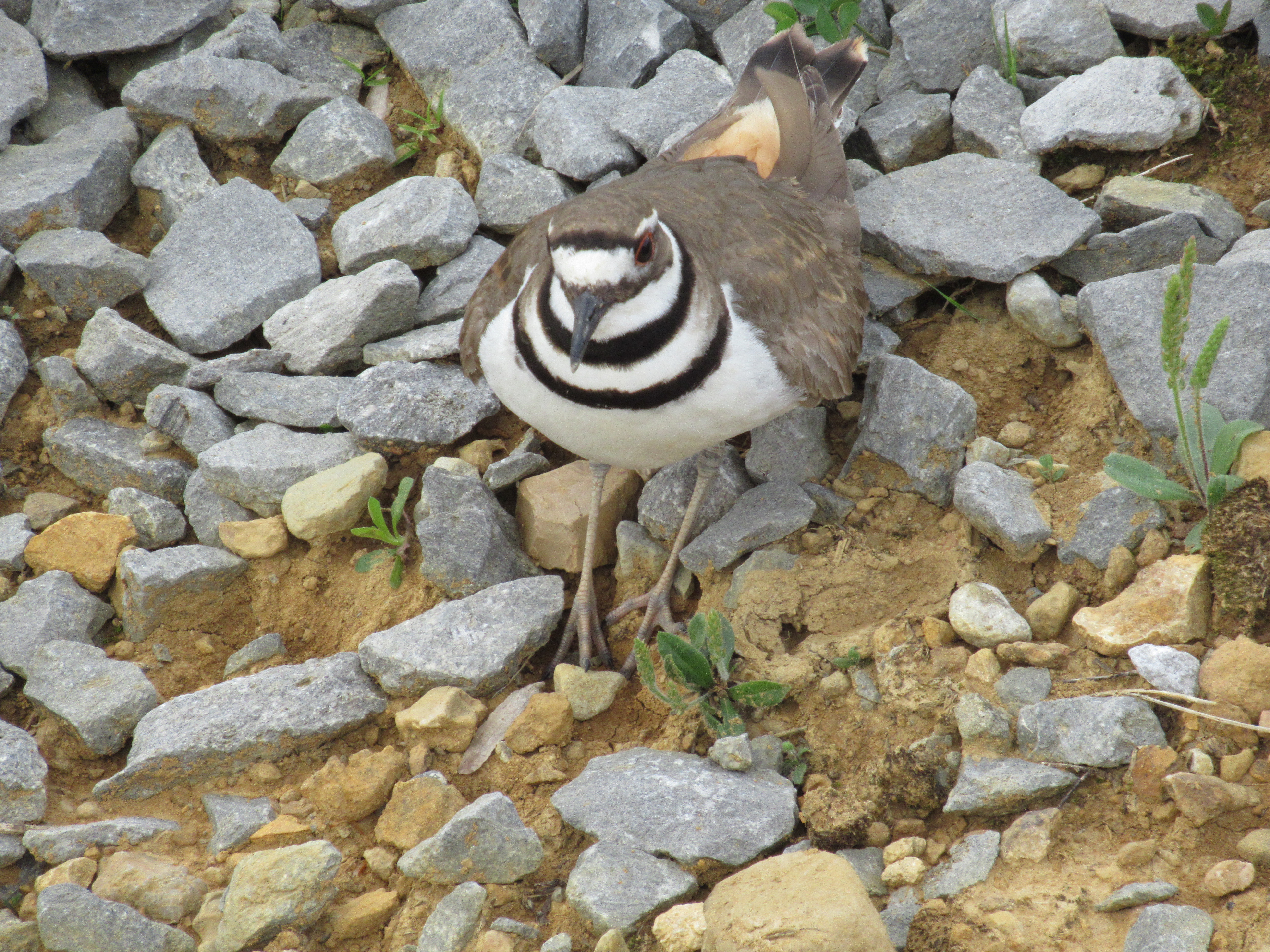
Kildeers are present here through all seasons. They dive low over the pastures and lane, swooping in tight circles, landing a few yards ahead to run in zig-zag patterns, while uttering their distinctive, "Kil-dee, kil-dee.'
In early May on my daily walks out to the mailbox near the road, I noticed one particularly agitated bird alternately flying up from the ground, then dropping to stagger along the graveled lane, squawking loudly. 


I noted a particular fence post opposite as a landmark and  next day carried my camera.
Even knowing where the 'nest' might be, it was difficult to locate the eggs. On an overcast day their mottled coloring blended well with the coarsely crushed rocks which line the sloping ditch above the lane.
I used the camera's zoom for a less than sharp photo, not wanting to risk unwittingly stepping on the eggs or getting too close and sending the mother bird into a panic.

Research online indicates that both kildeer parents incubate the eggs, the female usually taking daytime duties while the male takes over during the night hours. There is a high rate of loss since the eggs are laid directly on the ground where livestock may tread. As soon as their feathers dry the young are able to skitter about and search for food, although they are not able to fly immediately. 


The parent bird is trying to distract me, leading me away from the eggs.


The baby kildeers have hatched and are now running about with the adult birds.
Walking to the mailbox this week I found two feathers lying on the ground several yards apart.
The one on the right is identifiable as a kildeer's wing feather. The feather on the left is not so easily identified. 
I recognize many of the more common birds in the area. We have nesting bluebirds, cardinals, robins; barn swallows are taking advantage of the barn loft, several species of woodpeckers live year around in the trees that line the ravines. Gold finches are very noticeable in late summer when seed heads are ripening on the sunflowers.


Wild turkeys are frequent visitors, strolling through the fields. They are easily spooked and scuttle off, sometimes lumbering into clumsy flight no matter how quietly I slide out the door. 
This photo was taken through a window screen.


Deer often wander across the east meadow or browse in small groups at the western end of the property, melting quietly into the tree line when they realize they have been seen.
We've noticed a doe recently who seemed about to give birth. This morning Jim spotted her in the meadow above the garden, a tiny fawn with her. I eased through the back door and walked quietly around to the barn and along the side 'alley' to stand in the open end. I was able to take only one zoomed photo before the deer was off, baby in tow. When the photo is enlarged you can see that the fawn is attempting to nurse while the doe peers warily over her shoulder in my direction.


The guineas, appearing at the end of February, are not strictly wildlife. They are vagrants with no fixed address. Usually they appeared as a flock of eight, although they have meandered about in smaller groups. Sometimes they have disappeared for several days or less than the whole group comes by. We usually know when they are about--they are noisy and the cats alert us to their presence.
It has now been nearly three weeks since we've seen them.
I've wondered if they would become a nuisance should they stay around as the garden comes on; I can imagine greedy pecking of tomatoes, melons and such.
Still, I hope they are alive and well--somewhere--and they may return.


Squirrels are everywhere. In winter and early spring their untidy nests are visible in the trees along the lane. Once the leaves are out the nests blend in, but sitting quietly on the screened porch I will notice the trembling of a branch and can then follow the progress of a squirrel or several as they leap and bounce from one tree to another. 
This squirrel was harvesting a black walnut that had lain on the ground over the winter. He/she was quite bold, scampering about while I stood near, then whisking up to a comfortable branch and nonchalantly settling in for lunch.
Driving the mile to the Beachy's farm market earlier this week, I slowed to let a squirrel dash in front of my car and was surprised to see that a group of squirrels was cavorting madly about in the short grass just off the roadway. I took note of the spot--a wide swath of green, some shrubs, a  few trees. On the way home I slowed, trying to count the squirrels who were still chasing and tumbling about. I settled on seven, although they were so busy it was difficult to keep an eye on them.


this little bird was apparently thinking of creating a home in the upper reaches of the chimney. Jim decided to burn an accumulation of paper in the woodstove and the bird flew out the door into the room. It flung itself against window panes, swirling up to the ceiling, frantic and elusive. It didn't help that several felines were in fascinated pursuit.
Jim finally caught it as it fluttered against a window. He tossed it from the front steps and it flew away.


This racoon has been making early evening forays, hoping to find a few morsels remaining in the dish that serves the barn cats. Coons have a cuteness that makes them more welcome than opossums, but I'm aware that they can be mischievous. 
Several years ago a huge male coon overturned planters, dug up clematis vines, scrabbled in the raised bed near the door until Howard and I live trapped him and took him for a ride.


We were watching him/her through the window high up in the door. Although momentarily startled when the camera flashed, you can see he continued to pick up the last morsels in the dish.

Deer, racoons, possums, can all be a menace to our gardening efforts. During the remainder of the year most creatures are welcome as interesting transients.