Friday, June 4, 2010

From Tree to Pie

J. churned out 589 bales of hay yesterdy afternoon for JM.
He came home with the word that JM would like us to go over and pick some of the tart cherries from his dwarf tree.
That invitation was repeated today, so when we went to haul the baler home, we went prepared to pick fruit.


The cherries hung like jewels in the dazzle of sunlight.

We picked several quarts and in between poking perennials into the border,
snatching laundry off the line ahead of the rain,
making supper,
I got the cherries pitted.
They looked very appealing in a glass bowl ready for pie making.
I was so sticky by then--literally cherry juice to my elbows---that I didn't take a photo.
The cherries needed a good dose of sugar to make a tart-sweet pie filling.
J. [as usual] hacked into the pie while it was still warm, which reduced its photogenic qualities.
As a bedtime snack, it was surely luscious!

Thursday, June 3, 2010

Progressive Bloom


I was outside this morning at 7 A.M. to wander around with my camera.
During the gardening season, wonderful changes can happen overnight.
I took photos just after 7, again about 9:30 and finally about 10:45 A.M.

The magnolia tree.  A waxy bloom on the shady side of the tree.


The same blossom at 9:30.

This blossom was so fragrant.  Not cloyingly sweet as I had expected, but with a clean lemony scent.

Insects had found the rapidly opening blossom.

Close-up at 10:45.

The slightest touch loosened the stamens.
{Think I have that correct.}

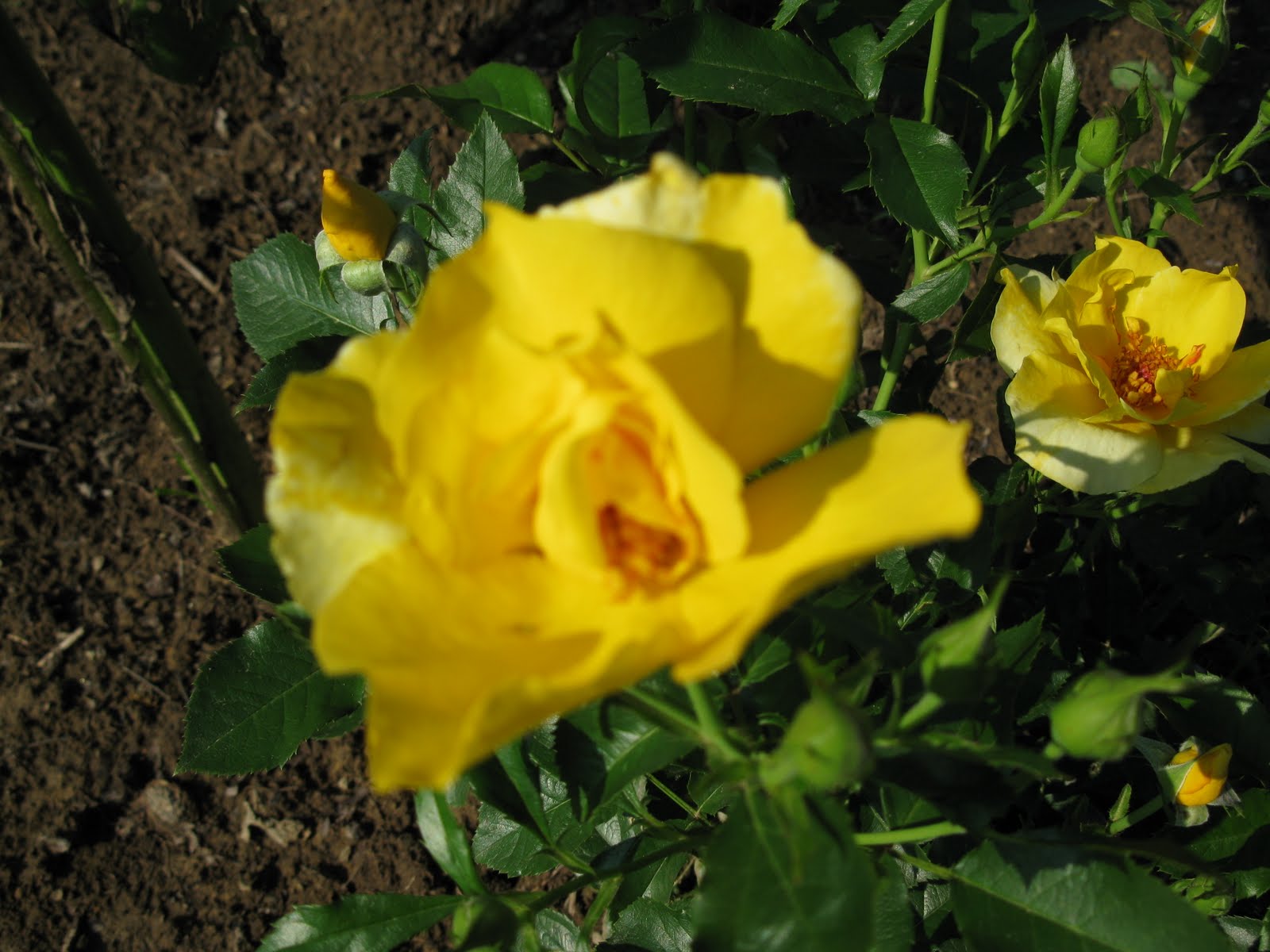
Yellow Simplicity rose in the morning shade of the maples.

Opening to morning sun.
I am really pleased with this rose!

A bloom that has widened its petals to the late morning sunlight.

Close-up. These are very delicately scented.
At about this time the UPS truck arrived with what had better be my last plant order for this season.
I got most of the new plants in the ground before a thunderstorm broke at suppertime.

Wednesday, June 2, 2010

Memorial Day, Part Two

On the left, my Dad and our daughter, preparing to ride his "bicycle built for two" in Orwell's parade in the mid 1970's.
On the far right is our son with his younger cousin, also set to trail up Main Street displaying the "red, white, and blue."

The paths of memory zig-zag through unmapped territory, stopping here, darting there, winding up in some unexpected place.
I had no intentions of composing a post, let alone two, in honor of Memorial Day.  I was inspired to do so after reading Al's blog on May 31st.
Go there to view his photo of red poppies. [Incidentally, he writes fine essays!]

Red poppies.  Of course.  Crepe paper poppies on wire stems, sold along the parade route for a few pennies, tucked in a buttonhole  and worn in remembrance.
My Dad always hustled us through breakfast and out to the car on Memorial Day so that he would be in time to snag a decent parking place  in Brandon where the parade took place.
Our town did not have a 4 year high school and most of our students attended the high school in Brandon about 12 miles away.  A goodly number of those students were outstanding musicians who played in the schools' marching band, so recognizing these teenagers made the parade more our own.

The parade was led by a gentleman in immaculate riding gear astride a beautifully mannered horse.  It was a serious affair--no Shriner clowns, no amusing floats.
Those war veterans who could march, did so--solemn, intent, their faces giving nothing away.
The American Legion and the Women's Auxillary followed, carrying their flags.
Boy Scouts, Girl Scouts--slightly out of step, faces flushed, important.

And there was the high school band. Majorettes in twirling short skirts; the brasses blaring through a Sousa march as the sun glinted off the horns. Woodwinds that trilled and twittered, and always the boom of the bass drum and the rattle of the snares marking the cadence.

I marched with that band in my turn, tootling away.  The uniforms were the same as the ones on view when I was a mere child on the sidelines. Wool.  All wool. Skirts or trousers of grey wool, worn with a long-sleeved white shirt, bobby sox and "white bucks." Topped with a wool cape and a stiff military-style cap. They were hot and scratchy.

As thrilling as the Brandon parade might be, it was always the hometown ceremony, held in late afternoon on the village green, which touched my heart.
I was in the grade school band there for a number of years.  No uniforms, no marching. 
We packed into the bandstand, or if it should rain, onto the dusty stage of the town hall to play our little repetoire.  Sometimes our bandmaster imported his own kids--brilliant musicians--to bolster our numbers.
The yearly duty of sounding taps was assigned to the best trumpeter we could muster.
How I agonized as he or she strained for that top note.

The highlight of our towns's ceremony came near the end when Mr. Glenn Bishop stepped to the front to read the honor role.
Mr. Bishop had a resonant deep voice [the only bass in the church choir!] and he gave full and respectful weight to each name, starting with those from our town who had served in the Revolutionary War.
I waited, ears tuned to hear the name of my great uncle Lawrence, a casualty World War I.

I like to think still of Memorial Day as it was observed in years gone by--without the contrivance of four-day weekends.  It was a time when folks were not ashamed to feel patriotic, a day when flags hung from white front porches, a time when real flowers were laid on graves old--or more recent.
It was a good time to be a young person growing up in a small town.

Monday, May 31, 2010

Memorial Day

Photo by Cathy Alger
Memorial Day 2008
Orwell, Vermont
My Dad was the honored Grand Marshall

Surely it must have rained on Memorial Day at times during my childhood. I don't recall that a shower or a deluge ever threatened to cancel the parade, or that the Memorial Day "exercises" at school were carried out under a sullen cloud.
Memorial Day as it was observed in the 1950's was one of the two holidays for which a school "program" was planned, practiced for, and produced for the edification of parents and neighbors. [The other holiday was Christmas.]
Every grade school teacher of the time cherished back issues of a magazine which held a storehouse of plays, pageants, drills and recitations for any season of the year.
Poems were assigned according to the memorization capacity of the dozen or so children attending a one room rural school in any given year.
In the school I attended for the first six years, the available candidates for public speaking was narrowed by the fact that half the students were from one large French Canadian family, all in various stages of struggling to learn the English language.
Using fluent English was difficult for them, but they could learn "flag drills."

I wonder now how on earth the formations of a flag drill could have been written out or illustrated.
I recall that we were lined up according to ascending heights, marched left and right, dividing and intersecting, a few moves added and practiced each day.  Our feet thumped on the old wooden floor, we were admonished to keep in straight lines, to set our feet down squarely, not toeing in or out.
Eventually we learned to do the drill with the music of a scratchy victrola record and ultimately, when the teacher no longer had to watch us and bark out the measures, she played a vigorous marching tune on the old pump organ. Not til a day or two before the "program" did we get to carry the small limp American flags mounted on thin wooden dowels.

Memorization came easily to me then. My mother had been a rural school teacher herself before taking some years off to raise her daughters. I was allowed to take a copy of my "piece" home to practice, to chant as I helped dry the supper dishes. From my mother I had learned early on to stand up straight and still, to read aloud or recite clearly and [so important!] "with expression."

I was in 6th grade the spring that I undertook to learn "The Blue and The Gray."
I knew in some vague way that the poem referred to the dead of the American War Between the States, The Civil War, it was called in our history books.
I had no idea at the time that England, France, Europe, had been wracked by civil wars as well.
I had no concept of "battle-blood gory"  nor yet of the anguish of conflicting loyalties which could persuade the division of states, of families, of a whole country.

I knew that filling baskets with branches of sweet-smelling lilac, watching while the biggest boys moved desks and tables to create a "stage" and a sitting area for our parents was a welcome diversion from the usual arithmetic class.
I knew that those of us who lived near the school would go home at lunch time and return for the afternoon's program.  I delighted in the fact that I would wear my Sunday best summer dress with its starched bell of a skirt on a weekday.

Some of the words of the poem created mind pictures well within my grasp. I knew about "morning sun-rays" and spent my summers wandering "forests and fields."
I regularly experienced the "cooling drip of the rain."

I stood in my pretty pastel dress with my hair brushed smooth and "spoke my piece" flawlessly,  unwittingly, with no concept that the poem's references must have wrenched at the hearts of any listeners, those who had served in the most recent war, who had bitter memory of "the ranks of the dead," or those who had lost a father, a brother, a sweetheart or a husband.

I can no longer recite the poem.
A few lines floated to the surface of my mind yesterday as I weeded down the long row of stringbeans, enough words so that I could readily search it out.
It is copied below.

The Blue and the Gray
By Francis Miles Finch
By the flow of the inland river,

Whence the fleets of iron have fled,

Where the blades of the grave-grass quiver,

Asleep are the ranks of the dead:

Under the sod and the dew,

Waiting the judgment-day;

Under the one, the Blue,

Under the other, the Gray.


These in the robings of glory,

Those in the gloom of defeat,

All with the battle-blood gory,

In the dusk of eternity meet:

Under the sod and the dew,

Waiting the judgment-day;

Under the laurel, the Blue,

Under the willow, the Gray.


From the silence of sorrowful hours

The desolate mourners go,

Lovingly laden with flowers

A like for the friend and the foe:

Under the sod and the dew,

Waiting the judgment-day;

Under the roses, the Blue,

Under the lilies, the Gray.


So with an equal splendor,

The morning sun-rays fall,

With a touch impartially tender,

On the blossoms blooming for all:

Under the sod and the dew,

Waiting the judgment-day;

Broidered with gold, the Blue,

Mellowed with gold, the Gray.


So, when the summer calleth,

On forest and field of grain,

With an equal murmur falleth

The cooling drip of the rain:

Under the sod and the dew,

Waiting the judgment-day;

Wet with the rain, the Blue,

Wet with the rain, the Gray.


Sadly, but not with upbraiding,

The generous deed was done,

In the storm of the years that are fading

No braver battle was won:

Under the sod and the dew,

Waiting the judgment-day;

Under the blossoms, the Blue,

Under the garlands, the Gray.


No more shall the war cry sever,

Or the winding rivers be red;

They banish our anger forever

When they laurel the graves of our dead!

Under the sod and the dew,

Waiting the judgment-day;

Love and tears for the Blue,

Tears and love for the Gray.


Sunday, May 30, 2010

Lilac Time in New England

Photo by Cathy Alger

Early spring and the lilac coming into leaf behind our old cabin in Vermont.


At the bottom of my grandfather's garden was a tumbling stone wall.  Yearly a neglected grape vine--wild grapes, we called them--trailed its bitter fruit over the remnant of a fence. A few stunted lilacs found a toe-hold in the ledge-y ground that sloped away toward the wide meadow below.
Lilacs grew in the yard of the one-room school up the dirt road--white lilacs that had survived the careless tramping feet of decades of school children.
Lilacs, blue-purple, ruddy-lavender, pure white, grew in nearly every door yard in town or in the country. They drooped, dew-wet over the fences of old cemeteries, defined piles of tumbled moss-grown rock, all that remained of nearly forgotten houses.

As the end of May approached with Memorial Day programs scheduled in the schools and on village greens, we watched anxiously, hoping that lilacs would be at their best to cut and cram into tall baskets or the biggest vase brought out from the dining room cupboard.
Never mind that the graceful leaves wilted as soon as the sprays were picked.  The fragrance of the lilacs made up for any difficulties in arrangement.

A warm spell early in the month might bring the lilacs into bloom too soon.  A late frost theatened to nip them just as the buds were tight beads of color.  A hard rain followed by muggy weather would leave the petals browned around the edges.
We loved them anyway--the sure promise of another summer--a link with every remembered New England spring.
My next younger sister sent a brief e-mail last week wondering if I could access a particular piece about lilacs.
I blundered around, suggested Amy Lowell's "Lilacs" and then Walt Whitman's  elegy to Abraham Lincoln which begins "When lilacs last in the dooryard bloomed."

The work in question eluded me for several days. Eventually I recalled that our late mother had watched the local paper each year for a familiar essay.
A rather imaginative entry on google's search engine finally produced the prose I sought.

It was first published in the Rutland Herald [Rutland, Vermont] in 1929 in the editorial column.
The writer was William H. Field, for several years the Herald's editor.

The untitled, much-loved essay is copied below for your enjoyment.


(Reprinted from the Herald of May 29, 1929)


Now is the brief season of the lilac bush, modest and enduring symbol of the depth and permanence of New England traditions. It has given a name to color, perfume, poems, songs, story.

Translated into many languages, its name is upon the lips of millions in many lands. Yet it remains unspoiled by such widespread fame. It is still the sturdy, wholesome dooryard emblem of the New England home.

With what eager anticipation has it been planted at the threshold of new, bravely begun homes.

With what poignant grief has it been left behind for long bitter migrations from whose hardship and loneliness homesick thoughts have turned in anguished longing.

To what strange and distant homes have its roots been transplanted, there to grow blossoms and, in turn, be abandoned again.

On this very day in mountain pastures and along deserted roads, over the graves of dead homes bloom the lilac bushes planted by the founders of those pioneer households. Many of those graves would be otherwise indistinguishable, their timbers long since buried, their cellar holes filled in and grassed over.

Were it not for the steadfast lilac bush, there would be nothing to mark that here once dwelt human souls who shared happiness, sorrow, hope and despair.

Who lived there, whither they went or what their adventures nobody knows. No descendants make annual pilgrimages to remember and decorate these forgotten graves of the homes of ancestors. But each year at this season, the lonely, faithful lilac bush blooms again and lavishes its sweetness in memory of the hands that planted it.

(W.H.F. 1877-1935)


Thursday, May 27, 2010

Haying

Finally, a forecast of warm, dry weather and the hay is laid down to cure.

A stand of daisies discovered in the midst of a field.

Although we haven't seen deer, there were many "beds" where they have rested hidden in tall grass.

A sprig of blue-eyed grass and a form of yellow clover.

The rains brought the grass on heavier than J. anticipated. The mower/swather is elderly and has to go at a slow pace through the denser hay.

The different heads of grass are intriguing. These had to be taken outside directly after I photographed them spread on the pine table.  The cats like to play with the stems and eat bits of the stalks--which they promptly and messily hawk up.

Pebbles always feels that we are doing things outside for her entertainment. She was very inspired by the scent of fresh hay curing in the sunshine and offered to do a taste test.
She has decided it is good stuff and that she should have frequent snacks.

As J. made the first rounds of the back field he saw a turkey fly up.  When I went out with a glass of ice water for him, he shut down the tractor and we walked through the uncut grass hoping to find the nest so he could spare it.
Next morning I found the nest, a considerable distance from where the hen turkey rose into the air.  J. figures he unwittingly hit the nest early on and the hen scudded through the grass in escape, only flying out after she had run quite a way.
  The eggs must have been recently laid as chicks hadn't yet formed.  The remains were still quite fresh and there was a scent as of a rich custard just removed from an oven.
The coloration of the shattered eggs was lovely: a dark cream with brown splotches.
We felt badly.  Such accidents to wildlife are unavoidable in haying season.  We've heard that a neighbor struck and killed a fawn while mowing deep grass.
I admit that my sorrow is selective.
I don't regret the large snake which was hit by the mower.  It became a meal for the always hovering vultures.

Bales curing in the sun.  J. has made adjustments to the baler, which wasn't packing and slicing off some of the rectangles as neatly as it should.

A neighbor who would like  J. to put up his own small stand of hay stopped and volunteered to help pick up hay from the field and stack it in the bays of the tobacco barn.  Hot, sweaty work.
J. made arrangements to pick up a young Amish man after his day's work at a local furniture factory. Joseph is slender and strong, a hard worker.
I drove the tractor at a snail's pace along the rows of bales.  Two men heaved bales onto the trailer while J. stacked them.
While each load was stashed in the barn I hurried to the house for pitchers of ice water.
I brought up cookies and the men consumed all but two.
When we quit for the evening and walked down the track to the house, Pebbles caught sight of the plastic zip-lock bag dangling from J.'s hand and set up a noisy begging.
He fed her the cookies!

The evening before cutting the hay, J. sat on the porch watching a pair of red-winged blackbirds darting in and out of the tall grass. Stepping carefully he disovered their nest and marked the location with a stake, so that he could leave it undisturbed.

Yesterday we visited the nest site and found  two absurd chicklets teetering on stalks of grass just outside the nest.

Who would have thought baby birds had tufty hair-dos?

Neighbors stopped yesterday afternoon to introduce themselves and inquire if they could buy 100 bales of hay directly off the field.
We enjoyed getting acquainted--and incidently selling this first "cash crop" from our tiny farm.

Tuesday, May 25, 2010

Upside-Down Cat

Teasel [aka "Sweetie Pie', Momma's Darling", "Tinker Belle"] is such a beautiful and personable cat.
I take numerous photos of her, but many have to be discarded.  Cats will look away at the crucial moment, wiggle, walk off, turn their backs.
The cats love to birdwatch. They spend many hours grouped by the sliding door peering at the birds.  The cardinals' nest is only a few feet away and above their heads. The sparrows run along the ground beneath the door. Robins bounce about under the maple tree.
When one is seriously alert to the birds, it is very important to be in control of the tail.  No twitching or slashing to give one away.
Viewed from this angle it has to be admitted that Teasel is getting PLUMP.
We tell her she is "stretching her stripes."


I love the herringbone pattern on Teasel's tail.

Taken from the outside.

No, she's not upside down.  When my chair at the dining table is pulled out, there are just inches between the back of the chair and the screen door.  I tried to wriggle around and hold the camera at different angles trying to capture my bird watchers.  My chin was nearly on the back of my chair and intrigued by my contortions, Teasel cranked her stripey head over backwards and gave me this beautiful blue-eyed stare.