Friday, May 7, 2010

A Day in Bowling Green

Our 08 Toyota Rav 4 has been making some scraping sounds when the brakes are applied.  I have driven very little since our arrival in Kentucky, but noticed the grinding rear brake when I drove the two miles to the Post Office and back about 10 days ago.
J. is more than capable of doing a 'brake job", but given that Toyota has had numerous recalls and problems with different models, he decided one of their service centers should do the work. The car has only 12,000 miles on it and is still under warranty.

He learned that the nearest Toyota dealership is about an hour away in Bowling Green, KY. With a 10 o'clock appointment, we decided to leave home about 7 a.m. which would put us in Bowling Green with plenty of time to order breakfast at a favorite restaurant, [Cracker Barrel] eat in a leisurely way, [Actually J. always eats very slowly] and locate the dealership in good time. 

We were checked into the service department shortly before 10. The dealership also handles Honda cars.  We decided to troll around the lot looking at new models and also seeing what might be available in used cars.  NOT that we intend trading cars---we've just always had an interest in such things.

By the time the 3rd or 4th salesman had popped out to ask if he could help us, by the time J. had repeated the tale of our vehicle being in for service, the fact that we had bought it in Wyoming, recently moved to Kentucky, etc, etc, etc, I was over it.  We had passed a mall about a block away and while I'm not excited at thought of doing a mall crawl, it seemed like something to pass the time.

We didn't make it to the mall. Across the side street we found a bookstore and I headed determinedly in, leaving J. little choice but to follow.

A quick glance at the display tables and shelves reminded me again that we have moved to the "Bible Belt" south.  There was a huge inventory of "Christian fiction," devotional books, self-help books with a spiritual slant, as well as the usual aisles of young adults' books, childrens' books, mysteries and such.   There was also a large sale table with books on crafting, building, decorating, gardening.
I was on a mission for a new bird book. Surprisingly I didn't find one.

I did find the first in a new series by Susan Wittig Albert, whose China Bayles mysteries I have enjoyed.
J. found a book on renovating basements into usable living space ,and a historical novel of the prohibition years in neighboring Virginia.
We trudged back across the road, expecting we would retreive our car with its repaired brakes and be on our way.
I found a comfortable chair in the customers waiting area and was quickly transported to an English country village via my new book.  I had reached the moment where [of course] a body is discovered when J. appeared to say that the mechanic had found a defective part in the steering linkeage which needed replacement [also under warranty] and that a loaner vehicle, a late model Toyota pickup had been rolled around to the side door and was at our disposal.

J. has been wanting to tour the nearby Corvette Museum, so we headed across town to find it.
I was sure that I had brought my camera, but a hasty search of our car hadn't turned it up.  We do have a photo from the museum.


We didn't buy a collector's Corvette!  As visitors come to the end of the tour, they are asked to pose against a green felt wall while two photos are taken.
Emerging  from the museum area into the gift shop, one finds a young man earnestly working at a computer.  The basic photos are brought up, and you're given the option of purchasing two photos. We chose to be inserted into a vintage model for the print. [Maybe because we're getting to be vintage models ourselves!]

From the Corvette Museum we drove to the Railroad Museum. [We had been told to expect a 4 hour wait while the car was repaired.]
A very personable volunteer tour guide took us through the restored L&N cars which are on their own permanent sidings created specifically for the purpose. The museum itself is housed in the old L&N terminal. [Louisville and Nashville]
I expect that from now on whenever I read of train travel whether in fiction or history, my mental images will be influenced by the two hours we spent in this interesting place.


In lieu of photos, here are links to the museums.
My camera?  Oh yes, when we returned home in early evening [after stopping again at Cracker Barrel] I was entranced by the peonies and iris which had more fully opened during the warm day and wanted more flower photos.  I began rummaging for the camera in any of the places which have become somewhat usual in our still disorganized house.  The camera didn't turn up and my frustration grew by the moment.
With a sort of desparate intuition I pawed once more through my large shoulder bag.  The camera, tucked in just before I floundered out to the car at 7 a.m. had been with me all through the day.
It is happenings such as this which cause me to insist that "I don't do mornings!"

Wednesday, May 5, 2010

Visits With A Southern Gentleman

J. with Mr. Haskel Rogers

The first wife of Mr. Rogers passed away at about the same time as did Phil Moss. James Philip Moss, born into an old Gradyville family,  worked all over the country as a construction electrician.  During his career he worked on a number of large hydro-electric projects, served as a representative for  several large electrical contractors. At one point in his career he and his family were able to live in Gradyville for a decade---I believe in the old house shown in my previous post. Phil and his wife Jerry were acquainted with Haskel Rogers and his family.
After Phil's death, Jerry decided to return to Gradyville and to have a modern house built on the site of the old farmhouse, which had suffered during its use as a tenant house. By the time the house was completed, she and Mr. Rogers were married. He owned one of his father's farms and for a time they kept both houses open. After her death in 2005, Mr. Rogers stayed on here alone until last autumn when he decided to sell this place, giving the proceeds to the heirs, and returning to his house on the Edmonton Road a few miles away.
Jerry Moss Rogers loved gardens and it was she who chose the plants which are delighting me this spring.
Haskel did the landscaping, transplanted trees from the nearby woods to the dooryard which had been razed to make way for the building of the cottage.
He created the shelves and cupboards which grace either side of the fireplace, using lumber from a cherry tree cut down on the property.
It was he who framed up the little garage. He had heard the tale of the yellow poplar lumber having been salvaged from one of the flood-ravaged houses.  He wasn't sure he credited that tale, until he dismantled the old building and saw the marks and nailholes in the boards which indicated it had been used in another setting.
He smiled wryly as he admitted to J. "That garage isn't as straight on one side as it should be.  The wind blew when I was framing it and knocked one side out of line.  I had to take the tractor and pull it back."

We weren't sure who was arriving yesterday when a blue Blazer turned slowly but confidently up the drive.
"Who on earth?" I said.
J. peered out and replied, "That must be the man who used to live here!"
We've been told--and told--"You need to stop and see Haskel. He could tell you history."
We hurried out to greet our guest as he pulled to a stop near the carport.  He wouldn't get out, though we urged him.
"I had an errand in town," he said, "and then I decided to see what damage the rain had done."
He shook our hands--his is slender, dry-skinned, warm.
J. had wondered about the exact location of the old well.  Mr. Rogers pointed it out.  He told us about the wonderful harvests from the old pear tree--"over a hundred years old--I remember it from when I was a boy in the neighborhood."
I enjoy history and I asked eager questions--about the flood, about life as it had been lived here decades before.
Mr. Rogers admitted that he didn't remember moving here with his parents. He was born in February, 1916, in  Metcalfe County a few miles away.
His father bought farmland here and Haskel grew to young manhood in Gradyville.
The house which Doctor L.C. Nell built [ on higher ground] after the flood which took the lives of his first wife and all but one child, was within easy walking distance and young Haskel was intrigued with the doctor's practice.
"I don't know just what Dr. Nell saw in me" admits Haskel, "But he made me welcome around his office and put me to work. Later he recommended me for work as an x-ray technician and since there was no large hospital in town then, emergency cases were often brought in to the same office that housed the lab, and I worked beside the doctors to treat the injured"

World War II interferred with any plans Haskel might have made for a more formal medical training.  Still, folks who knew and respected him continued to seek his skills when they were injured or ailing.
"I never pretended to be a doctor," he assured us. "If I could help someone, I did. I was never afraid to say that an injury was beyond what I could do and that the person needed to see the qualified doctors that I worked with."

Mr. Rogers returned for another visit Tuesday afternoon.  Knowing that I was interested in Gradyville history, he brought with him a copy of his late wife's book.  "I want you to enjoy this." he said.
He also brought apples which he picked from one of the trees in this yard, sliced and dried.  Several heads of garlic were presented in a plastic sack. He emerged from his car and led J. over near the grape arbor to point out the garlic growing there in clumps. [So that's what it is!]

He agreed to come in the house to see what we had done, pleased to see the items already displayed on the shelves he had made around the fireplace--"for my wife's antiques.  She loved old things."
When he left he paid us the ultimate compliment.  Pausing on the threshold he smiled. "My wife would have appreciated what you are doing with this house.  She would be pleased to know that you are taking care of things here."

This gentleman, courteous, quietly witty, reminds us of a man whom J. loved and revered as a boy.  There is the same integrity and generosity of spirit.

We ask questions and each question prompts a story.
 Today we sat on Mr. Rogers' front porch while he told us stories, described old landmarks, told us something of the sons he has out-lived.
We took him a loaf of the bread I made this morning to pass out as thank-you's to the neighbors who have welcomed us to this little community.
The bread was still very faintly warm and Haskel's slender, knotted fingers stroked the wrapper. He told us of depression days, when as a boy, he wondered why his family had so much company.
"We had no money,", he explained, "No more than anybody else.  But we had food--meat hogs, a beef, garden stuff and fruit in jars.  We had a springhouse with shelves built all around and they were full. Folks knew where to visit and be fed."

I have a feeling there will be more visits back and forth. Perhaps some of the stories will be twice-told. I won't mind. The stories are kindly told. Mr. Rogers' voice has an old man's timbre, but in it I hear the tones of a man who sang in the church choir, a man who was young when my parents were young.


Tuesday, May 4, 2010

Gradyville, KY: A Century Ago and Today


When we were buying this property, we were told about a book of Gradyville history, written in part by the woman who had this cottage built on the site of a much older house which had belonged to her late husband's family. I have found that this address is still given on the web as a place to order copies of the history.
Today I had the privileged loan of the book. The photos above were taken in June, 1907, shortly after the killing flood.


This is not the house which our cottage replaced, although there may have been a family connection.  Jerry [Geraldine] Baker Moss had our ranch style cottage built in 1980 on the site of an older frame house after her first husband's death. 
The old home shown in the photo is a very typical local style, Note the wide front part of the house which appears to be only one room deep with a back extension. We have admired a number of similar houses in the area which have been restored--and gazed sadly at the ruins of several which are sagging and falling into nearly hopeless decay.


I have wanted to turn onto the dead end lane that leads to the church ever since the morning we came back to view the property before putting down our deposit.  J. agreed to stop by there today on our return from town.

Left-overs from the deluge.


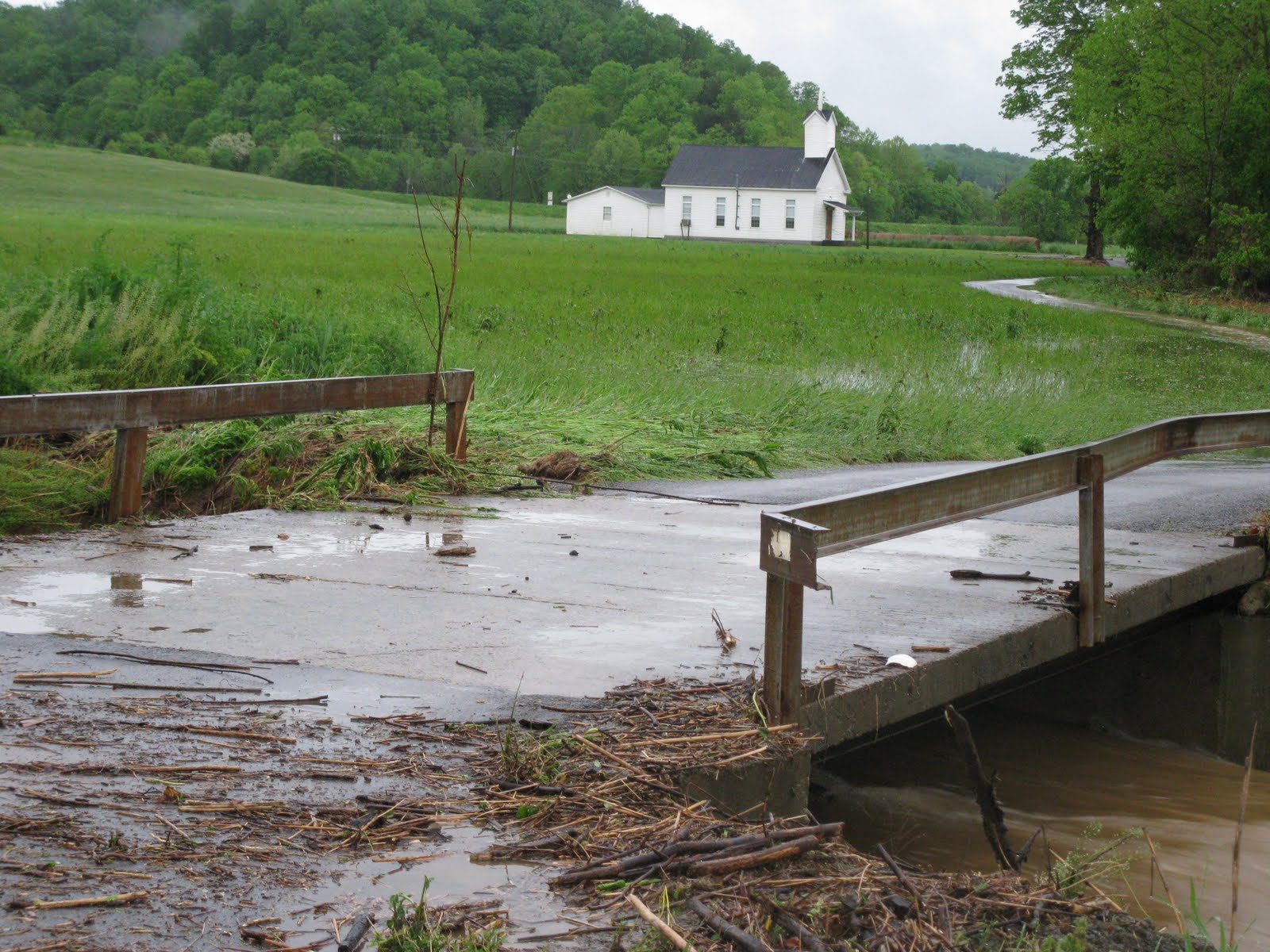
Sunday's flood, [minor in its damage compared to the one of 1907] left logs, branches and trash strewed in its path. This photo was taken in the church driveway.


These hay bales are "parked" at the edge of the church yard.  J. believes that the one which came floating down the flooded creek may have torn loose from here.


This old house and barn crouch, abandoned, in a field near the church.
I'd like to know if this is a building which survived the flood or dates from a later time.


The land to the left of the creek in this photo is the portion referred to as "the island".  It is really a pennisula closely surrounded on three sides by the creek waters.  Having seen the road, the bridge and portions of the fields under water on Sunday, it isn't  hard to imagine a furious flood wiping out the buildings that were there. Local remembrance is that the houses which were washed away or severely damaged were built very close to the creek's flow.


A last shot of one of the most handsome houses on Old Gradyville Road.
We have learned that some of the families whose homes were in the path of the 1907 flood salvaged  lumber and materials as they could when the waters receded and the dead had been found and buried.
Lumber from one of those houses was used to frame the modest garage on this property--built in the early 1980's.  It is yellow poplar. This is its third reincarnation--from the original house lost to the flood, to a house rebuilt and finally dismantled.
How do I know this?
Hurry back to read the story of a surprise visitor!

The three vintage photos are scanned from The Early Settlers of Gradyville and Adair County, KY.
This work was compiled and published by
 Mrs. Ann Elliot Odell
Phil Moss
Jerry Moss

Monday, May 3, 2010

Rain-Washed and Fresh

The burgandy iris survived the rain.

This taken in the morning; by evening a pink peony was almost fully opened.

Billowy white clouds in a blue sky.

The old grape vine wants pruning.

This lovely thing was nearly dead when I scooped it up from the road.  I wanted a closer look at the colors.

One of the transplanted delphinium.

I rescued this iris at the height of the rain on Sunday.  A bit tattered, but so pretty. [And that's the "accent wall" in Laura Ashley Russet!]

The garden fence in process.

The white clematis going to seed.

A view of the old barn in the next field.

Sunday, May 2, 2010

The Gradyville Flood [June, 1907] and A Sunday Deluge [May 2, 2010]

We went to bed last evening to the sound of rain on the roof and thunder booming and rolling about the hills.
This morning I woke to see the two bottom garden strips below the drive running with muddy water.
J. donned his rain suit, a hard hat [which formerly saw service as a snow-mobiling helmet] and boots. Armed with a shovel, he created run-offs for the accumlating water.

The creek which runs below our property had burst its banks by 11 A.M. and was encroaching on the roadway.  Our neighbor, Dale, came by to borrow a ladder in an attempt to clean the maple seed-wings and small leaves from his  clogged eaves troughs. His young grandson stuck his head and most of his excited small body out of the truck window and shouted, "You should see the creek!"

Our cottage sits on a sloping hill well up from the creek, safe from the flood. Still  we discovered that the storm drain in the basement entry was clogged--likewise with seed pods and leaves, allowing the fast-flowing rain water to gurgle under the door and spread across portions of the basement floor.  While J. worked to unstop the drain, I swept the water toward another drain near the heating/cooling unit.
The cats ventured down the basement stairway to watch.  Several very sensibly retreated to the dry, warm safety of the bedroom.
Charlie and Maizie trolled  the edges of the wet. Their daughter Jemima got her paws damp, shook them in disgust and retreated upstairs.

With a late breakfast finished, J. couldn't resist taking the car and driving in both directions until he encountered water flooding the roads. He announced on returning home that he didn't think it was "necessary" to see if the car would go through.

The water rose rapidly, surging into the road at intervals where the creek loops nearby.

From the living room window we could see small trees, logs, a huge round hay-bale, unidentified debris hurtling by.  J. called me to the window to see where a log caught against a roadside sapling which bucked and folded under the onslaught.

Slightly after noon J. announced that he was taking old Snort'n Nort'n and going out again to check the state of the several nearby bridges. This is the bridge up the road headed toward the hamlet of Gradyville.

Water pelts past the old Dodge truck, submerging the grass on the verge of the road.


Going the other way from the farm, past neighbor Dale's place, the road is closed, the bridge impassable.
I began to wonder where J. had gotten to.  As I suspected, the men of the area had convened to look at the water, pass judgement on the state of the roads, shake their heads and make sage comments.

Early in the evening the rain had slowed, we could see from the house that the water was beginning to recede.
A close-up of the debris caught along the lower bridge.

Dale's animals stand in the sopping grass, seemingly unfazed by the innundation of their pasture with water.
Dale spent Thursday and Friday evenings driving posts and stringing electric fence, most of it washed away.

Each time we go out Old Gradyville Road on our way to anywhere, we pass this bridge and the gravel road to the old church.  The church is in the area where the floodwaters in June 1907 caused death and destruction.


Hear you can see Big Creek roaring and leaping down the hollow much as it must have done on that dreadful night. Gradyville residents speak of "the flood" as though it had happened a decade or two ago rather than more than a century past. This is an area where families have lived for generations, inter-marryinging and neighboring.  Many of those still here bear the surnames of those who died in the historic flood.

It was houses postitioned like this old cottage which were swept away by the 1907 flood.

We crossed Highway 80, the Edmonton Rd just above old Gradyville and took the narrow road towards Sparksville.

There too, muddy water stood in the fields.

No more rain, please, for a few days!


The above link should take you to an archive of stories and reports of the 1907 Gradyville Flood.  Some of the accounts were published days after the event. Others are the memories of those who survived the flood or wrote out the family stories that were handed down regarding the events of that dreadful night.
They make for a fascinating, if chilling read.
A handsome old house which we pass going out Old Gradyville RD has just been listed for sale. It is the Moss [later Keltner] home which remained intact when many around it were swept away.  As the dead of the flood were recovered, nearly all of them women and young children, they were "laid out" in the parlour of  this house awaiting the caskets which were donated and rushed down from a funeral home in nearby Columbia.
The legend prevails that the voices of grieving woman have sometimes been heard in the house, murmuring over the lost children. All old houses have seen their joys and sorrows, births and deaths. I am sustained by staunch religious beliefs regarding the dead, but I don't discredit the "voices." I find myself wondering if this bit of the home's history will be part of the listing "features."
In this tiny community with its long ties of kinship and memory, the losses of the Gradyville Flood echo down the years. 
I pray for sunshine and  a drying breeze this coming week!

Saturday, May 1, 2010

"Miss Janice"

There are books which I cannot part with, no matter the trouble of packing for successive moves.  No matter that I've read the books in question many times.  Some authors, some stories, some fictional characters, strike such a rich chord that I know I will want to re-visit them yet again.

Such are the books which comprise The "Piney Ridge" trilogy by Janice Holt Giles.
I bought these years ago, one at a time, as they were offered by the Farm Journal Family Bookshelf.
[At the time, struggling to make ends meet on a less than prosperous farm, with little money for indulgences, it was an event to choose from the Bookshelf's catalog, mark the card, send it out, and then wait several weeks to receive my new book in our rural route mailbox]

My special favorite is the second in the series, "Miss Willie," which was the first one presented by the Bookshelf in their own edition.  I expect the response was so favorable they quickly arranged to publish the other two.
Miss Willie, a spinster schoolteacher is invited by her niece [married to a Kentucky man and moved with him "home" to the ridge where his family have lived since the Revolutionary War] to come, in a missionary spirit, to the ridge to teach in the one room school.

In telling these stories, Janice Holt Giles drew upon her own experience of moving in mid-life with her husband Henry to his ancestral home in Adair County, Kentucky. The books are rich in colloquial speech and customs, and the story threads spin out against a background of poverty and pride, staunch religious beliefs and human foolishness contrasted with the stubborness of people determined to do things as "they allus bin done."

 Loving and re-reading the stories as I have, it yet seemed a stretch of the imagination that the lifestyle portrayed could really have existed here in the late 1940's and 50's--the time in which I was growing up in rural Vermont.
I say "here" because it was a few miles away---over on the county line--that Janice Holt Giles set these fictional works.

Last Monday I clung to the arm-rest of the car door as J. drove the narrow roads which swoop up, down and around the ridges and plunge into the "hollers" along the endless creek beds that waver along the Adair/Casey county line. It wasn't difficult to imagine those same roads, unpaved still in the 50's and the isolation which must have been particular to the people living on the "ridges."

On Wednesday we had business at the bank in Columbia, the Adair county seat.  Marsha B. the assistant vice president [who set up our various accounts and saw to the transferring of funds when we moved here] was returning from her lunch break and stopped to ask how we were liking Kentucky and what we had managed to accomplish on our little farm.
We have learned that people in rural Kentucky have time to talk and that they ask questions in a neighborly way and truly want a detailed answer.
We catalogued the improvements made to the cottage, the 5 acre piece "turned" and seeded, the efforts underway in the garden. We told her of our Monday trip to the Mennonite-owned  greenhouses and our return on the back roads along the edge of Casey County and through the hamlet of Knifley.  I mentioned that I had never expected to live near the locale so richly described in these favorite books.

Marsha B. broke into a delighted smile. "I grew up in Knifley", she said, "and I remember Miss Janice.  She was an older lady when I was a girl, but she was still busy writing her books."

Marsha went on to recall the Saturday afternoon trips her family regularly took into Columbia for supplies.  "It seemed like we mostly bought bread because my mother and grandmother didn't make bread.  We shopped for sugar, flour, household things which we didn't grow or make ourselves."
She warmed to her memories telling us how the children, she and a brother, were allowed to choose a store-bought "treat"--a package of cookies or a bag of chips or candy to be shared.
"I could make my half of the treat last for several days," she said ruefully.  "My little brother gobbled his on the way home and then begged for part of mine each time I dipped into it during the week!"

She declared that Miss Janice took her writing seriously, carefully researched historical details for her nearly 20 novels.
"Miss Janice stayed close to home with her writing, but Mr. Giles---he got bored and wanted company, so he'd drive into Columbia and spend the afternoon."

Biographers of the Giles mention delicately that at some point Henry Giles became  a bit "jealous" of his wife's preoccupation with her writing--maybe even of her success.
In her autobiographical work "The Kinta Years--an Oklahoma Childhood" Janice Holt Giles creates a word portrait of her maternal grandmother.
" Let me say here that my grandmother was one of the world's best naggers, in the nicest way.  She was never hateful, high-tempered, ugly with her nagging. But she was very effective because she literally never quit. Her little darts went flying through the air and they pierced you as she laughed or joked or even as she sang. Even the hymns she sang as she worked were frequently chosen for their propaganda value.
Nice, sweet, endearing, good, clever, smart, highly intelligent, grand sense of humor, witty and full of fun, Catherine McGraw was nevertheless one of the world's worst and most successful naggers.
I feel no guilt in so describing Catherine McGraw. I recognize the same nice nagging propensities in myself.  When I want something very badly, or when I disapprove of something very strongly, my family hears about it pretty steadily.  I don't think I do as much of it as Catherine, but like her, I usually get my way."

Perhaps in spite of what was mostly a companionable marriage, Miss Janice's own admission is the key to Henry Giles little outings remembered by Marsha B.

The Giles home near Knifley is being restored as a museum, open on weekends from May to October.
J. has read several of "Miss Janice's" historical novels and enjoyed them, so we will be making a pilgrimage to the "Little Better Than Plumb" log house on a sunny Sunday afternoon.
Visit the link below if you would like to see photos of Miss Janice and Henry or to learn more about her books.


Friday, April 30, 2010

Friday

The dwarf fruit trees set out about three weeks ago are showing leaves.

The Yellow Simplicity roses [ordered with a Jackson and Perkins gift certificate from a dear friend] have been a bit slow to break dormancy. This is the more vigorous of the two and has spent the week developing leafy shoots. The second one is less branched, but is showing encouraging signs of life.

We set up the huge lodgepole bed this week and in lieu of hooks in the bathroom I've been tossing my robe over the bedpost.  An errand took me into the bedroom at midmorning and I discovered Charlie nested in the trailing folds of the robe. 
And yes, there's still masking paper here and there along the baseboards.  The application of "Cinnamon Swirl" paint is temporarily abandoned while we work in the garden.
Plan B suggests that we will remove the interior shutters from their mountings, take them outside and give them a good scrubbing, then spray paint them using aerosol cans of white enamel.

Pebbles has shown some lameness in her right foreleg these past two days.  We've kept careful watch but there are no signs of the laminitis which has been a problem for her in the past.  She has been tearing around the pasture like a colt ever since she arrived in Kentucky.  J. thinks she may have slipped in the wet grass and pulled a muscle.  She delights in giving him her hoof to hold and inspect.
Her gimpiness didn't prevent her taking advantage today when J. let down the electric wire in front of the barn while he moved out his tractor.
"Where", I said a few minutes later, "has that horse gotten to?"
"Oh, I didn't put the wire back up!"
Sure enough, Pebbles had gone through the center aisle of the barn and out to the lush green field beyond.
J. went after her, put his belt around her neck and led her back.  She was not pleased and while he tinkered with the fence she marched back through.
This time I was directed to hold her until the fence was repositioned.
We think she is feeling much better today. She spent most of the day on her feet--eating grass--and although the limp is still evident, she gets where she has a mind to go!
It has been a day of gardening.  A day of wind and flower-scented sunshine. The tawny iris has started to open, but the only photo I took of it was blurred as the flower stem tossed in the breeze.
Some tomato plants set out, as well as cabbage, peppers and melons. Cucumber seed, cantaloupe seed and zuchinni planted in "hills." 
Two rows of Stuttgarter onions set out, two long rows of bush Blue Lake beans planted, and just before dark, four clumps of dianthus dis-interred from their nursery pots and set into the flower border to be.
I am tired; witless; pleased with my day.