Tuesday, October 29, 2019

October Scenes


Sunrise has been vivid most mornings, even when the sky later becomes patchy with clouds.


The meadow is greener since the rains. 


On several days rain has moved in abruptly, continuing into the evening.


The ravine at the west end of the property billows with smoky mist as evening falls.


Leaves still cling to the trees along the lane.


There is changing color in the trees which rim the meadow.
Wind and rain over the weekend brought down leaves along the lane. 


Morning sun has been tardy in breaking through layers of mist and cloud.


There is nothing handsome or appealing about vultures.  The red-headed variety and the black-headed ones such as this duo are common in Kentucky. 
These are finding a favorite perch in the fire-blasted tree that still stands near the house site of former owners.
On a mid-morning errand last week we noticed a 'committee of vultures' roosting in a group of half-dead trees near the highway.  Jim remarked that we've seen them previously in that same area, a stretch of wooded marshland. Some of the birds were hunched on branches, others had their wings bent outward as though airing their feathers.
I didn't find them an attractive sight.


I saw only one or two black and yellow garden spiders [argiope aurantia] this summer, although I kept watch for their intricate webs with the signature zig-zag centers. 
One has left her sack of eggs attached to the south side of the barn.
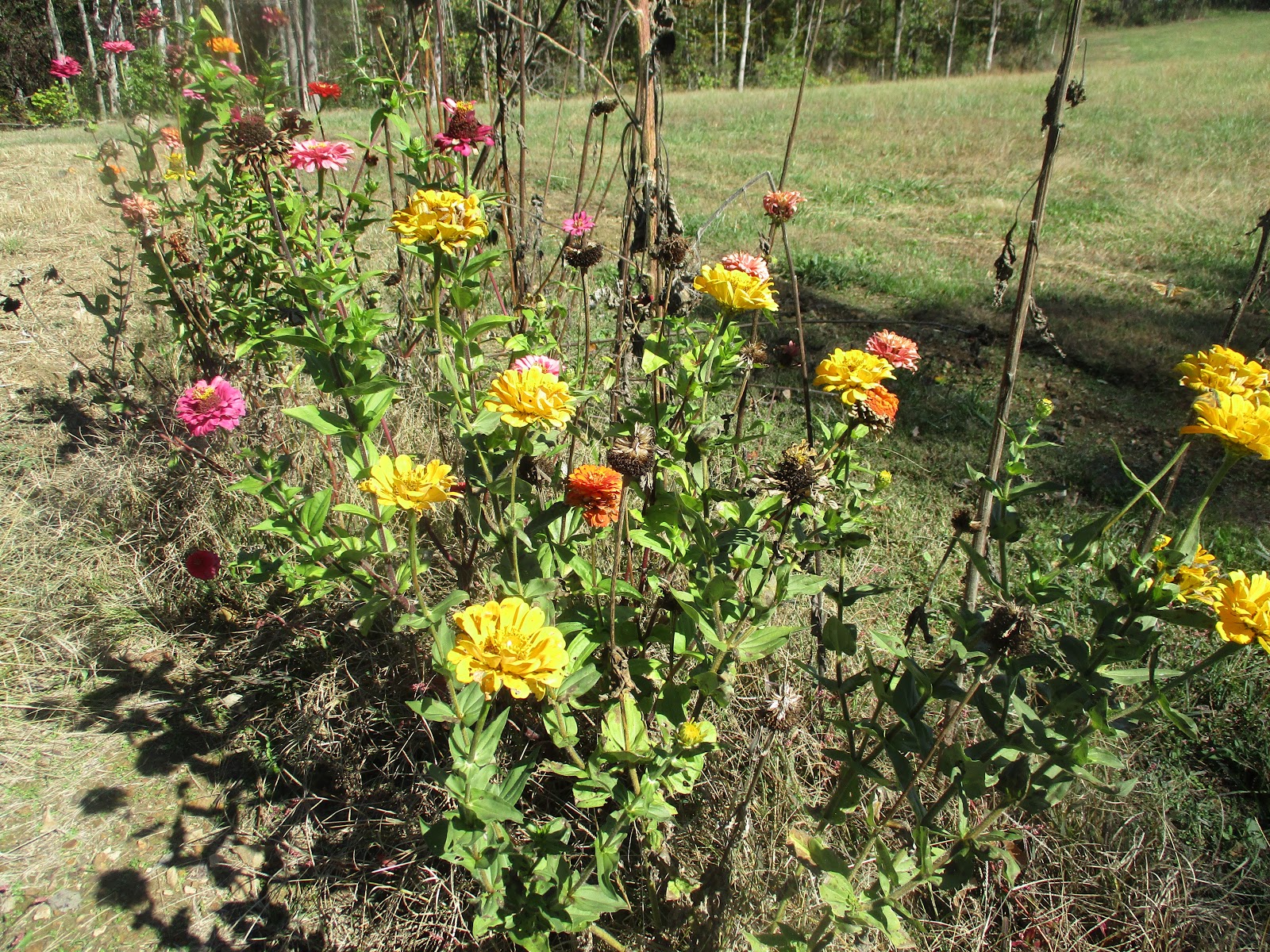

Yellow zinnias prevail although the other colors have mostly faded and gone to seed.


A very lethargic bumblebee 


We don't have maples to go out in a blaze of autumn reds and oranges.


Trees at the edge of the ravine behind the shed still hold green blending with muted shades of bronze and russet.
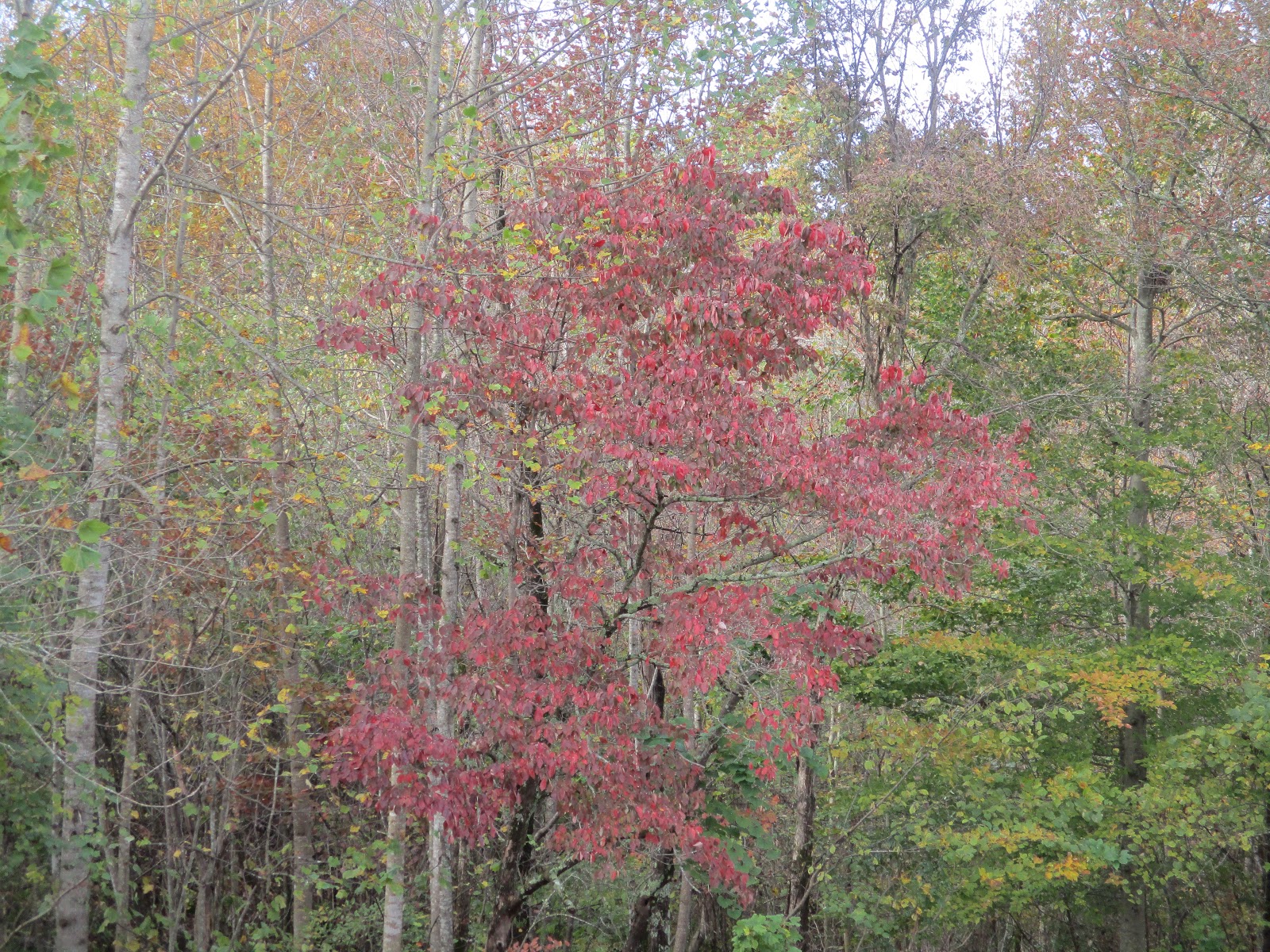

One crimson-leaved tree lights up a misty morning.


I began grubbing out a strip in back of the Knock-Out rose hedge.
After two afternoons of work  [not shown here] I have a space which can be further enlarged in the spring.  I removed sod [and weeds!] below the east facing basement windows and tucked in my seedling lavenders.
I also turned the soil along the edge of the patio bricks by the front door; more lavender planted there and the thyme, sage and oregano which summered in a big tub. 
It is late in the season to undertake transplanting, but it couldn't be done before the fall rains mellowed the dry soil. 
The proof of the experiment won't be seen until spring.


These roses were labeled as 'landscape/ground cover roses. They have instead matured as vigorous climbers.  They will need to be moved and given a trellis or other support.
Even as I have labored to put the gardens to bed for the winter, even as I've come inside to groan over an aching back, the possibilities  for another springtime fuel my imagination.


These David Austen roses were chilled when I brought them in, but later responded to warmth in the kitchen window.
The first blooms of spring and the last in autumn are especially treasured.


Saturday, October 12, 2019

Autumn Prelude


In the space of a week, the season has moved from seemingly endless summer heat to temperatures more representative of fall.
The first Friday of October dawned cool and warmed into a mellow sunshine that lured me outdoors.


I invented tasks beyond the usual watering of plants and the trek to the mailbox.


I harvested heads of sunflowers--all dwarf varieties--and will have far more seeds than needed for next season's planting.  
Although the sunflowers now look spent and straggling I've asked Jim to leave them standing so that birds can continue to glean seeds. 


I forked up the grass and weeds which edged this plot--a heavy job with the ground so dry.
A few late tomatoes still ripening, so the bedraggled plants were left for a few more days.


Intermittent showers on Sunday which tantalized  with the hope of rain.
At dusk it began to rain, a solid drumming on the roof which continued through the night and into Monday morning.
The cats darted out the door, came back damp, disgruntled, shaking wet paws.
After weeks of dragging a hose about to water gardens it seemed strange to have nature attending to that need.  


 Prodding experimentally in the soil around the transplants of foxglove and balloon flower  near the back porch, I realized that the moisture had soaked in deeply.
I cut half-opened blooms of David Austin roses, the petals cool and freshly sweet.


Yesterday [another Friday] I picked the remaining late tomatoes, yanked up the plants, spread out a bag of mushroom compost to await Jim's work with the Troybilt tiller.


The veg garden after bush-hogging--cabbages and broccoli responding to rain and cooler weather. 
A few zinnias and the sunflower stalks have been spared. 


Cockscomb rode in from the farm--stow-away seeds dropped into the potted perennials that I hastily stuck in the ground here a year ago.
I think there are two varieties--you can see that some of the plants are taller and tasseled, while others are more compact with the dense flower crests that give the plants their common name.
Prior to the rains they were still appealing.


After the rain, the tall cockscomb were leaning, well past prime and shedding seeds by the thousands.  I uprooted them--the lower stalks as thick as young saplings--and carted them off to the edge of the woods.  Tiny black seeds caught in my shirt, clung to my bare arms, sifted down my neck.
I left the low-growing plants for a few more days of brilliant color. 
With the towering ones gone, I could begin to clear weeds.


Raydon's Purple asters;  I will order several more of these in the spring.


I have watched for new seedlings to appear at the base of the Camelot foxgloves. Before the rain there were only a few--the larger ones in the photo. 
Kneeling on the damp earth on Friday I discovered  tiny seedlings --dozens of them--marking where each plant bloomed in the spring. They are late-comers--how many will survive the winter?  With their biennial tendencies, I hope to keep a new crop each season.  I should have bloom from those started from seed and nurtured in pots through the summer.


A clump of wild ageratum along the lane.

Ipomoea Coccinea 
Discovered growing up a rusty fence stake beside the old barn at the end of the road.  One of the common names suits it: 'red star.'
Tonight the temperature is expected to plunge into the 30's F--not a frost, but a chill that will proclaim autumn is finally with us to stay.


Tuesday, October 1, 2019

Sightings


The sky these past few mornings is nearly opaque, stained with faint colors like the inside of a seashell.
The air is not crisp as it should be with the calendar proclaiming autumn. 
I sit on the east porch, fingers wrapped around a mug of decaf sweetened with maple syrup.


Hummingbirds--still with us--make the first visits of the day to the feeders dangling from the overhang of the porch ceiling.
While I wait for the sun to appear around the corner of the barn, I watch for the squirrel families who live in the trees that line the ravine across the lane.
In the springtime, from this spot on the porch, the gymnastics of the squirrels were easily visible through nearly leafless branches.
Now I take note of a jiggled limb, a cluster of leaves suddenly shaken, and follow the sleek dark bodies as they shimmy down, branch to branch, make a horizontal run and leap to an adjoining tree.


During high summer we grew accustomed to sightings of the foxes--if not daily, on several consecutive mornings during the week. I've expected that they were out and about in the mornings even if I missed seeing them lope across the lower field or trot down the lane to melt into the tree line.  Pegging sheets on the line I once caught a flash of movement and turned to see a fox meandering behind the clump of small trees where our camper trailers were parked during the winter of house building.
A special confirmation of the fox family''s continued residence was seeing one saunter boldly across the meadow above the gardens last week as I stood at the kitchen window.


 The first owners named the lane leading to the three homes here in reference to the wild turkeys who frequent the area.
When we first came here to begin clearing the house site we saw the turkeys daily.  Like the foxes, they seem to disappear for weeks.
Unlike the foxes the turkeys have no discernible routine--they may appear at any time of day or evening. 


This group was pecking about below our bedroom windows early one morning.


Turkeys are skittery--as soon as they realize we are aware of their presence, panic ensues. 

Deer cross the property--usually grazing across the upper meadow.
We come to think of these creatures possessively--'our foxes'--'our deer.'
It is more accurate to realize that they were here before us; we are the interlopers.


Thursday, September 26, 2019

Transition


All week the sunrise has been lovely, although it is still barely light at 7 a.m.


Sunsets have likewise been splendid.


On this Thursday morning, all was pearly grey. We hoped for rain, but there was only a misty drizzle, quickly over.
Looking up the lane I noticed hundreds of birds ranged along the wires.


I walked quietly up to the bend in the lane that designates our driveway.
Birds jostled for space, while still more alighted in trees along the boundary hedgerow to the east.
The air was full of their soft twitterings and the swoop of wings.


Not barn swallows as I first thought, but tree swallows. Our neighbor has placed several nest boxes on fence posts along the lane, which the swallows are pleased to occupy.
Later, walking to the mailbox, I found a single blue tinged feather laying on the stubbly grass.


Bedraggled sunflower heads.


Zinnias are faded.


This one was a brilliant red-orange.


Leaves are drifting down along the drive; the cool air has a tang of woodsy dampness; a faint breeze stirs.


Willis, my ever faithful companion on walks. This has been his 10th summer.
He is still lean and supple, still the overseer of the property.


At the edge of the open-ended barn, a nest had fallen from the ledge above the entrance
It has a mud-daubed base, but has been sturdily wound into shape with fine stems, twigs and bits of moss, lined with soft down.


A balloon flower bud, so intricately veined.


A 'balloon' bud ready to spread its petals.


I miss the autumn proliferation of  New England Asters which grow wild on roadsides and in old pastures in my native Vermont. Here, the tiny frost asters bloom, but the purple beauties must be purchased as garden plants. There were no purple ones at my favorite local nursery in the spring, only some of a garish 'hot' pink. 
This one, Raydon's Purple came from Select Seeds--the only one in stock when I ordered.


Cockscomb in all its brilliant velveteen glory. There are seeds for a few million plants!
Temperatures are meant to climb again this weekend, but the days are shortened, giving way to cooler nights.  The equinox has passed and autumn is slowly moving in.