Wednesday, June 15, 2016

Goats and Cats--and a Dog [In No Particular Order]


The billy goats, Dandelion and Caraway, prior to their break out from the pasture.
When F. arrived home, he set to work reinforcing existing fences and constructing a sturdy 2- strand electric fence to separate the goat pasture from the area below our garden.
The billy goats were kept under surveillance in the dry goat pasture for a week and the four non-milkers moved across the lane to what had formerly been the domain of the bucks.


My favorite of the mature goats, Zenobia, who is the oldest goat in the herd. Her distinctive black 'beard' doesn't show well in this photo.


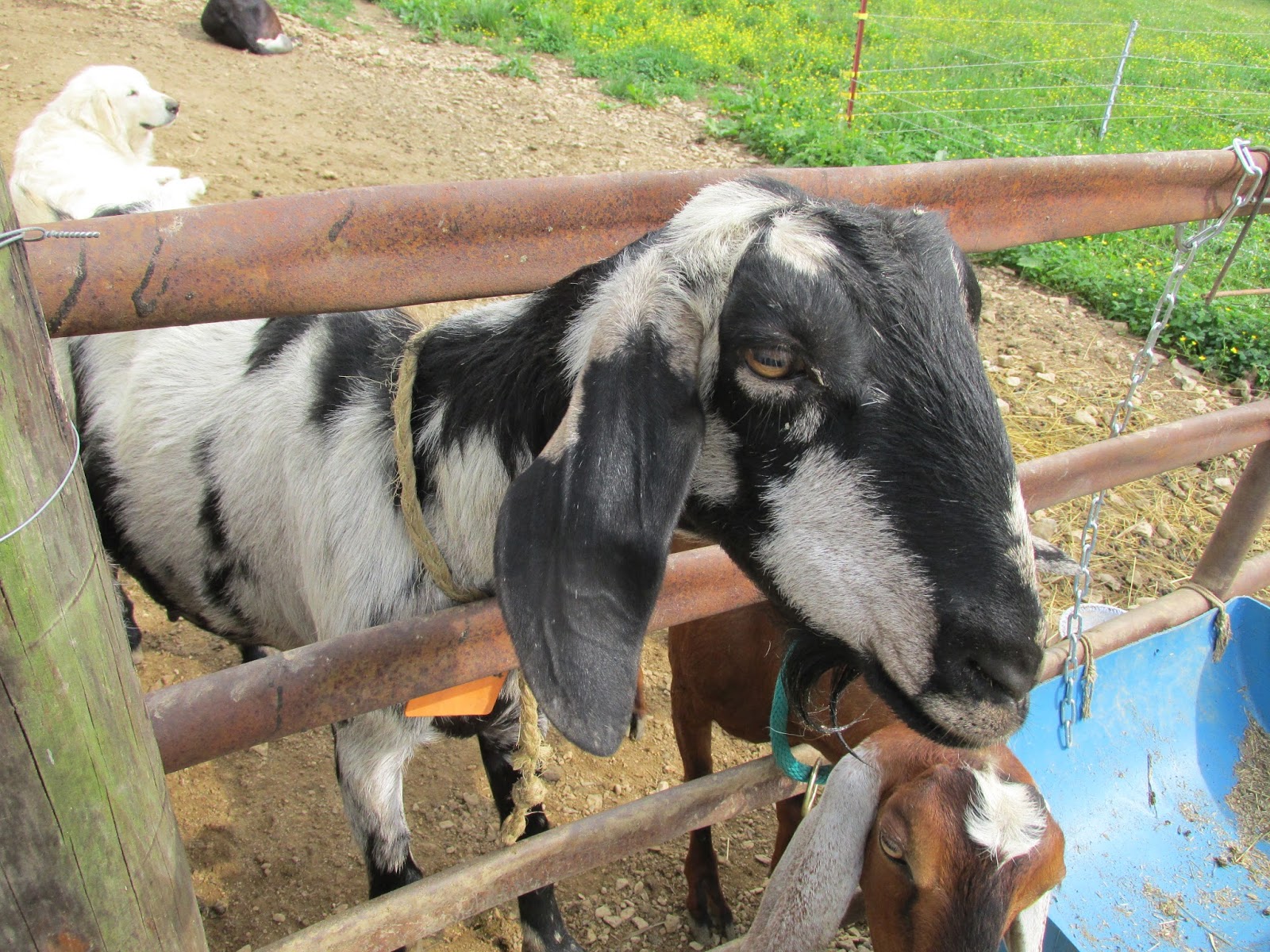
Dandelion with his head through the gate.


Bobby Mac showing off as he keeps me company in the garden.


Charlie is likewise a companionable soul, often getting in the way of my hoe, wanting my attention when I am weeding.


For a few days the dry goats stayed in the long pasture which borders the shady side of the lane.
They were alert to my footfalls whenever I walked down the lane and quickly formed a procession on their own side of the fence. 
I have found that goats are very conversational. 
At convenient spots along the fence,  heads were thrust through to be patted and complimentary remarks were exchanged. 


One of the goats, Evonnia, found a way to escape the pasture. Returned by F. she refused to stay in.
When I walked down last evening I was surprised to find that the ladies had been returned to their original pasture and the bucks were back across the lane.
F. assures me that the boys have considerable respect for an electric fence.
I will miss the enthusiastic greetings of the does.  If I wish to fuss over them I will need to go through the barn and out to the hill pasture gate.


The baby goats at their grain trough.
When I was caring for them, there was persistent pushing at the fence above the trough.  One little girl goat managed to get her head stuck three times.
I lashed a variety of found objects to the fence as a deterrent. 


This is Munchkin, who patrols the hill pasture. The dry goats are her usual 'group' to guard.
She is friendly, takes her job seriously, doing a great deal of barking.
When we drive up or down the lane she races along the fence, whirling in circles as she nears the end of the pasture.


Charlie and Willis frequent the garden, sometimes disagreeing as to who is 'top cat.'
Willis takes his role as the farm overseer to heart.

Charlie is an amiable nitwit!


Sally, one of our outside cats. Sally likes to assist if I am weeding the strip below the porch. 
She and her sister, Sadie, have developed testy ways in response to the years of lordly dominance by Willis.

One of the mom-cats who lives in the goat barn.

Misty morning in the pasture.


Delphinium, waiting her turn to be milked.
She habitually stands in her grain bucket, removing her feet only to put her head in the depths of the bucket and slam it against the wall. 

Willis--Himself.


Sunday, June 12, 2016

Early June Gardening


The lavender that spills over at the foot of the porch steps is past its prime bloom.
I had my camera nearby as I pruned sage plants which had gone straggly and took several shots of this butterfly which I hadn't seen before.
Most of the shots were even more blurred than this one.
There is always a companionable cat or two when I work in the gardens.  I was concerned that the hovering butterfly was about to become prey.
Two hummingbird feeders are attracting visits from a pair of ruby-throated hummers who are once again nesting in one of tall spruce trees below the side porch.
Although I have tried through many seasons, I've never taken a clear photo of these busy 
darting birds.


Bees love the lavender. Working in this small plot I need to be wary that I don't upset a bumble bee or a smaller honeybee.
The garden sage in the background produced showy spires of blue in May, then the plant began to look shabby. I've snipped off the faded stems of bloom in hopes that the sage will produce some woody stalks and healthy leaves.
Purple sage has looked unkempt with a litter of clinging dead leaves.  I recall it had this untidy habit in my previous herb garden. 


This solitary 'toadstool' sprang up in the rough path that edges the perennials set in place last autumn.
It caught and held a sparkle of drops from an early morning rain.
By the following day it had melted and collapsed.


Hawkeye Belle--a favorite of the roses planted in my Gradyville garden [the one ignominiously buried under a new parking lot!]
I moved this 'offspring' to the bedford stone house in 2014, then here last summer.
The bush is still small, but the first blooms are encouraging.


I saved seeds from last summer's cosmos.
This one and the white one pictured below are volunteer plants.
It appears I will have a perpetual supply of cosmos.


Some seeds found a toehold at the base of the retaining timbers. Strangely, the plants have bloomed while still small and stunted. The same happened with the poppies. I suspect I should have thinned out the huddle of plants rather than letting most of them grow on.


Nasturtiums are a favorite. I raised them every summer during our Vermont years, letting them billow from a half barrel planter.
I bought these as starts from the nursery. I've no doubt I will find some morning that they have been consumed overnight by squishy green caterpillars--the usual fate of my Kentucky nasturtiums.


Garden helpers--Bobby Mac and Willis parading along the retaining timbers.


A spray of daisies flattened in the rock-lined drainage ditch.


White foxglove, seed-grown and cosseted on the porch last summer, planted in the last warm days of mid-November.


The untidy rugosas have had their spring flush and need to be trimmed back as they lean too far into the side porch walkway.


Sutton's Apricot foxglove at its peak before the last rain.
Seed pods are forming now and I've tied the stalk to the fence so that the seeds will ripen and can be saved.  I nurtured seedlings from three foxglove varieties last year: the white, shades of rose and the apricot. Less than a half dozen of the apricot germinated. Only two have bloomed, the second one a less hardy plant with blossoms in a pale peach-pink.


Lavender a week ago in peak bloom.
The unpruned sage is very visible in the background.
The weather turned hot today--about 90 F--after a week of nearly perfect June days.
Mornings were cool, the sun's heat at mid-day tolerable.
I labored outside, hoeing the row of beans, the Swiss chard, the hills of cucumbers and melons, loosening the rain-compacted soil around the tomatoes. 
I ripped and hacked at weeds in the perennial strips, tweaked weeds and an excess of self-sown cockscomb from the area between the concrete steps and the edge of the porch.
It doesn't read like a great accomplishment!
Considering what yet needs to be done, I'm feeling a bit daunted by aching knees and shoulders. 
This business of 'aging' shouldn't be allowed to interfere with my passion for gardening!
I daresay I must learn 'moderation'--some fussy way of working for an hour and
 knowing enough to quit.
I don't like to quit a task once I've gotten started.  In the case of gardening, once the knees of my jeans are grubby and my fingernails are dark with embedded earth, it seems a shame to hoist myself to my feet and abandon the rest of the patch!
With the weather tipping into the heat and humidity of summer I know that garden chores will need to be accomplished very early in the morning. 
The first exuberant blooms will fade rapidly in the simmering heat, plants will soon need to be cut back, mulch needs to be renewed. 
I am torn between the longing for 'more garden' and the reality of diminished stamina.
Creating a fertile area, civilizing a patch of ground that has known only rocks and weeds is a demanding chore, not accomplished in one season.
Perhaps it is time to explore the possibilities of 'container gardening.'


Tuesday, May 31, 2016

Scattered Hours


I plodded down the stairs this morning in the early coolness of the day, mentally 
lining up 'things to do.'
As late spring tips into the heat of summer, morning is the best time to go into the garden, to peg out laundry, to make plans for the day.
There are the usual chores that must be done: meals, clean-up, the 'reward' of time at my desk.
I contemplated my on-going genealogy project, thought of selecting fabric for the quilting class I have registered for on Thursday.
Dirty laundry chugging in the washer downstairs, bed made, bathrooms tided.
A knock on the door.
It was Lizzie, wondering if there was more kibble on hand for the Pyrenees dogs.
I picked up my key and walked with her down the lane.
In the washroom of the lower house we wrestled with a 50# bag of dog food scooping it into the covered bins that are kept in the barn. 


 Mary had finished milking and was shepherding the goats toward their enclosure.  I carried milk in to the kitchen fridge and returned to the stable to find Mary on her knees by the old supply cupboard, portable phone in one hand.  
"The kittens are chewing up the phone cord," she announced.
She tugged the cupboard away from the wall, while kittens darted in all directions.
I offered to take the phone to the house, realized I had locked the door and set the key down--somewhere.  Lizzie located the key, I trudged from barn to house and back again.
Mary was still  fretting over the kittens, Lizzie had finished feeding goats.
They are competent young women, working quietly each morning to care for the animals while their owners are away. 


Heading down the drive I noticed evidence of scouring in one of the small goats, knew that I would need to check on her in a few hours.
Washing pegged on the lines, time to make the mid-morning breakfast that Jim prefers.


Glancing out the kitchen window I noted the billy goats were on the wrong side of the gate--again.
Dandelion, the white goat, is a wizard at finding ways to escape the pasture.
Once he is 'out,' Caraway, the spotted goat, sets up a piteous bleating while he decides whether to follow his companion.
Jim has gone around stopping up any gaps he can find in the fence.
Wily Dandelion is able to find more gaps!
Breakfast consumed, potato salad in the fridge to cool. 
Jim has returned the goats to the pasture.
Astonishingly, it is nearly noon!
From that point, the day unraveled.
I read at my desk for a bit, made a cool drink for Jim when he came in from the workshop.
Jim off on an errand and the now familiar 'halloo' of Dandelion the Billy Goat as he crossed 
the back yard.
Irritated, I stomped out, grumbling at the goats.  Caraway rested placidly in the shade of the stable, the gate seemingly in place, while Dandelion strode past me into the bay where Jim parks a tractor.
I rested my hand against the gate, considering what to do.
A hot stab of pain in my forearm, the whir of a wasp.
I yelped, located another wasp peering from a hole in the lower bar of the gate.
I felt a compelling need to sit on the ground and wail; instead I ran to the house for calamine lotion and an aerosol bug bomb.
I located a lead rope, hooked it into Dandelion's collar. 
He lumbered along pleasantly enough.
At the bend in the lane a large black snake whipped across the gravel.
I found I didn't have energy to waste in screaming.
Caraway, not wanting to be left behind, plodded down the lane inside the fence.
I turned Dandelion into the pasture at the lower gate, hoping he would stay there long enough for me to think how best to deal with him.
[He didn't!]
A check on the young goats to discover that four of them were now presenting scours.
Back home to anxiously contact the owner family for advice.
I fed the cats their 'tea', rinsed the tin and carried it to the rubbish bin in the washroom--in time to watch Dandelion come round the back of the barn and down over the retaining wall.
Aha!  So that's where he's been getting out! 
I stomped toward him.
'You blardy, useless goat!' I bellowed.
He stared at me--and belched loudly.
I realized that I was completely out of patience with his goatly shenanigans. 
I also realized the lead ropes were all in the goat barn--down the lane.
I huffed down the lane, collected the leads, started back up to find that Dandelion was strolling into my garden.
Furious, I stormed up to him, clipped on the lead and began towing him as fast as I could go without breaking into a run. 
He protested, snorting and blowing.
Halfway down the lane he dropped to his knees.
I hauled him up, tugged on the lead. A few more yards and he balked again.
Dandelion out-weighs me by a good bit, but I daresay I can match him in stubborness.
I got him into the barn, into the stall, went back for Caraway.
True to form, Caraway had trotted down to the lower gate--I had only to clip on the lead and coax him up the drive. 
The baby goats were to have a gatorade/water mix instead of their evening milk.
They didn't relish it, but most of it went down.
I put hay in the rack, leaned against the gate, patting the bony small heads thrust up for attention.


It should be a simple job--a few days of helping to tend these animals.
Jim has pitched in, assisting with the evening feeding, corralling the billys.
I had time one evening to brush and clip Munchkin-dog, removing matted clumps of winter hair.
I've enjoyed the greetings of the does each time I walk down the lane.


Today concerns for the baby goats, frustrations with the escaping billies, a sense of my own incompetence, of hours wasted.
Sitting here at a few minutes til midnight, I attempt to gather calm and courage for tomorrow.
I have confined the billy goats to their quarters in the barn.
I have implemented the changes in feeding which will hopefully put the little goats right.
I can't replace the scattered hours of this day.
Tomorrow?  There are a few hours until I must tackle tomorrow!


Thursday, May 26, 2016

A Catching-up Post


 So many days of rain! Sunshine early in the week and the garden starting to dry out, with a 'crust' of soil, weeds that have had a field day while it was too wet to work.
On Tuesday I labored with my garden fork to loosen clumps of dirt, then scratched away with a hand 'digger' to tweak out weeds.

There is always a cat or two for company.
Nellie settled himself in the scented depths of the catnip.
Although I had planned to put down mulch I left my labors late in the afternoon to travel with Jim to deliver a tractor he had refurbished and sold. 


Wednesday's forecast called for rain to move in by evening.
I worked through the day with an eye on the sky.
Jim broke up the weedy ground between rows of veg with the big tiller and I followed behind sifting out the churned up weeds. I work on my aging knees, clearing a row to right and left.
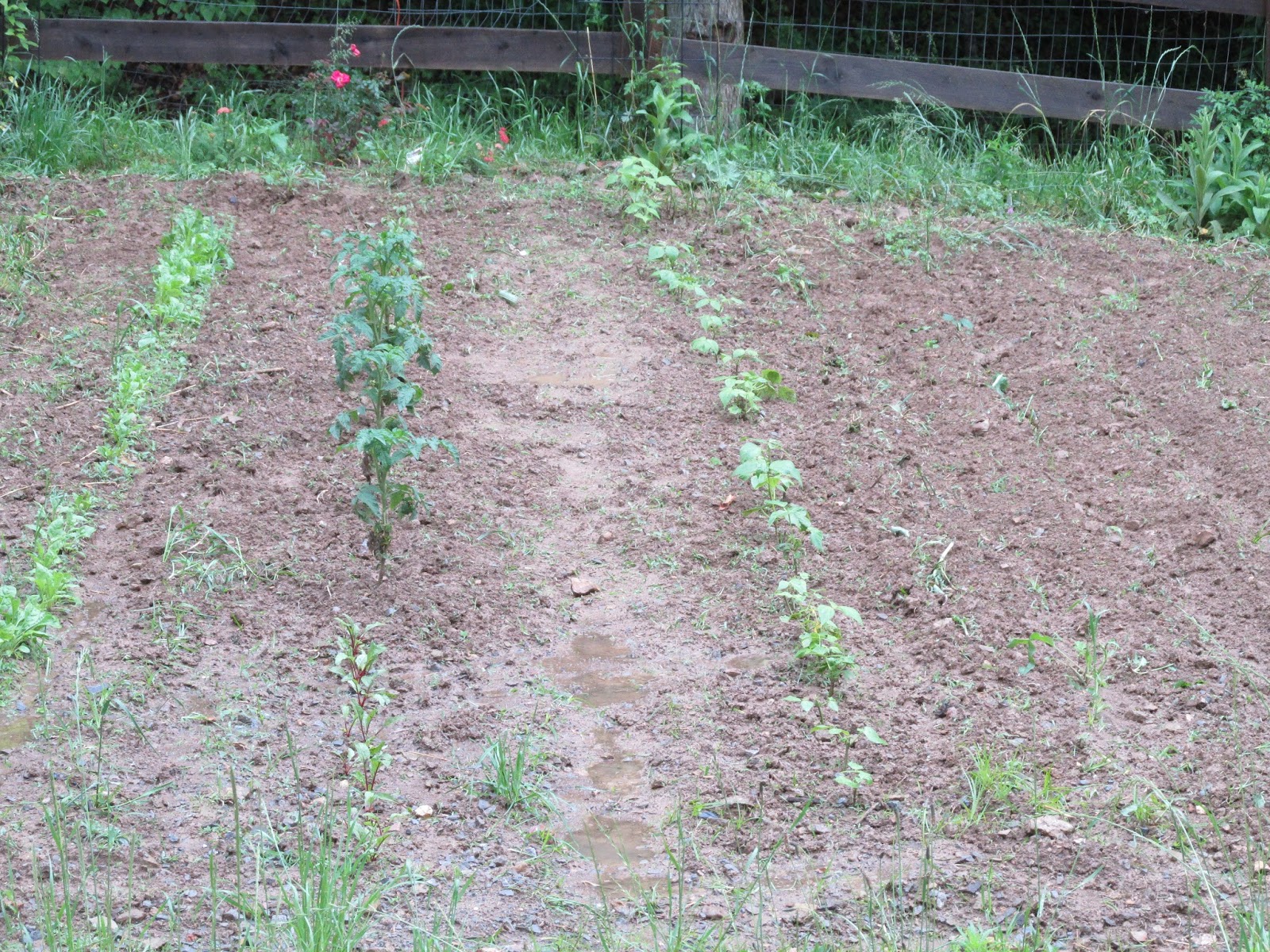
I managed to weed the hills of cucumber and melon, then green beans on one hand and 4 tomato plants and a planting of beets on the left before rain began to spatter down.
The photo above was taken Thursday morning after a night of rain and prior to a thunderstorm that rolled in at breakfast time.

A corner of the flower garden with an Impressionistic blur of rain.

Fog rose from the creek across the road, the sky was grey after the thunderstorm.


I slogged down the lane to check on the goats.
All were safe, though protesting the wet.
Their 'keepers,' the three Pyrenees dogs, bounced, barking, along their separate fence lines, their coats clotted with damp. 
Each pasture has a shelter should goats and dogs be inclined to get out of the wind and rain.


For a few minutes a patch of pale blue showed in the sky.


The billy goats have realized [after nearly three months!] that there is as yet no upper fence to separate their long narrow pasture from the area directly below our garden.
They discovered this during Tuesday night.
Jim escorted them back down the lane where they settled for a companionable snooze in a favorite spot in the willows.


About noon I looked out the kitchen window to see that the pair had taken up residence in the end stall of our three-sided stable.
Our renters [who own the goats] have been called away for awhile, so we are sharing goat care with the two young Amish women who arrive promptly each morning to milk and  feed the goats.
We keep an eye on things and feed the baby goats in the evening.


The garden is so muddy after a second deluge today that I can only take photos from below the retaining wall. 
I have more to share, hopefully tomorrow.
Sometimes life becomes too busy to document day by day.

Monday, May 16, 2016

Legacy

The old apricot tree at the edge of the garden.
The apricot tree had weathered many seasons--planted before my birth, before my mother's birth.
Its uneven form, leaning from the tidy rectangle of a picket fence, frames the edge of a vintage photo, taken in the latter 1800's.
Behind it in springtime a peony thrust through the sparse grass, unfolding glossy leaves and tight round buds destined to burst into bouffant spheres of dark red petals.  
At the foot of the tree pale lavender iris appeared, season after season, undivided, untended. A tangle of slender rose briars spilled onto the grassy slope of the lawn, a wildling with tiny white blossoms, perhaps transplanted from a pasture hedgerow.

I have no decent photo of the small garden. 
It is a part of my earliest memories, and the rest of layout--in full color--is vivid in my mind's eye.
The garden lay a few yards beyond the formal front door of the white farmhouse--an entrance seldom used, as the semi-circle of the gravel drive swung past a welcoming side porch with a 
south-facing door.
The garden was bounded on the other end by a shrub which we called the honeysuckle bush.
Its tiny pale flowers scented the air in June, followed by small dark orange berries in late summer.
I like to think that some woman of the 1800's planned the garden, near enough to the house to be enjoyed on a summer afternoon, a pleasant and peaceful area to view from the parlor window.

The garden's creator placed a second red peony near the honeysuckle bush, and a clump of lemon lilies at the center of the narrow strip. 
Lily of the Valley flowed softly from under the lowest branches of the honeysuckle, ebbed outward toward the yellow lilies. 
At the edge nearest the house my great-grandmother planted a rambling rose.  My mother recalled the cereal boxtops saved and sent off with an order form, and the eagerly awaited arrival of the tiny slip of a rose.  It was a petite rose, well behaved, with flowers like small pink pompoms.
It may have been the variety named 'The Fairy.'

 My world prior to the age of five didn't range far beyond the immediate 'dooryard' of the farmhouse;  I spent contented hours pottering near the apricot tree, with the hum of bees for company.
No one fussed over the little garden.
Grass grew thinly around the base of the apricot tree, the perennials seemed scarcely to spread.
Perhaps the shade of the huge sugar maple just below kept all in bounds.
The garden was cool and quiet on summer mornings; its position on the west side of the house made for golden autumn afternoons when the scarlet leaves of the nearby maple drifted down leaving the dark fretwork of branches etched across a blue sky.

My parents, my younger sister and I, shared the farmhouse with Grampa Mac, Great Grandmother Eliza and Uncle Bill, until our small house was built within hollering distance along the dirt road. We soon created a 'short cut' between the two dwellings, trotting along the road then skirting the prickly hedge of Cinnamon Roses which divided the farmhouse lawn from the area where my uncle's hens and geese had their coops.
Our footpath wound past an old sweet rose [probably Maiden's Blush] at the north corner of the house, along a rampage of common orange lilies and so to the 'back yard' and the door into the kitchen ell.

Years later, after living in several New England states, Jim and I built a modest log home on the two acres which had once served as night pasture for Grampa Mac's dairy cows.

I was by then a dedicated gardener. 
The vegetable garden was prepared first--a practicality--then I embarked on what became an 18 year adventure with heirloom roses, peonies, lilies, delphinium--every sort of cottage garden treasure which had a chance of surviving a zone 3 winter. 
Some of my plants were shared from the gardens of friends, some I coaxed along from seeds.
I shopped at garden centers and nurseries for miles around, ordered special treasures from the catalogs that piled into the mailbox while snow lay deep on the ground.

In the autumn of our 18th year in that place we knew that we would move in the spring to Wyoming.

We left as my garden was putting on its spring show.


My grand daughter posed in the garden for my sister's photo later in the summer.
It would take several seasons for me to realize the difficulties of gardening in Wyoming.
In the foothills of the Wind River Mountains, there are less than 3 full months of frost-free weather.
Drought and searing winds prevail.
Grasshoppers arrive in the brittle heat of July, in a plague of biblical proportions.
At our final Wyoming home I managed a sparse hedge of hardy shrub roses. The resident group of mule deer nibbled them down in June--which seemed to inspire a vigorous re-blooming 
just before the first snow!


Early spring at our first Kentucky property was a time of intense gardening.
The former owners had been plant lovers.
We 'inherited' two sprawling pink peonies, a variety of iris, hydrangeas along the west wall of the house, a hibiscus by the garage, a magnificent clump of Michaelmas daisies near the clothesline. 
The iris at some point had been divided and dotted about the dooryard--some poking up through the fading spikes of daffodils, a few competing with the honeysuckle that tangled around a lamp post.


 My grandson helped prepare an extended rock-edged 'bed' near the peonies and I painstakingly separated tangled iris rhizomes, tucked them into the new space, added more peonies.


I had coveted clematis for years, never quite dared to plant them in my zone 3 Vermont garden.
I was delighted to recognize two varieties growing against the brick wall of the carport.
Haskell Rogers [the previous owner] had frugally rigged a support of metal fence stakes and chicken wire. During our second season there I bought a new trellis for the white clematis--an heirloom variety called Candida.


My son-in-law contributed an elegant tower for Nellie Moser to climb.


Nellie Moser clambered over the rocks at the base of the trellis and climbed a nearby nandina bush.


Both plants set seedlings, a few of which I pried gently out and set into a large pot.


The potted seedlings moved with me to the Pellyton farm where they sulked in their planter until early autumn when I had time to set up a trellis and tuck them into the ground of a new garden.
I was pleased to see that the seedlings wintered and thrust up fresh tendrils to begin the climb up the trellis.  I didn't know if I had managed to move starts from both varieties.
Nellie Moser, the striped rose variety is readily available both at local nurseries and through mail order. Candida is harder to find.

Only one bud appeared--from the vine growing on the right hand side of the support.

Candida!


It will likely be another season before a full flowering. 
I hope to find that I saved starts of both varieties.


I have been out daily with my camera, enjoying this blossom from plump bud, through a slow unfolding of green-tinged petals, to full blown beauty and then fading to a feathery seed head.
I could have searched out a tiny start of this increasingly rare old clematis, had it shipped in, nurtured and fussed over it.
There is a special value in having an offspring of the vine that Haskell Rogers and his wife tended at the place we called home for several years.

In memory I often revisit that first Vermont garden I knew as a child, a garden that had its beginnings more than a century ago.
I can imagine a young woman bringing a peony or an iris root from the home of her parents or grandparents. Perhaps as a young matron she visited a neighbor when lily of the valley was in bloom and was given a clump wrapped in damp newspaper to carry home.
Could the lemon lilies have come from the weedy dooryard of a long-abandoned homestead?

Wherever I have lived in a home previously owned by another family I have discovered a legacy of plants and flowering shrubs.
When I have left the homes which we built from the ground up I have left behind a gardener's labor of love, hoping it would be enjoyed and nurtured.

There are two houses on our Pellyton farm.
At each house there is an inheritance of roses chosen by the Amish women who lived here. I discovered Four o'Clocks growing beside the doorstep of the larger workshop.

Already I have the beginnings of a new garden; there are clove pinks moved from my Gradyville plantings; there are divisions of the bouffant pink peonies, a Therese Bugnet rose salvaged from a runner thrust out onto the lawn.
My daughter brought bundles of iris and tiger lilies from the wild edges of her property.
I moved Canterbury bells and a straggle of Stella d'Oro lilies from the property we refurbished in Cane Valley. I have coneflowers started last year in crowded plastic trays, fragrant lavender which first saw life on my pantry windowsill.
Plants have arrived, neatly packaged from mail order nurseries and I have come home well laden from the Mennonite garden centers in the next county.
Our renter has brought lilacs from his property in Michigan and set them out along a fence 
near the stable.
On cold winter afternoons I sit by the fire turning the pages of my garden books--books with photos of famous formal English gardens; books about raising and using herbs; books with plans for elegant borders or tiny cottage plots.
I linger over a cup of tea, a nursery catalog spread open on the table, a pen ready to boldly mark a coveted offering.
Oh, to have the funds--the space--the stamina--to indulge in all the plants that take my fancy!

I can't know how many years I have to garden in this place, nor have I fully learned what will flourish in our stony soil, or what plants will languish in a hot and  humid summer.
I can only trust that whatever I accomplish in my gardening endeavors I will be leaving yet another legacy for a future owner to enjoy and enlarge.